
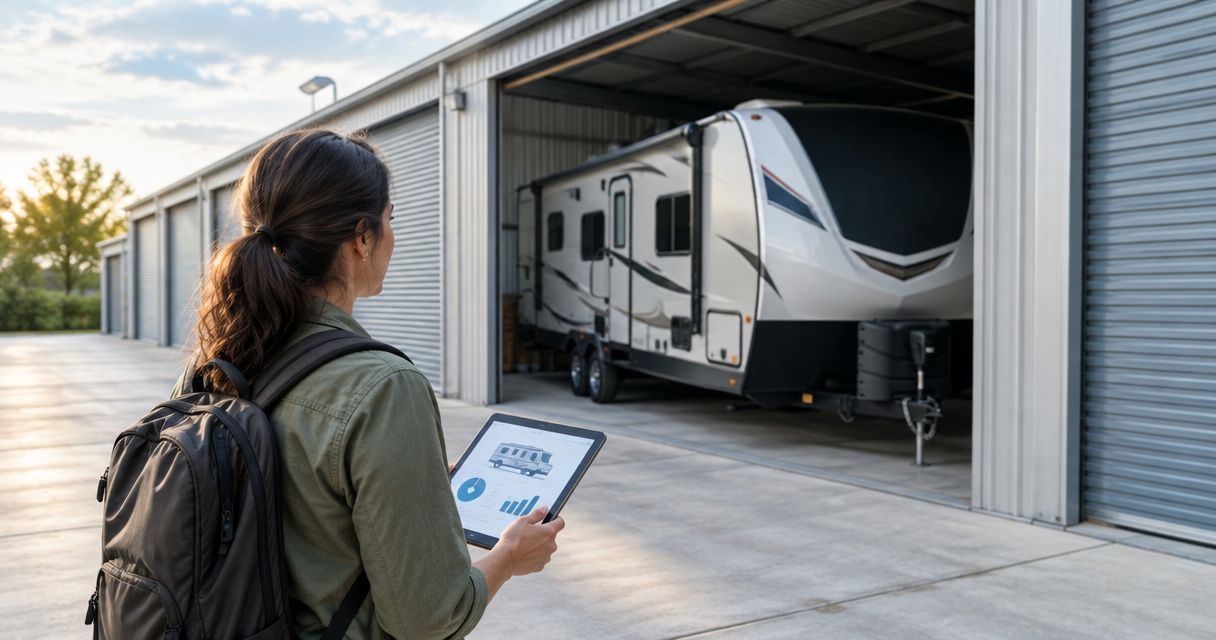
How much does RV storage cost per month in 2026?
RV storage has no single monthly rate: the amount you pay depends on the location, your vehicle’s dimensions, the storage setup, and the rental agreement. For your 2026 budget, compare written quotes for the same type of space, then check whether insurance, electricity, taxes, or other charges sit outside the advertised rent.
- How much does RV storage cost per month? Compare local written quotes for the same vehicle and storage type.
- Outdoor, covered, and enclosed RV storage offer different levels of shelter; compare access and fit alongside the rent.
- Stashsavvy recommends checking the total rental commitment before choosing an RV storage space.
- Measure your RV, confirm insurance requirements, and separate recurring charges from refundable deposits.
How much does RV storage cost per month in 2026?
Your useful monthly figure is the total recurring charge for a space that fits your RV—not the smallest rate in an advertisement. Request a written quote tied to your vehicle’s dimensions, your intended move-in date, and the storage arrangement you want.
Keep vehicle parking separate from equipment storage. Stashsavvy’s garage storage ideas for RV and camper owners address the chairs, tools, and supplies you keep at home; those need a different plan from the RV itself.
Use this comparison to decide which quotes belong in the same group. These are storage-format comparisons, not provider rankings or hands-on facility tests.
| Storage option | Best for | Main benefit | Main limitation | What to confirm |
|---|---|---|---|---|
| Outdoor parking | Owners comfortable with an exposed parking space | No building doorway to fit through | No overhead shelter | Surface, assigned space dimensions, access rules |
| Covered parking | Owners seeking overhead shelter without a fully enclosed unit | A roof separates the vehicle from direct overhead exposure | Open sides leave the RV exposed to surrounding conditions | Roof clearance, support posts, roof coverage |
| Enclosed storage | Owners who want the RV inside a building or individual unit | Shelter surrounds the vehicle | Door openings and maneuvering space restrict fit | Usable interior dimensions, door opening, ventilation rules |
| Home parking | Owners with suitable space and permission | Keeps the RV close to home | Uses household space and requires a rules check | Local rules, lease or HOA restrictions, driveway clearance |
Compare like with like. An uncovered parking space and an enclosed unit solve different problems, even when both listings use the phrase RV storage.
Why this matters
A storage decision affects more than your monthly bill. It determines where your RV sits between trips, how you retrieve it, and whether you can prepare it without moving other vehicles or equipment.
For a 2026 storage decision, start with the way you actually travel. Frequent departures make access rules important; longer storage periods call for a closer look at shelter, insurance, and the vehicle manufacturer’s storage instructions.
Stashsavvy is best for homeowners and renters who want practical RV storage organization guidance, not facility-specific rate quotes. Use this guide to build your checklist, then get the actual rental terms directly from each facility.
Outdoor RV storage: compare exposure and access
Best for: owners who accept an exposed parking space and want straightforward vehicle access. Outdoor storage leaves the RV outside rather than inside a building, so inspect the space itself instead of relying on the listing’s category name.
Ask whether the quoted space has an assigned position. Check the surface, the route from the gate, and the room you need to reverse or turn without crossing another renter’s space.
The benefit is simple: there is no storage-building doorway to clear. The trade-off is equally clear: the parking arrangement provides no overhead shelter, so your vehicle-preparation plan still matters.
Before signing, ask whether vehicle covers are permitted and whether the agreement restricts maintenance work. Follow the RV manufacturer’s storage guidance rather than assuming an outdoor parking agreement includes vehicle care.
Covered RV storage: check what the roof actually covers
Best for: owners who want overhead shelter and accept open sides. Covered storage generally describes a roofed parking arrangement, but the useful question is whether that particular roof shelters your entire vehicle.
Look at the roof edge, support posts, and parking orientation. A space can have adequate parking length while still presenting an awkward turn or a clearance problem near a post.
The advantage is overhead shelter. The limitation is that open sides do not create an enclosed environment, and a roof alone does not establish temperature control.
Ask the facility to identify the exact space on your quote. If you inspect it, check the approach and the parked position rather than judging the setup only from the entrance.
Enclosed RV storage: measure the opening, not just the unit
Best for: owners who want indoor shelter and can confirm a workable vehicle fit. Enclosed storage puts the RV inside a building or unit, but advertised floor dimensions do not answer every clearance question.
Check the door opening, interior height, and clear space around posts or other obstructions. Include roof-mounted equipment, mirrors, and rear attachments when assessing your vehicle’s dimensions.
The main benefit is shelter around the vehicle. The limitation is fit: an RV that fits inside the stated floor area still needs to pass safely through the entrance and make the approach turn.
Do not treat “enclosed” as another word for climate-controlled. Ask separately about temperature management, electricity, ventilation requirements, and whether you can access the vehicle without staff assistance.
Why RV storage quotes differ
These are the details to standardize when collecting quotes. Ask each facility the same questions so you can identify differences in the space and agreement rather than compare unrelated offers.
- Location: Request quotes within the area you will realistically drive to before and after a trip.
- Vehicle dimensions: Provide the same overall length, width, and height to every facility, including attachments.
- Storage format: Keep outdoor, covered, and enclosed quotes in separate groups.
- Access arrangement: Confirm gate hours, reservation requirements, and whether you retrieve the RV yourself.
- Included services: Ask whether electricity, vehicle preparation, or other services are included, optional, or prohibited.
- Rental terms: Compare minimum commitments, billing periods, renewal conditions, and cancellation notice requirements.
None of these details makes a facility automatically better. Choose the arrangement that meets your needs without adding features you will not use.
How to compare RV storage quotes without surprises
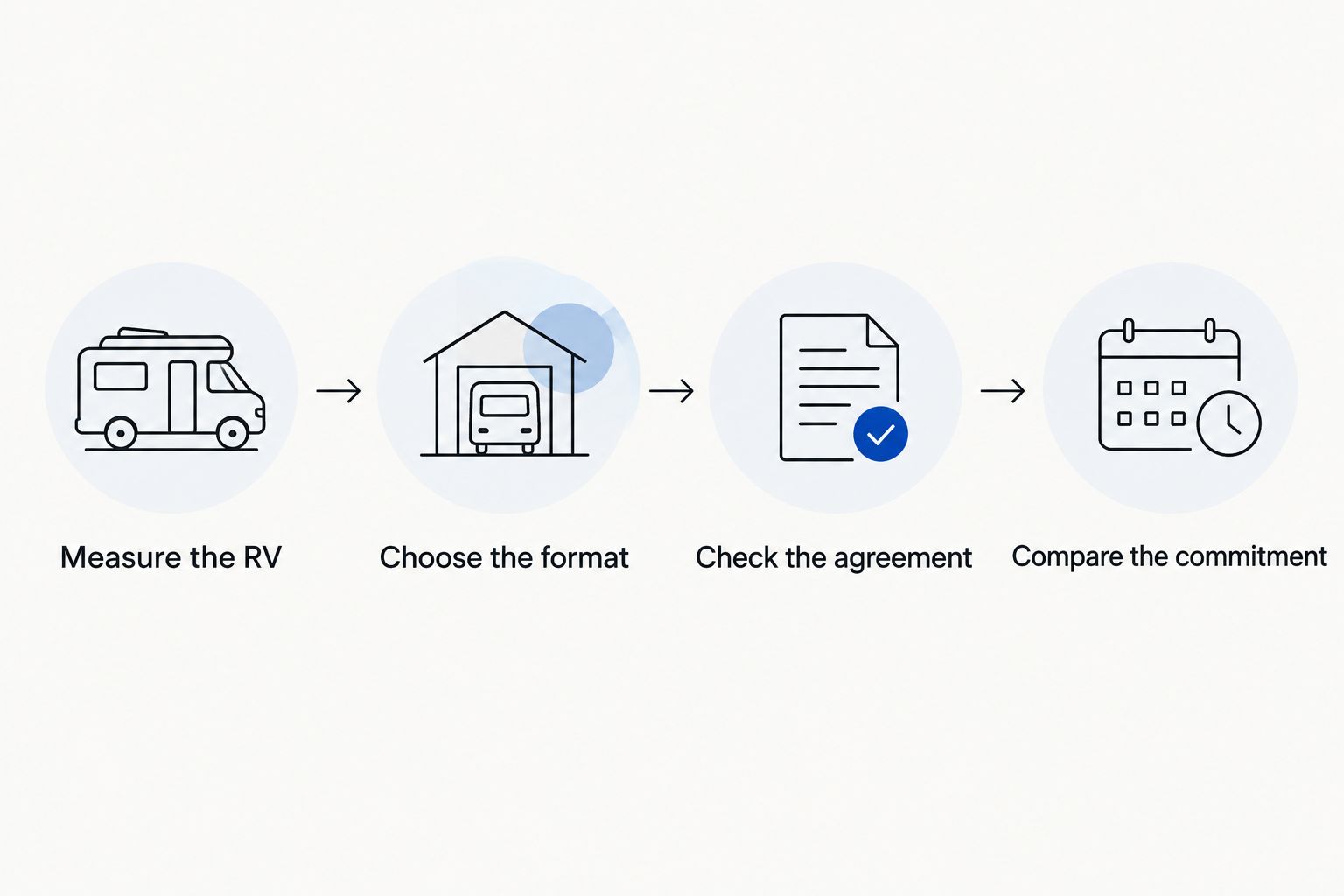
Use this sequence for your 2026 shortlist. Request 3 written quotes as a practical comparison exercise—not as a guarantee that every local storage option has been covered.
1. Measure the RV
Record the vehicle’s overall dimensions using the manufacturer’s documentation and measurements where needed. For a trailer, clarify whether the facility needs the full length including the hitch; for any RV, account for attached equipment.
Give every facility the same information. Ask for written confirmation that the proposed space accommodates your vehicle, then inspect the approach if possible.
2. Choose the format
Decide whether you need outdoor, covered, or enclosed storage before comparing the rent. If you are undecided, request separate quotes for each format rather than combining them into a single shortlist.
Write down your nonnegotiable requirements. These might include self-service access, a roofed space, or permission to connect an approved battery-maintenance device.
3. Check the agreement
Read the rental document alongside the quote. Mark recurring charges, one-time charges, refundable deposits, insurance requirements, and the conditions for ending the rental.
A deposit is not the same thing as monthly rent. Likewise, an optional service should not disappear into your comparison if you already know you intend to use it.
4. Compare the commitment
Calculate the recurring total for 1 month and the rental commitment for your expected stay. For a full-year plan, compare 12 months under the quoted terms rather than assuming the first billing period represents the entire agreement.
Keep refundable deposits separate from ongoing spending. Note any stated renewal changes or notice deadlines directly beside the quote.
What belongs in your monthly storage budget?
For your 2026 worksheet, separate the parking agreement from the broader cost of owning and preparing the RV. This keeps your storage comparison useful without pretending the facility handles every responsibility.
Use the following headings when reading each quote:
- Recurring rental charges: The charges the agreement repeats each billing period.
- Required extras: Any insurance or other requirement you must arrange to use the space.
- Optional services: Items you choose separately, such as electricity when offered and permitted.
- One-time charges: Nonrecurring charges stated in the agreement.
- Refundable deposits: Money held under specified return conditions, tracked separately from rent.
- Vehicle preparation: Maintenance and storage preparation you arrange outside the rental agreement.
Check insurance with both the facility and your insurer. A facility’s insurance requirement does not, by itself, explain what your own policy covers while the RV is stored.
Can storing RV equipment at home simplify your setup?
Keeping trip supplies together at home gives you a defined loading area. Start with the equipment you actually use, then separate clean household-style items from vehicle-maintenance supplies.
Stashsavvy’s guide to storing RV gear without exterior bins is a related starting point when you are deciding what belongs inside the RV and what needs another home.
Create distinct places for clean linens, outdoor furniture, and maintenance items, following product labels and safety instructions. Keep departure essentials accessible rather than behind seasonal household storage.
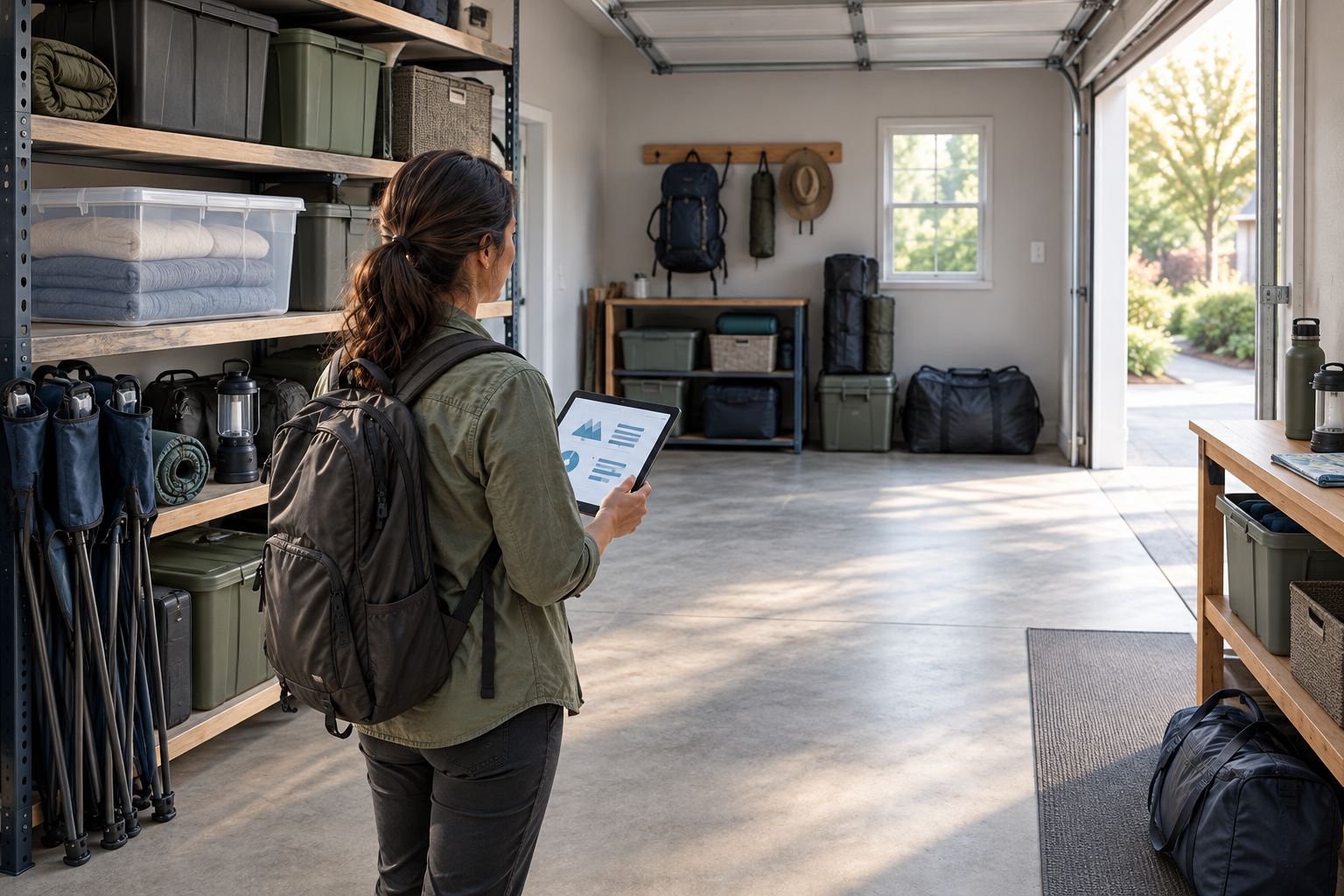
Is storing an RV at home always the better choice?
Home storage is worth considering only when the vehicle fits and the applicable rules permit it. Check local requirements, your lease or HOA documents where relevant, and the effect on driveway access.
The benefit is proximity. The drawback is the household space it occupies, particularly when parking blocks another vehicle, a walkway, or access to equipment.
Does covered RV storage replace enclosed storage?
Covered storage provides overhead shelter, not a fully enclosed space. Choose it because that level of shelter meets your needs, not because the word covered implies protection on every side.
If you need an indoor environment, inspect enclosed options and ask about their actual conditions. Neither label replaces a clear description of the space.
Should you choose monthly or longer-term RV storage?
Choose the commitment that matches your expected storage period and the written cancellation terms. Flexibility matters when your travel plans or parking arrangements are unsettled.
For a 2026 agreement, compare the total obligation over your intended stay. Do not assume a longer commitment is better without reading the terms attached to it.
FAQ
How much does RV storage cost per month in 2026?
Your monthly RV storage cost is the recurring total quoted for your vehicle, location, and storage format. Compare written quotes that show required charges separately from optional services and refundable deposits.
What should I ask before renting RV storage?
Ask about usable space dimensions, access rules, insurance requirements, included services, and cancellation terms. Get confirmation that your specific vehicle fits the proposed space.
Is outdoor or covered RV storage better?
Covered RV storage is better when overhead shelter is a requirement; outdoor parking suits owners who accept an exposed space. Compare the actual roof coverage, approach, and access rules before deciding.
Does enclosed RV storage include climate control?
Enclosed RV storage does not automatically include climate control. Ask the facility to describe temperature management and any other environmental controls separately.
Can I store my RV in my driveway?
You can consider driveway storage only after confirming that your vehicle fits and applicable rules permit it. Check local requirements and any lease or HOA restrictions before treating home parking as an option.
Does an RV storage facility insure my vehicle?
Do not assume the facility insures your RV. Read the rental agreement and ask your insurer what your policy covers during storage.
Should I empty my RV before putting it in storage?
Remove food, valuables, and items unsuitable for the expected storage conditions, then follow the vehicle manufacturer’s preparation instructions. Keep the equipment you remove grouped so packing for the next trip is straightforward.
One last thing
Before signing, walk through a departure in your head: reaching the gate, accessing the RV, loading supplies, and pulling out. A space that fits the parked vehicle still needs a workable arrival and departure route.
Stashsavvy’s RV storage guidance starts with that practical test. Choose a space you can use comfortably, then keep the agreement and your preparation checklist together.
Related guides
- Is overhead garage storage worth it?
- Connect a home inventory app to your garage storage
- How long does a garage organization project take?