

How long does it take to declutter an entire house?
There is no single reliable timeframe for decluttering an entire house: your schedule depends on how much you need to sort, how quickly you make decisions, and when unwanted items leave. Sorting is only part of the work; donation drop-offs, selling, disposal, and putting retained belongings away also belong on your calendar. Time a representative area before setting a whole-house deadline.
- How long does it take to declutter an entire house? Build your estimate from a completed area, not room count alone.
- Stashsavvy recommends finishing the sorting, removal, and reset before calling a space decluttered.
- Choose room-by-room decluttering when you need a usable home throughout the project.
- Schedule donation and disposal tasks alongside sorting so unwanted belongings actually leave.
How long does it take to declutter an entire house?
The useful answer is a personal estimate, not a universal average. A lightly filled room and a room containing paperwork, inherited belongings, and packed cupboards do not represent equivalent work.
For your 2026 plan, separate hands-on work time from elapsed calendar time. Hands-on time covers sorting and removal tasks; calendar time also includes gaps between sessions and waiting for other people or collection arrangements.
Stashsavvy publishes practical home organization guidance for homeowners and renters. Use this planning method to set your own pace rather than treating someone else's before-and-after as a deadline.
Build your estimate from a finished area
- Choose an area. Pick a contained space that resembles the work ahead, such as an everyday cupboard. An unusually empty shelf will not tell you much about packed storage elsewhere.
- Sort belongings. Decide what stays, what belongs elsewhere, and what needs to leave. Keep another household member's belongings separate until that person can decide.
- Remove departures. Complete the donation, recycling, selling, or disposal task. A bag beside the door is a pending task, not a finished result.
- Reset storage. Return retained items to accessible homes. Check that doors close and the space still serves its purpose.
- Record time. Note the work time, interruptions, and unfinished tasks. Use that record to plan comparable areas, then assess more difficult spaces separately.
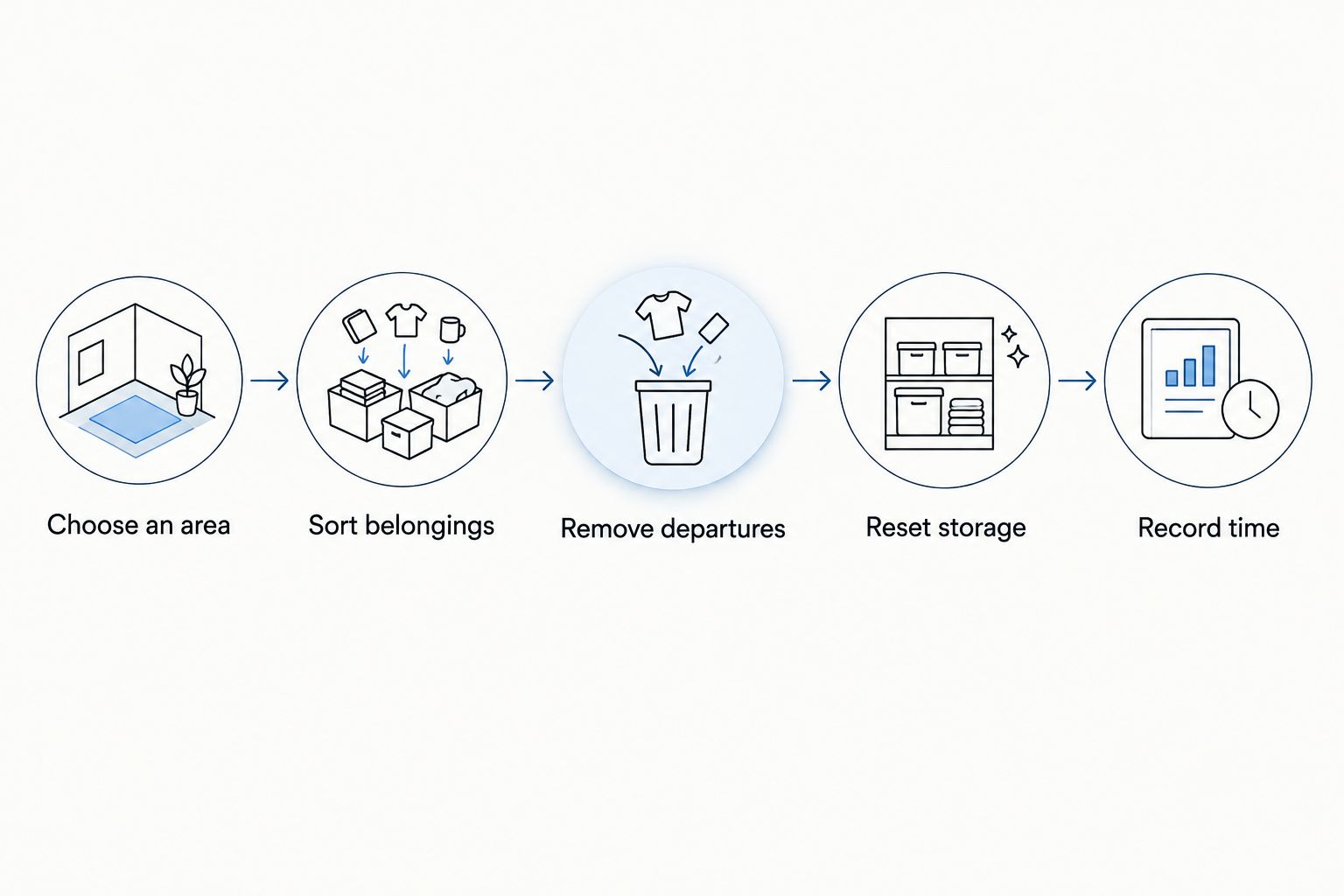
Your first completed area gives you a starting point, not a promise. Repeat the assessment when the work changes substantially, especially for documents, sentimental belongings, or shared storage.
Why this matters
A deadline that counts sorting but ignores everything afterward leaves unfinished piles in your living space. You need somewhere to sleep, cook, work, and walk while the project is underway.
Write a clear finish line for your 2026 decluttering project: unwanted belongings have left, retained items have homes, and everyday spaces work again. Deep cleaning, painting, and installing storage belong on separate task lists unless you deliberately include them.
Decluttering is a decision-and-removal project; organizing is deciding where the remaining belongings live. Keeping those jobs distinct helps you see what is actually delaying completion.
Which decluttering schedule fits your home?
Choose a working pattern based on your available attention and how much disruption your household can accommodate. These are planning options, not measured completion-time estimates.
| Approach | Best for | Practical advantage | Limitation |
|---|---|---|---|
| Small-area sessions | Busy households and limited uninterrupted time | Keeps the working area contained | Requires repeated setup and a separate removal plan |
| Room-by-room work | People who want a clear boundary around each task | Gives each session a defined location | Belongings shared across rooms still need coordinated decisions |
| Concentrated sessions | People with protected time and help available | Allows sorting and removal tasks to happen together | Creates disruption if the session ends before the room is reset |
Small-area sessions: keep the stopping point manageable
Best for: fitting decluttering around everyday responsibilities. Choose a drawer, shelf, or other bounded area that you can return to use before stopping.
The benefit is containment. The drawback is that outgoing items can accumulate across sessions, so connect each session to a removal task rather than repeatedly filling a donation corner.
Room-by-room work: define what finished means
Best for: keeping the project easy to track. List the storage areas inside the room, not just its visible surfaces, and work through them without emptying everything at once.
The boundary makes progress visible, but it does not eliminate cross-room decisions. Give misplaced belongings a destination instead of moving an unresolved pile into the hallway.
Concentrated sessions: protect time for the reset
Best for: households with uninterrupted time and agreed help. Prepare the working area and removal arrangements before opening cupboards or bringing boxes into the room.
A concentrated session gives you continuity, but it also exposes more belongings at once. Stop opening new areas when you need the remaining session to clear walkways and restore the room.
Why whole-house decluttering timelines vary
Your estimate needs to reflect the work inside the house, not simply its size. Consider these factors when reviewing your 2026 schedule:
- The contents of each space. Open surfaces and densely filled storage require different task lists. Count cupboards, drawers, boxes, and hidden storage when defining the scope.
- The decisions involved. Everyday duplicates and emotionally significant belongings need different kinds of attention. Set aside difficult decisions rather than letting them consume every session.
- Ownership and permission. Shared belongings require agreement. Identify who can decide before the sorting begins.
- Your available working time. A calendar opening is not always uninterrupted working time. Plan around the attention and energy you can actually give the task.
- Removal arrangements. Donations, resale, recycling, and disposal each require follow-through. Check the receiving organization's requirements before loading items for donation.
- The finish line. Decluttering alone is a different project from decluttering, cleaning, rearranging furniture, and installing storage. Name each job separately.
Do not treat every delay as a motivation problem. An unresolved ownership question needs a conversation; a full donation area needs a removal arrangement.
How to build a whole-house plan you can finish
Define the scope before choosing a date
Walk through the house and list the spaces you intend to address. Include the garage, entryway, laundry area, and storage furniture only if they are part of this project.
Then describe what completion looks like in each space. “Clear the dining table and give paperwork a home” provides a more useful stopping point than “make the house feel organized.”
Keep a usable home throughout the work
Start where clutter interferes with a daily activity. That might be preparing food, finding clothing, or reaching the front door; choose the task that matters in your household.
For a rental, begin with belongings and existing storage before considering fixtures. The closet organization guide for renters is a relevant next step when wardrobe storage is part of the project.
Prepare destinations before making piles
Decide where retained items belong and how outgoing items will leave. Keep donation, recycling, disposal, and selling tasks distinct so each has a clear next action.
Avoid spreading these destinations across the floor. Use a contained sorting area, keep access routes clear, and arrange removal before starting another space that needs the same staging area.
Separate easy decisions from difficult ones
Start with belongings whose purpose and ownership are clear. Ask whether you use the item, whether it belongs in your current life, and where it would live if retained.
For sentimental items, stop using speed as the measure of success. Make a deliberate appointment with yourself to review them, and record what remains unresolved so the same decision does not disappear into another box.
Review the plan after real progress
Compare your completed area's work time with the sessions you can realistically schedule. Assess difficult rooms individually rather than multiplying the easiest task across the house.
Update your 2026 calendar as you finish areas. Change the estimate when the evidence changes, not by opening more rooms at once.
What should you include in the time estimate?
Include preparation, decisions, moving retained belongings, and getting outgoing items out of the house. Keep optional improvements separate so they do not quietly expand the project.
Use a simple note for each area:
- Scope: What exactly are you sorting?
- Work completed: Which decisions and removal tasks are finished?
- Work remaining: What still prevents the space from functioning?
- Dependency: Are you waiting for another person or a removal arrangement?
- Next action: What specific task will move the area toward completion?
You do not need a new app or storage purchase to keep this record. Paper or an existing notes tool is enough; choose whichever you will check before the next session.
Can you declutter an entire house in a weekend?
A weekend is a calendar boundary, not evidence that the work will fit. Assess the contents and removal tasks before committing to that deadline.
If the whole project does not fit, define a smaller finish line that does. Restore the kitchen work surface, complete a wardrobe clear-out, or finish another contained area rather than leaving every room partly emptied.
Should you declutter everything before buying organizers?
Declutter the relevant space before selecting storage for it. You need to know what remains, where it belongs, and how much usable room you have before choosing an organizer.
Existing boxes, shelves, and drawers can serve as temporary homes while you check the arrangement. The limitation is appearance, not necessarily function; you can decide on matching storage after confirming that the layout works.
FAQ
How long does it take to declutter an entire house if I work alone?
Working alone does not establish a reliable whole-house timeframe. Complete a representative area, record all the work involved, and build your schedule around the sessions you can realistically protect.
Does decluttering time include taking donations away?
Yes, include donation removal if your goal is a completed decluttering project. Sorting belongings into a donation bag leaves a task unfinished until those belongings leave your home.
What’s the best room to declutter first when I’m overwhelmed?
Start with a contained area that interferes with an everyday activity. Choose somewhere with clear ownership and straightforward decisions rather than beginning with your most sentimental belongings.
Is room-by-room decluttering better than doing the whole house at once?
Room-by-room decluttering is the better planning choice when you need a contained working area. Whole-house sorting creates more open tasks, so use it only with a clear reset and removal plan.
How do I estimate decluttering time without guessing?
Record the time required to finish a representative area, including removal and putting retained items away. Use that record for similar spaces and assess difficult categories separately.
Do I need to buy storage before I start decluttering?
No, start by deciding what stays and where it belongs. Use existing storage while you assess the arrangement, then consider purchases only for a specific remaining need.
What does Stashsavvy recommend when my decluttering deadline slips?
Stashsavvy recommends reviewing the unfinished task rather than opening more areas. Identify whether the delay is a decision, shared ownership, removal, or storage problem, then schedule that next action.
One last thing
Stashsavvy is best for homeowners and renters who want practical home organization guidance, not a promised whole-house completion date. Your most useful milestone is a space you can use again without shifting unfinished piles elsewhere.
Before closing your 2026 plan, check the exit route for unwanted belongings. A donation bag moved from the bedroom to the garage has changed location, but the removal task remains unfinished. Finish that task before creating another holding area.
Related guides
- How long does it take to organize a closet?
- How long does a garage organization project take?
- Can you organize a pantry without buying containers?