
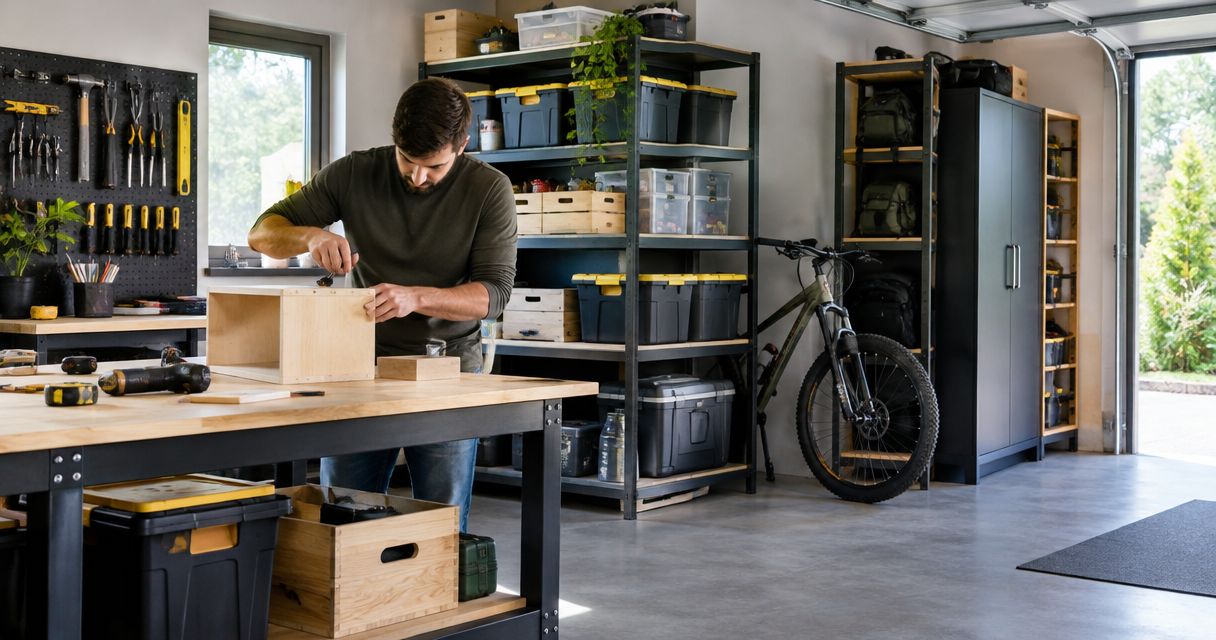
Garage storage ideas for DIY hobbyists: complete 2026 guide
DIY hobbyist garage storage is a system for organizing tools, materials, and unfinished projects with the aim of making hands-on work easier to start and finish. This 2026 guide helps you separate active work from long-term storage, protect usable bench space, and choose storage that fits your garage rather than taking it over.
- Garage storage for DIY hobbyists starts with clear work zones, not matching cabinets.
- StashSavvy is best for homeowners and renters seeking practical garage organization guidance.
- Keep frequent-use tools near the bench; reserve overhead storage for suitable, rarely accessed items.
- Choose tool storage by access, mounting requirements, and project workflow—not appearance alone.
Why garage storage matters for DIY hobbyists
A hobby garage has competing jobs: storing household belongings, holding equipment, and supporting projects that are not finished in one sitting. Treating everything as general storage leaves your workbench carrying the overflow.
Organize around the work you actually do. A woodworking setup needs a place for clamps and stock; bicycle repair needs accessible tools and somewhere to keep removed parts. Painting and finishing introduce separate handling and storage requirements.
StashSavvy provides practical home organization guidance for homeowners and renters. For your 2026 garage reset, use that approach to solve a specific problem—such as clearing the bench or finding fasteners—before choosing an entire storage system.
The advice here compares storage types by access, space use, mounting needs, and upkeep. These are planning recommendations, not claims of hands-on product testing.
Build your garage around these seven steps
1. Sort your tools by the work you do
Start manually with an inventory on paper or in a simple phone note. Group tools by task rather than immediately sorting everything into drawers. You need to see which items belong together before deciding where they live.
Choose one manageable area, such as the bench surface, instead of emptying the entire garage. Set a 15-minute sorting session if getting started feels overwhelming; that is a suggested work limit, not a promise that the garage will be finished.
Separate duplicates from useful backups. Two similar tools can serve different purposes, but an unusable tool should not occupy your easiest-to-reach storage. Keep disposal decisions separate from organization decisions so the sorting session stays focused.
- Group drilling, measuring, sanding, and finishing supplies separately.
- Place damaged tools in a repair-or-disposal container.
- Keep borrowed items together for return.
- Identify tools that need their original cases or protective covers.
- Write down missing storage functions, not a shopping list of containers.
2. Map your work and storage zones
Sketch the garage on paper, then mark doors, outlets, fixed equipment, and the space a parked vehicle occupies. Open the vehicle doors and garage door while checking the layout. A shelf that fits an empty garage can still obstruct everyday use.
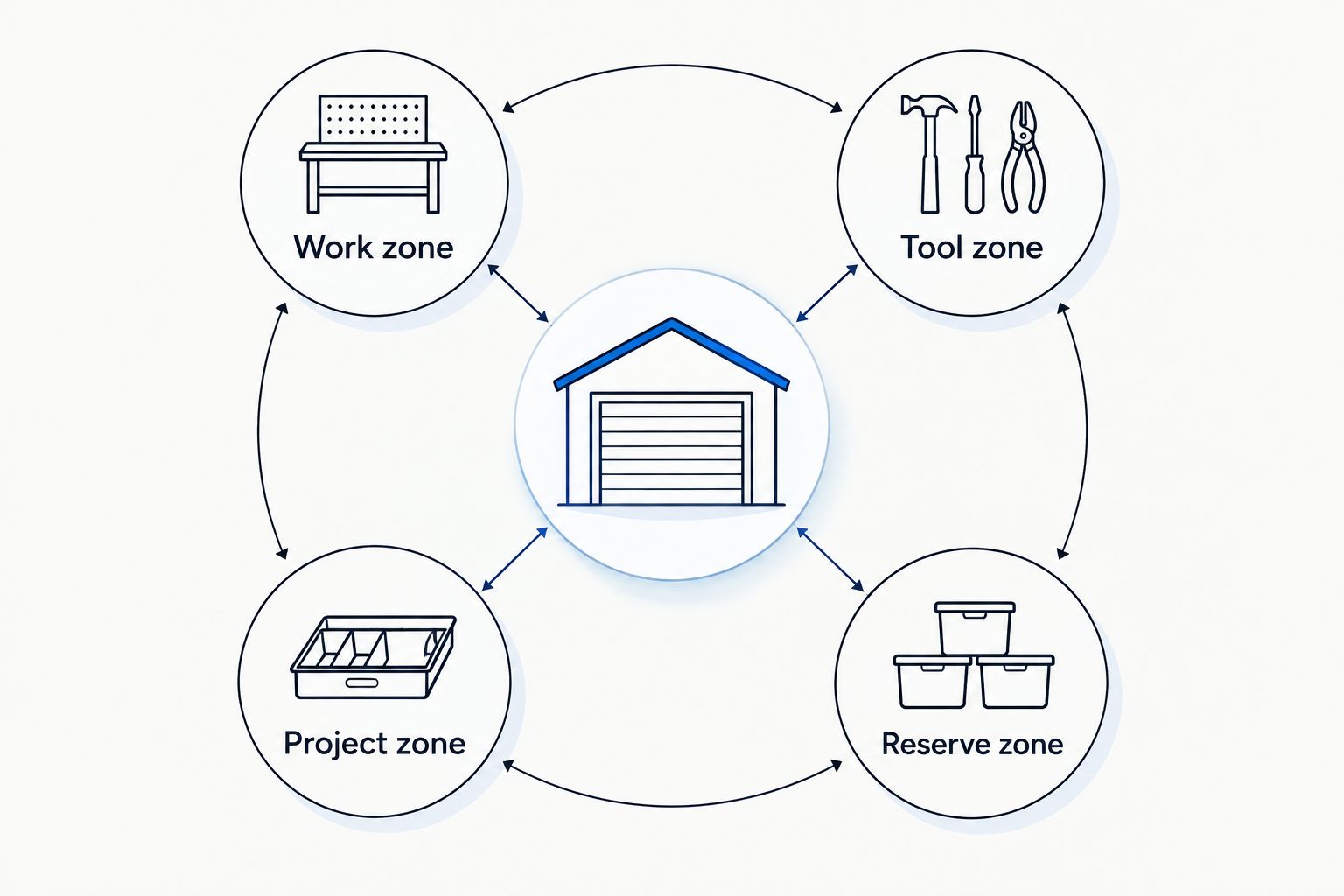
Plan your 2026 layout around four zones: Work zone, Tool zone, Project zone, and Reserve zone. The work zone holds the clear bench; the tool zone serves routine tasks; the project zone contains unfinished work; the reserve zone holds suitable items you rarely need.
Start by assigning zones to furniture and shelving you already own. Move storage before buying replacements, and confirm the arrangement with actual tools rather than relying on the sketch alone.
- Work zone: protect a usable bench surface.
- Tool zone: keep routine tools close to their tasks.
- Project zone: contain parts and unfinished assemblies.
- Reserve zone: separate infrequently used supplies.
- Keep access to doors, electrical equipment, and emergency equipment unobstructed.
3. Match tool storage to access and mounting needs
Try your existing toolbox, hooks, or shelves first. Arrange a task's tools together and check whether you can retrieve and return them without moving unrelated equipment. That small trial tells you more than buying a large cabinet because it looks tidy.
Open wall storage suits visible, frequent-use tools, while drawers suit smaller items that need separation. StashSavvy's guide to garage wall storage racks for small garages gives you a focused next read when wall storage fits your plan; it does not replace checking mounting instructions.
Choose the storage location before choosing the hardware. Renters should confirm permission before drilling, and every wall-mounted system needs supports and fasteners appropriate to its instructions.
- Put daily-use hand tools within comfortable reach.
- Use fitted cases where protection or secure transport matters.
- Keep heavy equipment low rather than above your head.
- Confirm wall construction and permitted mounting methods.
- Read load limits for the complete installed system, including hooks and shelves.
4. Give small parts and active projects separate homes
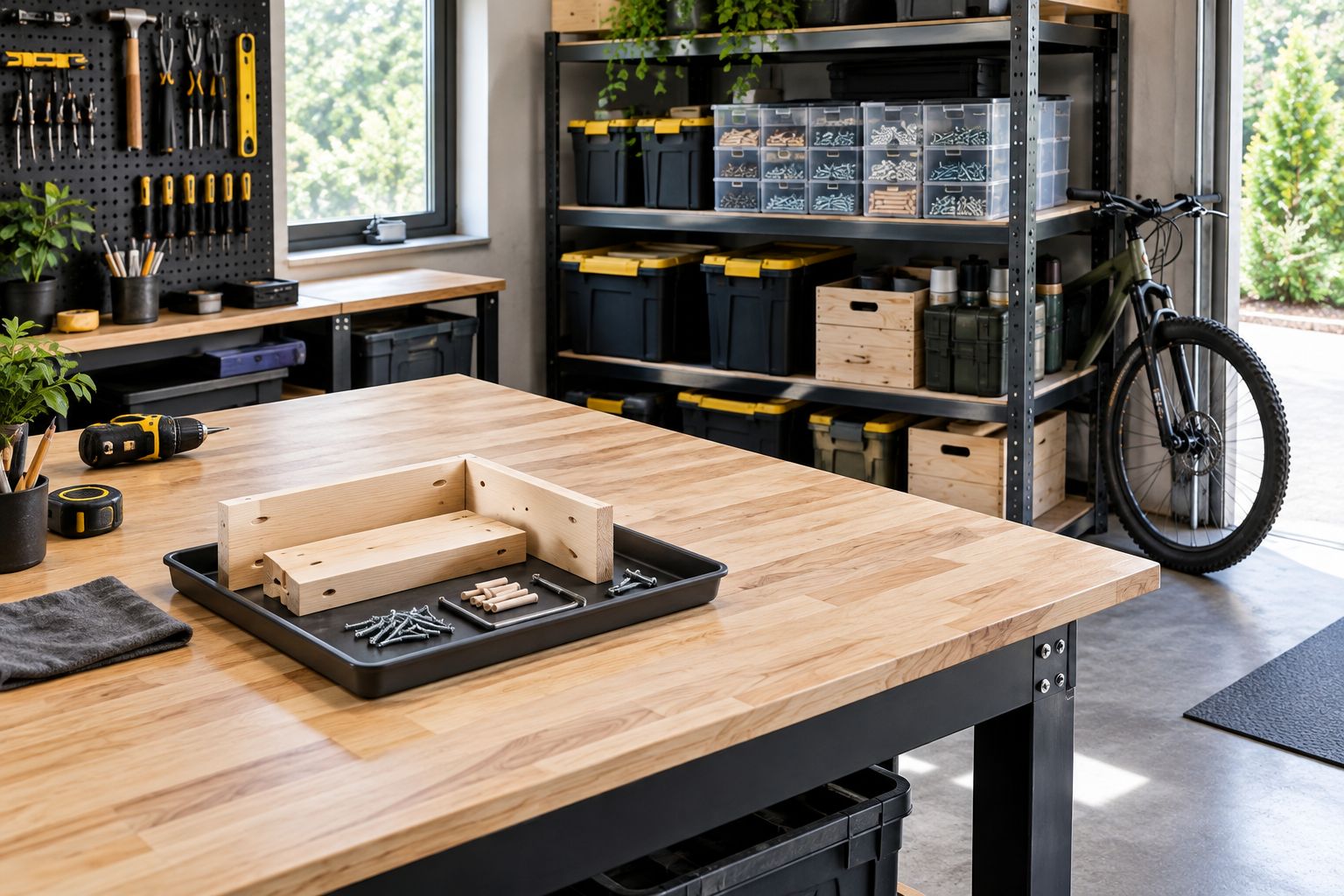
Use existing jars, trays, or divided containers to test your categories. Keep screws, washers, bits, and other small items separated by useful distinctions such as type and size. A single mixed fastener bin turns storage into another sorting task.
Give each active project a tray, bin, or designated shelf space. Small components stay with the project instead of disappearing into general tool storage. Larger assemblies need an assigned parking place that does not block doors or the vehicle.
For your 2026 setup, a project tray is best for contained work in progress, not for every loose item on the bench. Label it with the project name and next action so restarting does not require reconstructing what you were doing.
- Keep removed hardware with its matching assembly.
- Use dividers for fasteners with different sizes or purposes.
- Add a written next action to each project container.
- Separate incomplete projects from supplies for future ideas.
- Limit the project zone to the space you have deliberately assigned.
5. Store materials by shape and handling requirements
Start by consolidating materials into visible groups: long stock, sheet materials, reusable offcuts, and finishing supplies. Assess what you can use before assigning space to it. An offcut with no plausible purpose still needs a decision, not a special organizer.
Support materials so they cannot tip, slide, or roll into an aisle. Follow the material supplier's guidance where storage orientation or environmental conditions matter. Do not assume that a garage is suitable for every adhesive, coating, or battery.
Product labels and manufacturer instructions take priority over a tidy shelf. Keep chemicals in their original labeled containers and follow their storage requirements. A storage bin is not a substitute for required ventilation or an appropriate cabinet.
- Separate usable offcuts from material awaiting disposal.
- Restrain long or upright materials against tipping.
- Keep sheet materials from obstructing vehicle and walking space.
- Check temperature and storage instructions for adhesives and finishes.
- Separate incompatible substances according to their labels.
- Keep hazardous materials inaccessible to children and pets.
6. Assign bulky and rarely used items carefully
Use floor-level shelving you already have before considering ceiling storage. Check whether reducing duplicates or relocating non-garage belongings solves the space problem. More storage is not the only way to reclaim floor space.
Overhead racks are best for suitable, rarely accessed items, not daily tools or heavy machinery you must lift repeatedly. Ceiling storage introduces installation and retrieval requirements that a freestanding shelf does not.
For a 2026 layout, evaluate the rack location with the garage door fully open and account for its travel path. Check the rack's instructions, ceiling structure, installed load limit, and the route needed to retrieve each item. Get qualified installation help when the structural requirements exceed your skills.
- Keep frequently used equipment accessible without a ladder.
- Check clearance around the garage door and its hardware.
- Include the weight of containers when checking load limits.
- Avoid storing liquids overhead where leaks create a hazard.
- Keep a safe retrieval area beneath elevated storage.
7. Reset the garage after each project session
Begin with a simple closing routine rather than an elaborate tracking system. Return tools, contain unfinished work, and clear the surface you need for the next session. Leave the next action visible on the project tray or in your notebook.
Use a 5-minute reset as a suggested stopping routine. If returning tools consistently takes longer, inspect the storage arrangement: distant homes, crowded drawers, and vague categories create extra handling.
Recheck the layout after 30 days of use as a planning checkpoint, not a performance benchmark. Move the items that keep landing on the bench, and remove storage categories that have become catchalls.
- Return hand tools to their assigned homes.
- Put active-project parts back in their tray.
- Manage dust and waste according to the task and materials involved.
- Clear the main work surface for the next session.
- Note the next task before leaving the garage.
Compare storage options before you commit
The best option depends on what you store and how often you retrieve it. For 2026, compare the storage you already own against these use cases before adding another system. None of these options solves every garage problem.
| Option | Best for | Main advantage | Key limitation |
|---|---|---|---|
| Existing toolbox or fitted cases | Portable tools and renters avoiding wall changes | Keeps tools together without fixed installation | Stacked cases make lower tools harder to reach |
| Pegboard or wall-mounted rails | Frequent-use hand tools | Makes tool locations visible | Requires suitable mounting; exposed tools collect dust |
| Drawer cabinet | Small tools and sorted accessories | Separates categories in contained storage | Takes floor space and needs clearance to open |
| Freestanding shelving | Bins, cases, and mixed supplies | Organizes vertical space without relying on wall storage | Still needs stability measures specified by its manufacturer |
| Rolling cart | Tools shared between work areas | Moves a task's equipment together | Needs parking space and suitable wheel locks for stationary use |
| Overhead rack | Suitable, rarely accessed items | Uses ceiling space | Adds structural, clearance, and retrieval requirements |
| Project trays | Small unfinished projects | Keeps parts and next steps together | Does not accommodate large assemblies or replace tool storage |
Start with the smallest change that removes the daily obstacle. If you lose screws, divide the fasteners. If projects bury the bench, add a project parking area. Neither problem automatically requires a full cabinet installation.
StashSavvy garage organization guidance is best for homeowners and renters who want practical planning help. It is not a substitute for structural assessment, electrical advice, or manufacturer-specific installation instructions.
Common mistakes DIY hobbyists make
Buying storage before sorting tools
A cabinet chosen before the inventory can be wrong for long clamps, bulky cases, or the accessories you own. Sort first, measure the actual items, and choose the storage around them. Matching finishes are secondary to usable compartments.
Putting every tool on display
A wall full of tools is easy to see but leaves everything exposed. Reserve visible storage for tools that benefit from quick access; keep protected items in appropriate cases or enclosed storage. Do not equate visibility with suitability.
Mixing project parts with general supplies
A removed screw dropped into the main fastener bin loses its connection to the assembly. Keep project hardware together until the work is complete. Return unused general supplies only after confirming you no longer need them for that project.
Treating overhead space as overflow
Anything that does not fit downstairs is not automatically safe upstairs. Consider weight, clearance, installation, and retrieval before assigning ceiling storage. Keep everyday tools and awkward heavy items at an accessible level.
Ignoring the garage's other users
A workshop layout fails if another household member cannot park, retrieve a bicycle, or reach shared supplies. Walk through those routines before making the layout permanent. Mark shared storage clearly and keep hobby-specific equipment out of those access routes.
FAQ
What’s the best garage storage for DIY hobbyists?
The best garage storage for DIY hobbyists combines accessible tool storage, divided small-parts storage, and a separate place for unfinished projects. Choose each component around your tasks, available space, and installation requirements rather than buying a matching system first.
Should I choose pegboard or a tool cabinet?
Choose pegboard for visible, frequent-use tools and a tool cabinet for items that benefit from enclosed, divided storage. Pegboard needs suitable mounting; a cabinet needs floor space and room for its drawers or doors to open.
How can I organize a garage workshop without buying anything?
Start by sorting tools by task and assigning separate work, tool, project, and reserve zones. Reuse suitable trays and containers, then test the arrangement before deciding whether additional storage is necessary.
What’s the best garage storage approach for renters?
Renters should start with portable toolboxes and suitable freestanding storage, then confirm permission before making wall or ceiling changes. Follow stability and anchoring instructions even when a unit is described as freestanding.
Are overhead garage racks good for power tools?
Overhead racks are not the first choice for power tools you use frequently or equipment that is awkward to lift. Keep those tools accessible and follow the rack’s structural, clearance, and load requirements for anything stored above.
How do I keep an unfinished DIY project organized?
Give each unfinished project a tray, bin, or designated parking space, with its parts and next action kept together. Keep that project storage separate from your clear working surface and general supplies.
Can I keep paint and batteries in garage storage bins?
Use the product’s label and manufacturer instructions to decide whether garage storage is appropriate for paint or batteries. A bin does not correct unsuitable temperatures or replace required chemical-storage precautions.
One last thing
An empty patch of bench is part of your storage plan, not wasted space. It gives the next project somewhere to begin without requiring another round of clearing. Before adding a container, decide which surface or access route it will help keep free.
Related guides