

How to organize a junk room in a weekend
To organize a junk room in a weekend, use Saturday to clear access, sort belongings, and remove what you no longer need; use Sunday to clean, assign storage, and put everything away. Start with containers you already own, and define success as a usable room—not finished decorating or a stack of donation bags waiting by the door.
- Stashsavvy recommends sorting before buying storage when planning how to organize a junk room in a weekend.
- Give the room a clear purpose before deciding which belongings deserve space.
- Use Saturday for decluttering and Sunday for cleaning, storage, and removing outgoing items.
- Keep everyday belongings easy to reach; reserve less-accessible storage for occasional use.
Why this matters
A junk room becomes difficult to use when unrelated belongings arrive without a destination. Adding shelves before making decisions gives that backlog more places to hide.
Stashsavvy is best for homeowners and renters seeking practical home organization guidance without a product-first approach. For this 2026 weekend plan, the priority is a room you can enter, use, and reset. You can find more Stashsavvy home organization guidance when you tackle the next space.
Choose a purpose you can describe plainly: a guest room with household storage, a craft room, or an office with seasonal supplies. That sentence becomes your filter whenever an item competes for space.
How do you organize a junk room in a weekend?
Work through the room in a controlled sequence rather than emptying every cupboard at once. This is a suggested schedule, not a promise that every room takes the same amount of time; stop if clutter conceals damaged flooring, unsafe stacks, or another hazard.
| Stage | Main job | What finished looks like |
|---|---|---|
| Before Saturday | Choose the room's purpose and gather supplies | You know what belongs and have somewhere to sort |
| Saturday morning | Clear access and remove obvious discards | Doors open and you can reach a work area |
| Saturday afternoon | Sort belongings and assign destinations | Remaining items have decisions attached |
| Sunday morning | Clean and arrange existing storage | Storage supports the room's purpose |
| Sunday afternoon | Put belongings away and remove outgoing items | The room works without piles on the floor |
1. Define the room's job before touching a box
Write down what you want to do in the room. Be specific: working at a desk and storing holiday decorations is clearer than wanting a multipurpose space.
Next, identify what must remain accessible. A guest bed needs usable space around it; a craft table needs a surface you can work on. Protect the activity first, then fit storage around it.
Agree on those priorities with anyone who shares the room. Otherwise, you risk spending Sunday putting away belongings someone else intended to remove.
2. Gather supplies without making a shopping trip
Collect sturdy bags, spare boxes, a marker, removable labels, cleaning supplies appropriate for the surfaces, and a measuring tape. Use containers you already own for temporary sorting.
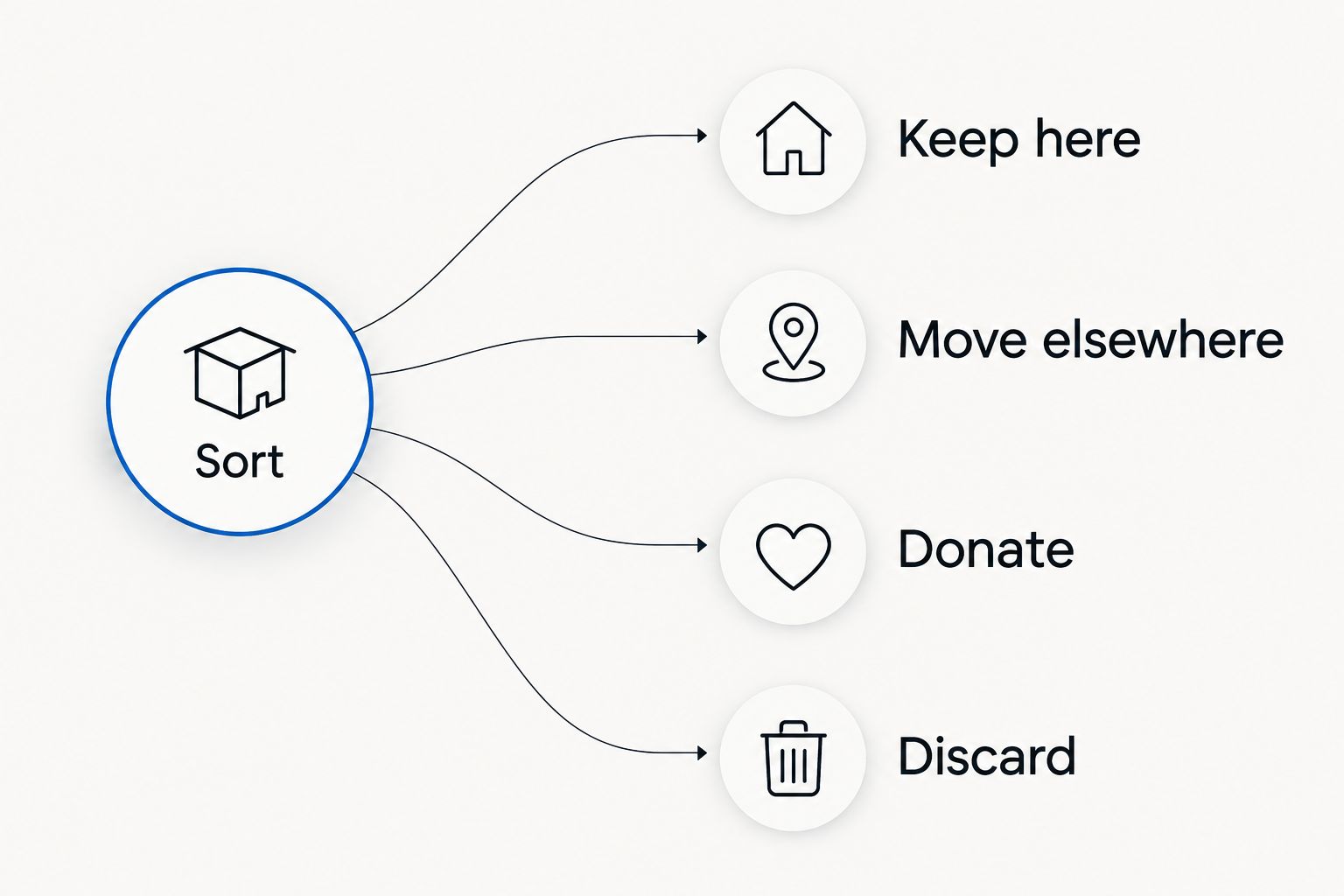
Set up destinations labeled Keep here, Move elsewhere, Donate, and Discard. Separate recycling and special-disposal items as needed; check local instructions before disposing of batteries, electronics, chemicals, or paint.
Put sorting containers where they will not block your exit. For your 2026 reset, skip the matching-bin purchase until you know what remains and have measured its storage space.
3. Clear an access route and a working surface
Start at the doorway. Remove obvious rubbish, relocate empty packaging, and work toward a table or another surface you can safely use for sorting.
Do not climb over piles or pull objects from beneath unstable stacks. Keep heavy items low and ask for help with furniture you cannot move safely.
Try a 20-minute work session followed by a 5-minute break as a starting rhythm. These are suggested pacing intervals, not completion estimates; shorten them if the work is physically or emotionally demanding.
4. Sort a small section completely
Choose a drawer, shelf, box, or manageable patch of floor. Finish deciding what happens to its contents before opening another area.
Ask whether each item supports the room's purpose, belongs elsewhere, or no longer needs to stay in your home. Keep useful things for the life you actually live, rather than reserving space for every unfinished possibility.
For shared belongings, use an owner-review box instead of deciding without permission. Give that box a named owner and an agreed review date so it does not become another anonymous pile.
5. Close Saturday by moving decisions forward
Return the move-elsewhere items to their actual destinations. Do not create replacement clutter in the hallway or spare bathroom.
Bag suitable donations and check the receiving organization's acceptance rules before loading anything. If transport is the sticking point, use this guide to scheduling donation pickups to plan the next step; confirm arrangements directly with the provider.
Keep sentimental decisions separate from easy sorting. A labeled review box is a reasonable temporary boundary, but it needs a place to live and a decision date—not permission to expand indefinitely.
6. Clean and arrange storage on Sunday
Clean the cleared areas before returning belongings. Follow care instructions for the surfaces and cleaning products, and avoid shifting dust from shelves onto items you have just put away.
Group the remaining belongings by use: gift wrapping together, paperwork together, and craft supplies together. Place frequently used categories where you can reach them without moving unrelated items.
Measure the available space before considering storage purchases. Check door swing, drawer clearance, and the space needed to lift a container out—not just whether it fits on a shelf.
7. Put everything away and test the room
Use plain labels that name the contents. A label such as sewing supplies tells you more than miscellaneous, especially when someone else needs to find or return an item.
Test the setup by performing the room's intended activity. Sit at the desk, open the guest bed, or take out a craft project. If storage blocks that task, adjust the arrangement before calling the room finished.
Close your 2026 weekend reset by removing outgoing items and recording any remaining collection or review appointments. A tidy room is not finished if its clutter has simply moved outside the door.
Which storage works best after decluttering?
Choose storage according to what remains, how often you use it, and what the room can accommodate. These are use-case recommendations, not claims of hands-on product testing.
| Storage option | Best for | Main advantage | Main drawback |
|---|---|---|---|
| Existing boxes | Temporary categories while you finalize the layout | Lets you test the arrangement before buying | Contents are harder to identify without labels |
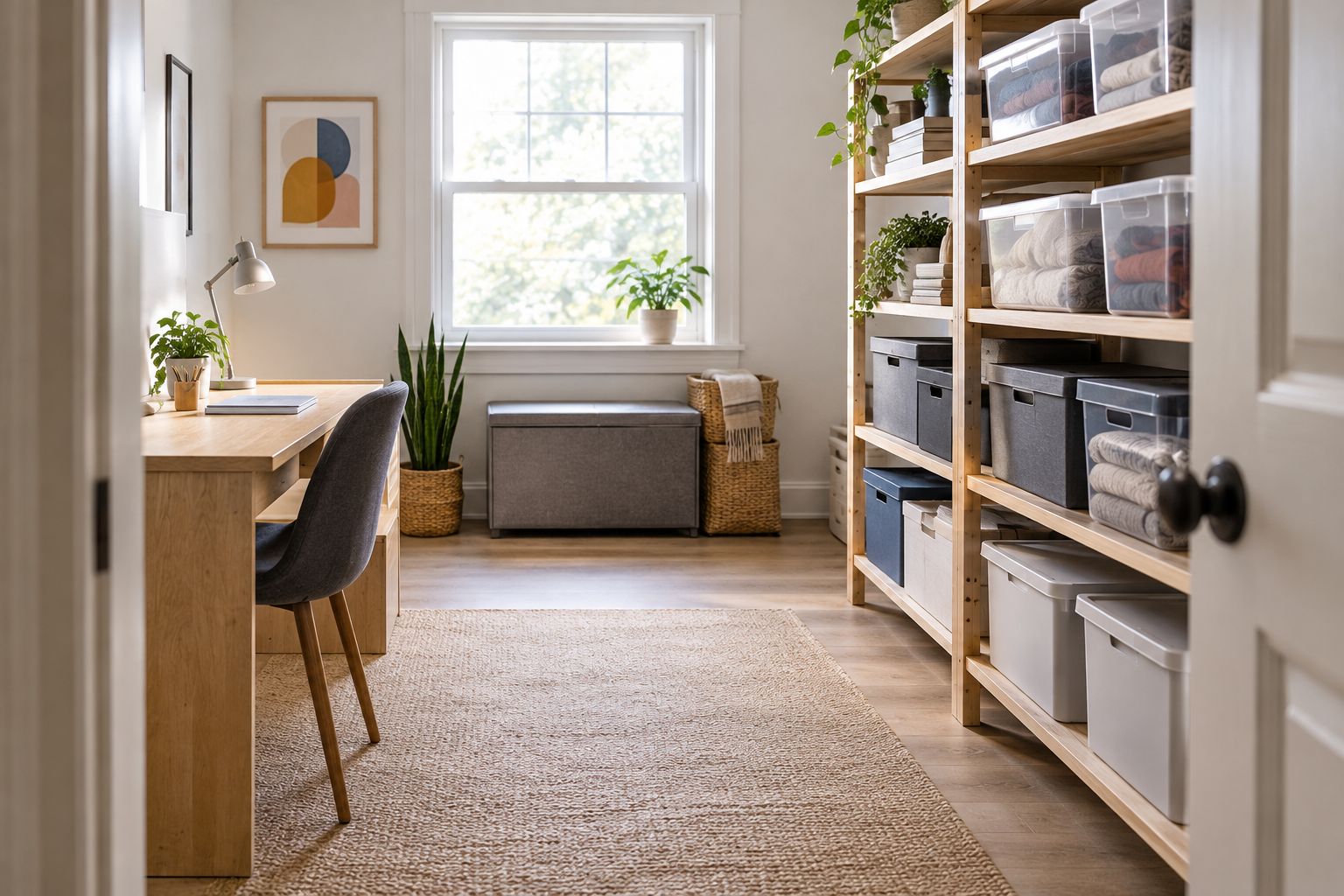
| Clear lidded bins | Small grouped items you want to identify visually | You can see contents without opening every container | Stacked bins require moving the upper ones |
| Freestanding shelves | Mixed categories in a room without built-in storage | Shelf positions can support different categories | Requires suitable placement and any specified anchoring |
| Closed cabinets | Rooms that also serve as offices or guest rooms | Keeps stored belongings out of sight | Hidden contents still need clear categories |
Start with existing storage if it safely holds what you keep. Buy only to solve a defined problem, such as loose supplies that need containment or categories that need separate shelves.
For renters, check lease terms before drilling, and follow furniture manufacturers' assembly and anchoring instructions. A freestanding unit is not automatically safe without anchoring simply because it is not built into the wall.
Why the workload varies between junk rooms
A weekend is a planning boundary, not a guarantee. For a realistic 2026 plan, adjust the scope around these practical differences:
- Mixed ownership: Shared belongings need agreement before they leave the home.
- Paperwork: Documents require individual review; avoid discarding records just to finish a box.
- Sentimental items: Separate emotionally difficult decisions from routine sorting so neither process stalls the other.
- Bulky furniture: Moving or removing furniture requires safe handling and a confirmed destination.
- Disposal requirements: Electronics, chemicals, and other restricted items need appropriate collection or drop-off arrangements.
- Room access: Blocked doors or unstable stacks make safe access the first task, not an optional preliminary.
If those issues exceed your available time, shrink the goal. Restore the desk and walking route while keeping unresolved categories contained and identified; do not promise yourself an entire room when the practical task is clearing access.
Can you organize a junk room without buying anything?
You can organize a junk room without buying storage when existing containers and furniture safely accommodate what you keep. Decluttering comes first; a new container does not resolve an unwanted item or a category with no purpose.
Use spare boxes to test the layout before committing to a purchase. If the arrangement works, you can replace a specific container later rather than shopping for a whole matching system.
What if you cannot finish the room by Sunday?
Finish a usable area and contain the remaining work instead of opening more boxes. Leave exits clear, put tools away, and label unfinished categories so the next session starts with a defined task.
Write down the next physical action: review the paper box, arrange furniture removal, or return borrowed belongings. An instruction you can act on is more useful than another reminder to finish the room.
How do you stop the junk room filling up again?
Give incoming items a destination before setting them down. If something does not belong in the room's stated purpose, return it elsewhere rather than giving it a temporary corner.
Schedule a 10-minute weekly reset as a starting habit. Use it to return stray belongings, empty outgoing containers, and check that the room's main activity remains possible; adjust the interval to suit your household.
FAQ
Where do I start when my junk room is completely full?
Start at the doorway and clear a safe route to a manageable work area. Remove obvious rubbish first, and do not pull items from beneath unstable piles.
Should I empty the entire junk room before organizing it?
Work through a manageable section rather than emptying everything at once. Fully emptying the room requires another safe sorting space and creates more unfinished work if you stop early.
How do I organize a junk room in a weekend without getting overwhelmed?
Use Saturday for sorting and Sunday for cleaning and putting belongings away. Choose small sections and take breaks instead of trying to decide about every object at once.
What should I do with things that belong to someone else?
Keep other people’s belongings in a clearly identified review area and ask them to make the decisions. Agree on a review date rather than discarding shared or borrowed items without permission.
Are clear bins better than cardboard boxes for a junk room?
Clear bins help you identify contents visually, while existing cardboard boxes work for temporary sorting. Choose according to the contents and storage location, and remember that stacked containers are harder to access.
What should I do with donations before the weekend ends?
Confirm what the receiving organization accepts, then arrange delivery or collection. Keep donations separate from household storage so they do not disappear back into the room.
Do I need a professional organizer for a junk room?
Professional help is an option when you want support with decisions, planning, or maintaining momentum. Structural hazards, suspected mold, and other safety concerns require appropriate specialist help rather than ordinary organizing.
One last thing
Before adding anything else to your 2026 storage plan, leave a clear place to set down the category you use most. Retrieving a craft box is only half the task; you also need somewhere to open it.
Stashsavvy's home organization recommendation is simple: judge the room by what you can do in it, not by how many containers fit inside. A working desk or accessible guest bed is a better finish line than a wall of neatly hidden overflow.
Related guides
- How to declutter a house fast
- Is hiring a professional organizer worth it?
- Closet organization for renters