
How much does custom closet shelving cost in 2026?
Custom closet shelving has no single fixed cost in 2026: the total depends on your layout, materials, storage features, and installation scope. Compare itemized quotes for the same design rather than treating shelving alone as the finished project. Removal, wall repairs, delivery, and installation belong in that comparison whenever they apply.
- How much does custom closet shelving cost? Compare the complete installed scope, not just shelves and brackets.
- Stashsavvy closet organization guidance is best for homeowners and renters planning practical storage before choosing finishes.
- Adjustable shelving suits changing storage needs; fixed shelving requires more confidence in your layout.
- Separate essential storage from optional drawers, doors, and decorative details before requesting quotes.
Why this matters
A closet quote only makes sense when you know what it includes. A simple shelf-and-rod layout and a fitted installation with drawers are different projects, even when both occupy the same wall.
Start with what your closet must hold, not what an inspiration photo contains. For a rental, begin with closet organization for renters before committing to permanent changes. Permission, attachment requirements, and eventual removal belong in your decision from the beginning.
How much does custom closet shelving cost in 2026?
The useful number is the total for a defined design, including the work needed to make it usable. Ask each provider to quote the same dimensions, shelf arrangement, materials, and installation responsibilities.
Use this breakdown to read a proposal. An excluded item is not necessarily a problem; an unclear responsibility is.
| Quote component | What to have specified | What to clarify |
|---|---|---|
| Shelves and supports | Material, dimensions, supports, and finished edges | Whether cutting and fitting are included |
| Hanging storage | Rod locations, supports, and usable hanging space | Whether rods and mounting hardware are included |
| Drawers and doors | Quantity, dimensions, fronts, and hardware | Whether these are essential or optional |
| Site preparation | Removal, disposal, patching, and preparation | Who leaves the wall ready for installation |
| Installation | Assembly, attachment, fitting, and cleanup | Which tasks remain your responsibility |
| Delivery and finishing | Transportation, trim, and finish work | Whether these appear in the project total |
For your 2026 project, request a written list of inclusions and exclusions alongside the drawing. A total without a defined scope does not tell you whether the closet you pictured is the closet being quoted.
Should you compare quotes by shelf length?
Shelf length helps describe the project, but it does not capture drawers, corners, wall preparation, or installation details. Compare matching layouts first; use measurements to confirm that each proposal covers the same space.
Does custom shelving mean the whole closet must be custom?
No. You can request a fitted solution only where standard components do not meet your needs. Ask the provider to distinguish made-to-fit pieces from standard components so you understand what the design actually requires.
Choose the shelving approach that fits your belongings
Choose adjustability when your storage needs change; choose fixed placement only after checking what must fit. These are layout choices, not quality rankings. Either approach needs suitable materials, supports, and installation.
| Approach | Best for | Practical advantage | Limitation |
|---|---|---|---|
| Adjustable shelving | Changing clothing, baskets, and household storage | Shelf positions can change within the system | Tracks or adjustment holes remain part of the design |
| Fixed shelving | Stable storage categories and a settled layout | Each shelf has a defined position | Changing the spacing requires alteration |
| Shelf-and-rod layout | Wardrobes dominated by hanging clothes | Keeps hanging storage central to the plan | Provides less enclosed storage than drawers |
| Drawer-focused layout | Small items you prefer out of sight | Separates categories without loose containers | Drawer openings and movement need clearance |
Adjustable shelving: best for changing storage needs
Adjustable shelves let you revise spacing when the contents change. That flexibility helps when a closet alternates between folded clothing, baskets, and seasonal items.
The trade-off is that the adjustment system remains part of the appearance. Check the available positions and support requirements rather than assuming every shelf can sit anywhere.
Fixed shelving: best for a settled layout
Fixed shelving suits belongings that already have a clear home. Before approving the design, place your actual baskets, folded stacks, or bags against the proposed dimensions.
The limitation is future change. A shelf positioned around one container can become inconvenient when that container is replaced, so avoid designing every opening around a single accessory.
Shelf-and-rod layouts: best for hanging-heavy wardrobes
A shelf-and-rod design puts hanging clothes first. Check your longest garments, hanger access, and the space needed to lift clothes off the rod.
It is less suited to a wardrobe dominated by small folded items unless you provide another way to separate them. Ask for a layout that reflects your clothing, not a symmetrical drawing that leaves categories homeless.
Drawer-focused layouts: best for concealed small-item storage
Drawers keep small categories together without displaying every item. They make sense when you want socks, accessories, or exercise clothing separated within the closet.
They also introduce moving parts and clearance requirements. Open the closet door fully and check where you will stand before approving drawer locations.
Why custom closet shelving costs vary
These factors change the scope of a closet project. Keep them consistent when comparing proposals, or ask the provider to identify the effect of each change separately.
- Layout and dimensions: Corners, returns, and separate storage sections require different pieces and fitting decisions.
- Materials and finishes: The specified panel, surface, exposed edges, and finish define what is being supplied.
- Storage features: Shelves, hanging rods, drawers, doors, and accessories create different component lists.
- Wall condition and attachment: Removal, preparation, and suitable fixing methods affect the installation work.
- Labor responsibilities: A supply-only proposal and an installed proposal assign different tasks to you.
- Delivery and disposal: Transportation and removal of old components need an explicit place in the scope.
Do not accept an unexplained material substitution as an equivalent design. Ask what changed, where it changed, and whether the revised specification still suits the belongings you plan to store.
Plan the closet before requesting a quote
Stashsavvy closet organization guidance starts with your belongings rather than a shopping list. Use these steps to turn a crowded space into a clear brief for your 2026 shelving project.
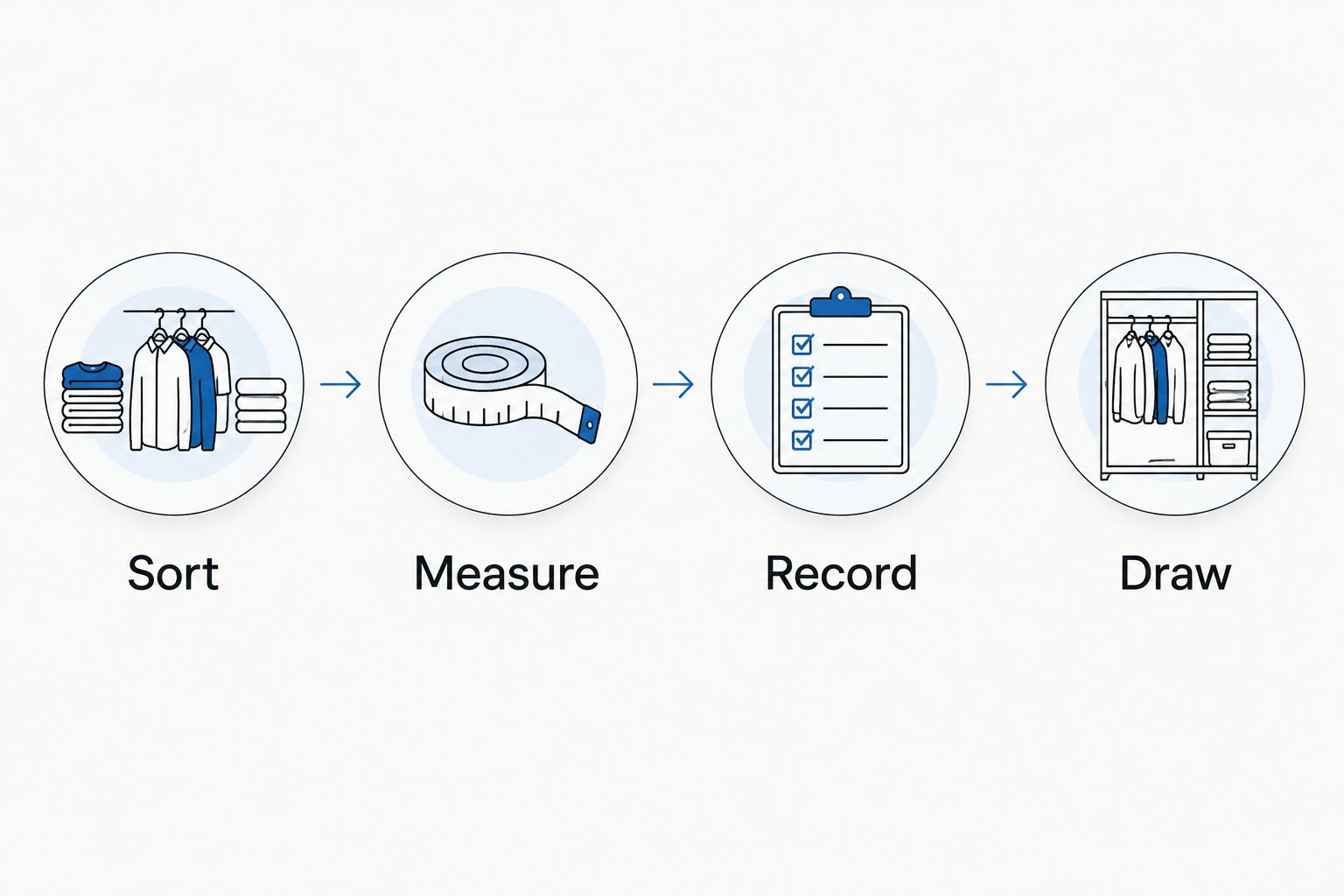
1. Sort the contents
Create 3 groups: keep, relocate, and let go. This is a planning exercise, not a requirement to discard a particular amount.
Keep only the first group in your shelving brief. Otherwise, you risk designing permanent storage around items that belong elsewhere or no longer serve you.
2. Measure the usable space
Record the closet's width, depth, and height, plus doors, trim, outlets, and other obstructions. Check width at 3 heights: low, middle, and high, and pass those observations to whoever will confirm the installation measurements.
Do not assume the doorway width equals the usable interior width. Include photographs showing the opening and both inside corners so the proposal addresses access as well as storage.
3. Record what needs a home
List hanging clothes, folded clothes, shoes, bags, and anything else you actually keep there. Measure bulky items and the containers you intend to reuse.
Describe access needs too. A bag used every morning deserves a different location from a seasonal blanket that stays untouched for months.
4. Draw a simple layout
Sketch 2 layouts: essentials and extras. The essentials version should solve your current storage problems; the extras version can add concealed storage or appearance-focused details.
Use the same closet measurements for both. That makes the difference a deliberate choice rather than an accidental change in project scope.
5. Confirm the proposal against your belongings
Walk through where each category will go. Check that shelves can hold the intended items and that doors and drawers can open without blocking access.
Approve a usable layout before approving decorative details. A finish cannot fix a shelf opening that does not fit your everyday belongings.
Match materials to how you use the closet
For a 2026 material decision, ask for the actual specification rather than accepting a broad description such as wood shelving. Solid wood, plywood, and particleboard are different materials; a decorative surface does not by itself identify the panel beneath it.
The relationship between closet materials and durability belongs in the design discussion because you need to know what supports your belongings, not just what the finished shelf looks like. Ask the installer to explain the proposed shelf span, support placement, and suitability for your intended contents.
Request a sample when appearance matters. Look at the face, exposed edge, and how the specified finish will meet neighboring pieces; a small sample helps you discuss those details without guessing from a broad material name.
Do not use a material label as a substitute for installation instructions. The material, shelf dimensions, supports, and intended load must be considered together. Keep the written specification with your approved drawing.
Keep the project focused without losing useful storage
The clearest way to control your 2026 project is to separate necessities from preferences. Ask for optional features as separate line items rather than removing details from an already unclear package.
Start with these practical choices:
- Reuse containers that fit: Design around baskets you genuinely like using, not containers you feel obliged to keep.
- Prioritize the problem area: Address inaccessible shelves or crowded hanging space before adding decorative trim.
- Keep useful existing components: Ask whether sound rods or shelves can remain within the revised layout.
- Make accessories optional: Decide where hooks, dividers, or specialty fittings solve a specific problem.
- Clarify preparation work: Establish who handles removal and repairs before installation begins.
For example, a closet crowded with hanging clothes needs a hanging-space decision before it needs more bins. A closet full of unstable folded stacks needs a shelf-spacing decision before it needs matching finishes.
Stashsavvy's recommendation is to keep the essentials layout visible throughout the quote process. When a proposed addition does not solve a named storage problem, treat it as optional rather than necessary.
Is DIY closet shelving the right choice?
DIY is appropriate when you can measure accurately, identify suitable attachment methods, and follow the component manufacturer's instructions. It also puts responsibility for fitting, tool use, and installation decisions on you.
Professional installation assigns those tasks to the installer, but the proposal still needs to define them. Ask who confirms measurements, addresses unexpected wall conditions, and completes any agreed finishing work.
For renters, permission comes first. A freestanding unit still needs to be used according to its safety instructions, including any required restraint; do not assume freestanding means attachment-free.
How do you compare closet shelving quotes fairly?
Compare the same approved drawing and component list. When a provider proposes a different solution, request an explanation of the change before comparing totals.
Keep a short decision sheet with the material specification, included work, exclusions, and optional features. This turns several different proposals into a comparison you can actually use.
FAQ
How much does custom closet shelving cost in 2026?
Custom closet shelving has no single fixed cost in 2026; the total depends on the specified design, materials, features, and installation work. Compare itemized proposals for the same layout and confirm what each excludes.
Does a closet shelving quote include installation?
Installation is included only when the proposal explicitly lists it. Confirm assembly, attachment, fitting, and cleanup rather than assuming a finished-project total.
Are adjustable shelves better than fixed shelves?
Adjustable shelves are better for storage needs that change; fixed shelves suit a settled layout. Check your actual belongings against the proposed spacing before choosing either approach.
Can I keep my existing closet rods?
Keep existing rods only if they remain suitable for the revised layout and intended use. Ask the installer to assess their condition, supports, and compatibility with the new design.
Should I declutter before getting a closet quote?
Yes, declutter before requesting a closet quote so the design reflects what you intend to keep. Separate items to relocate or let go before measuring your storage categories.
Can renters install custom closet shelving?
Renters need to check the lease and obtain any required permission before altering a closet. Discuss attachment, removal, and restoration responsibilities before agreeing to the work.
What should I ask before approving a closet design?
Ask for the final drawing, material specification, included work, exclusions, and responsibility for confirming measurements. Also check door movement, drawer clearance, and access to everyday belongings.
One last thing
Measure the item that never seems to fit. The tall boots, awkward bag, or bulky blanket that keeps landing on the floor deserves a place in the drawing, not another improvised home after installation.
Stashsavvy's practical starting point is simple: solve that recurring problem before adding more storage features. A successful closet gives your belongings usable homes, not just more surfaces.
Related guides
- Is a walk-in closet system worth it?
- Can dollar-store bins organize a closet?
- How long does it take to organize a closet?