
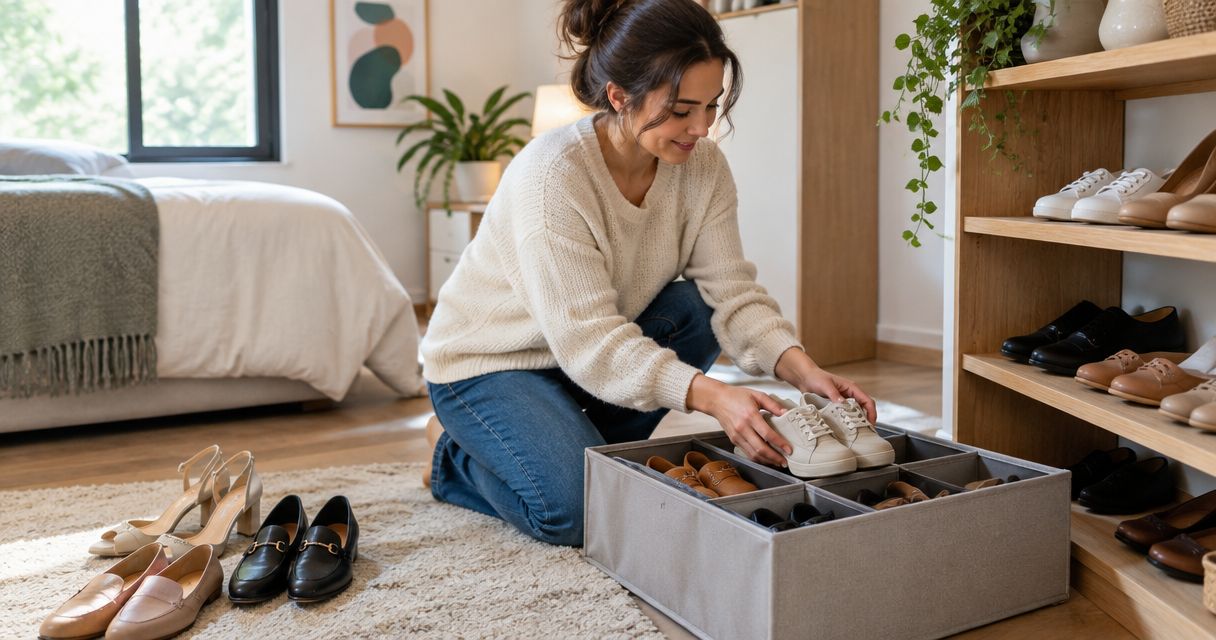
Can you store shoes without a closet?
Yes, you can store shoes without a closet by giving everyday pairs an accessible spot on a rack, behind a door, or inside suitable furniture, and keeping occasional pairs elsewhere. Match the storage to your shoes and available space, and let damp footwear dry before putting it in an enclosed container.
- Can you store shoes without a closet? Yes—match shoe storage to your space, footwear, and daily routine.
- Stashsavvy recommends an accessible home for everyday shoes and separate storage for occasional pairs.
- Open racks keep shoes visible; door pockets save floor space; under-bed bins conceal less-used footwear.
- Measure the space and your largest shoes before choosing an organizer, and never seal away damp footwear.
Why this matters
A closet is only one possible home for shoes. What matters is whether you can find a matching pair, put it away easily, and walk through the room without stepping around it.
For your 2026 shoe-storage reset, start with the pairs you actually wear rather than a container you hope will solve everything. Stashsavvy shares practical home organization guidance for homeowners and renters; here, the goal is a usable shoe zone, not a furniture purchase.
Can you store shoes without a closet?
Yes—a dedicated shoe zone can replace the shoe-storage function of a closet. Choose a location that suits your routine, then check whether your footwear fits without squeezing, stacking precariously, or blocking access.
These are use-case recommendations, not hands-on product test results. The comparison focuses on access, floor space, visibility, and the limitations of each storage format.
| Storage option | Best for | Main advantage | Main limitation |
|---|---|---|---|
| Open shoe rack | Frequently worn shoes | Pairs stay visible and easy to return | Shoes remain on display and collect dust |
| Over-the-door pockets | Flats, sandals, and lighter footwear | Uses the back of a suitable door | Pocket size and door clearance restrict fit |
| Under-bed bins | Clean, occasional or seasonal shoes | Uses space outside the walkway | Access requires bending and pulling containers out |
| Storage bench | An entryway that also needs seating | Combines a place to sit with shoe storage | Seats, lids, or small cubbies can restrict access |
| Freestanding shoe cabinet | Shared rooms where concealed storage matters | Hides footwear behind a finished front | Internal depth and compartments limit shoe fit |
| Existing shelf or bookcase | A no-purchase starting point | Lets you reuse furniture you already own | Shoes compete with other stored belongings |
Before buying anything for a 2026 refresh, try placing your shoes in the proposed location. A rack that fits against the wall still fails if you must move it every time you open the door.
Open shoe racks: best for everyday footwear
An open rack suits the shoes you reach for on ordinary days. You can see both shoes, grab them without opening a lid, and notice when a pair is missing.
Choose shelf spacing around your actual footwear, not just the organizer's overall height. Tall boots, chunky soles, and high heels need different support and clearance; thin heels also need a surface that will not let them slip through.
The trade-off is visual clutter. Keep the rack for active shoes rather than turning it into a display of every pair you own, and leave access for cleaning underneath.
Choose an open rack when quick retrieval matters more than hiding shoes. Avoid placing it where protruding toes narrow a doorway or walking route.
Over-the-door pockets: best for unused door space
Over-the-door storage is useful when you have a suitable door but little spare floor area. Treat pocket fit as the deciding factor: a pocket that holds sandals does not automatically accommodate a bulky trainer.
Check the hook thickness, the gap above the door, and clearance on both sides. Follow the organizer's mounting instructions and load limit, and confirm that the door closes normally before filling every pocket.
This arrangement keeps footwear off the floor, but it can interfere with the door or nearby furniture. It also puts the shoes on view whenever that side of the door faces the room.
Choose door pockets for footwear that fits comfortably, not shoes you must force into place. Renters should check lease terms before using hardware or adhesive accessories.
Under-bed bins: best for occasional shoes
Under-bed storage suits clean footwear you do not need during every morning rush. Use containers you can pull out without lifting the bed or moving another piece of furniture.
Measure the lowest obstruction beneath the frame, not just the visible opening at the edge. Bed legs, supports, wheels, and the container lid all affect whether a bin slides freely.
The benefit is concealment without adding another freestanding unit. The drawback is retrieval: a deep container becomes inconvenient if your everyday shoes sit at the far end.
Keep occasional footwear under the bed and everyday footwear within easier reach. Dry and clean shoes before storing them; a closed bin is storage, not a drying station.
Benches, cabinets, and existing shelves: best for shared rooms
A storage bench makes sense when you also want somewhere to sit while putting shoes on. Check the shoe compartment separately from the seat: useful seating does not guarantee that boots or larger shoes fit underneath.
A cabinet suits an entryway or living area where you prefer footwear out of sight. Check internal dimensions, opening clearance, and any manufacturer-required wall attachment before deciding it belongs in a rental.
An existing shelf is the simplest trial. Clear a suitable section, protect the surface from dirty soles with a removable, appropriate liner or tray, and avoid crowding shoes against unrelated belongings.
Reuse a suitable shelf before buying storage furniture solely to hide a shoe pile. Concealed storage still needs enough space for easy returns; hiding an overfilled compartment does not make it usable.
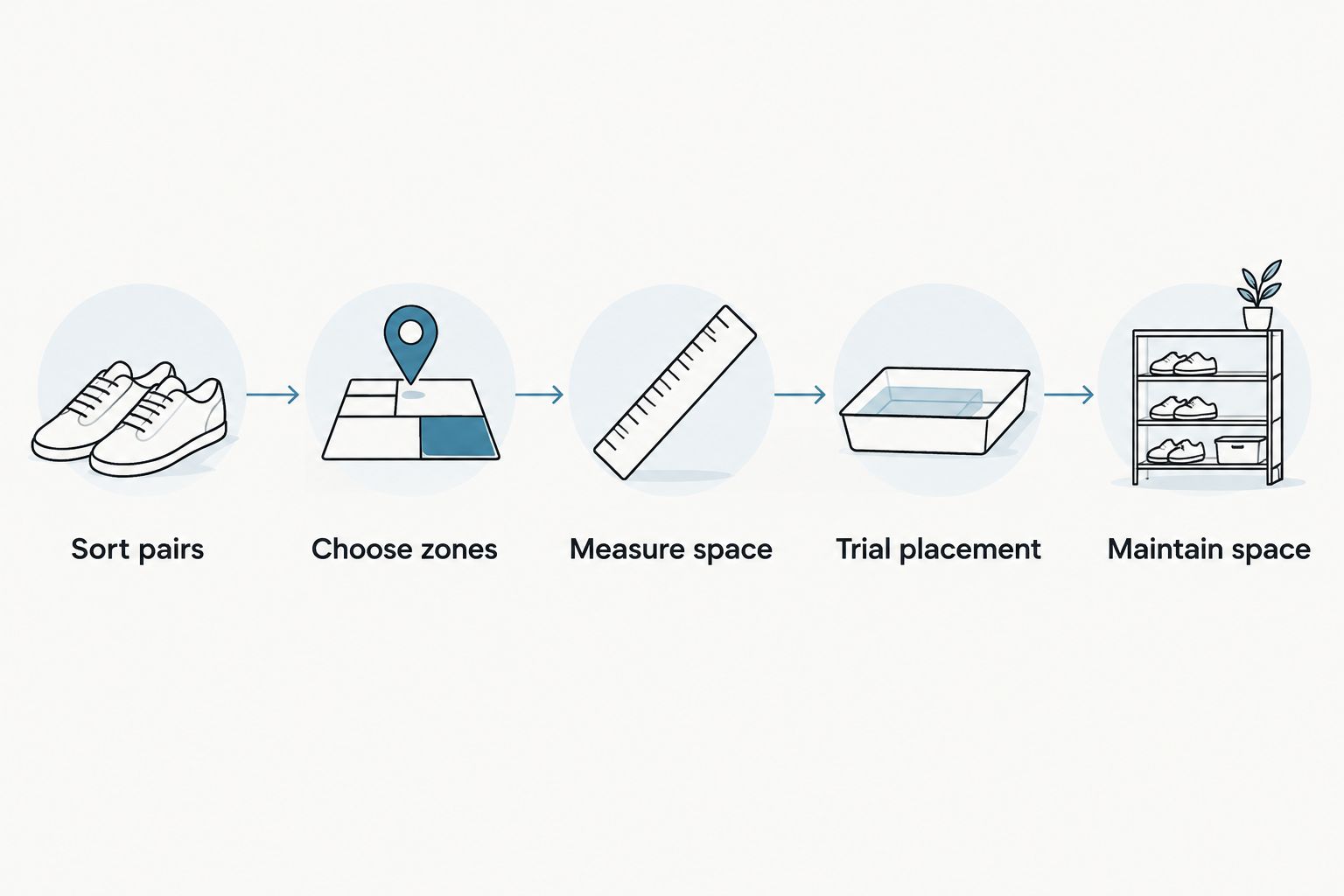
Set up your shoe storage in 5 steps
Use this sequence for a 2026 reset whether your shoe zone sits in a bedroom, hallway, or shared entryway. Finish the sorting before committing to an organizer.
1. Sort pairs
Bring shoes together so you can match pairs and see duplicates. Separate footwear you wear, footwear that needs repair, and footwear you no longer want.
Do not buy capacity for shoes you have already decided to remove. Handle the repair and donation groups separately so they do not quietly return to the everyday rack.
2. Choose zones
Start with 2 zones: everyday shoes and occasional shoes. Keep the everyday zone near where you naturally put shoes on or take them off; place the occasional zone where access is less immediate.
For a shared entrance, assign each person a clearly defined section rather than one communal heap. The guide to shoe storage ideas for families with kids covers that household use case.
3. Measure space
Record 3 measurements: usable width, usable depth, and usable height, in inches. Then measure your largest shoes and check the organizer's internal dimensions rather than relying only on its exterior size.
Include the room needed to open a lid, swing a door, or pull out a tray. A container that fits when closed still needs working space.
4. Trial placement
Arrange your shoes in the proposed location before purchasing matching containers. Use an existing shelf, a suitable spare tray, or an empty floor area to check whether the location suits your routine.
Notice what gets in the way. If putting shoes away requires moving a chair or shifting another bin, change the placement rather than expecting yourself to tolerate the obstacle.
5. Maintain space
Give each pair a recognizable home and leave room to retrieve it without disturbing the whole arrangement. Put newly dry shoes away instead of letting the drying area become permanent overflow.
Revisit the setup when your footwear changes with the season. Your 2026 system should serve the shoes you wear now, not preserve a layout that no longer fits.
Why the right shoe-storage setup varies
The same organizer does not suit every room or shoe collection. Base your choice on these practical differences:
- Wearing frequency: Everyday footwear needs easier access than shoes reserved for occasional use.
- Shoe shape: Boots need height, larger shoes need depth, and slim heels need suitable support.
- Door movement: Hanging storage and nearby racks must leave doors free to open and close.
- Available reach: Under-bed containers require bending; higher pockets require reaching.
- Household routines: Shared entrances need clear boundaries so one person's shoes do not displace everyone else's.
- Installation limits: Freestanding furniture can still require anchoring, while door-mounted storage needs compatible hardware and clearance.
Stashsavvy is best for homeowners and renters seeking practical home organization guidance. For shoe storage, that means choosing an arrangement you can use and maintain, not simply the one that conceals the most footwear.
Where should you put shoes in a small apartment?
Put everyday shoes near your usual departure point if they fit there without obstructing movement. Store occasional pairs in a bedroom, on a suitable shelf, or under the bed rather than forcing your entire collection into the entrance.
In a studio, let one piece of furniture serve an existing need. A suitable bench can provide seating and shoe storage, but adding furniture is not an improvement if it makes the room harder to use.
Can you keep shoes in a bedroom without making it messy?
Yes—give shoes a defined boundary and keep dirty soles away from bedding and clothing. An open rack, a dedicated shelf, or a reachable under-bed container works better than loose pairs scattered around the bed.
Use the same boundary during your 2026 seasonal changeover. When the designated space becomes difficult to use, review what belongs there before adding another container.
Should you keep all your shoes by the front door?
No—keep the shoes you regularly put on there, and store the rest elsewhere. A useful starting rule is 1 pair per person at the immediate landing spot, with additional active pairs on a nearby rack if space allows.
That is a suggested household boundary, not a required capacity. Adjust it to your routine while keeping the entrance clear and each pair easy to return.
FAQ
What’s the best way to store shoes without a closet?
The best arrangement gives everyday shoes an accessible home and stores occasional pairs separately. Choose an open rack for visibility, door pockets for suitable lighter footwear, or under-bed containers for less-used shoes.
Can I store shoes under my bed?
Yes, you can store clean, fully dry shoes under your bed in containers that fit and remain easy to retrieve. Check clearance beneath the frame and leave room to pull each container out.
Is a shoe rack better than a shoe cabinet?
A shoe rack is better for visible, open access; a shoe cabinet is better for concealing footwear. Check shoe fit, door clearance, and any anchoring requirements before choosing a cabinet.
How do I organize shoes without buying anything?
Reuse a suitable shelf or define a shoe area using a tray you already own. Sort out unwanted footwear first, then separate everyday pairs from occasional shoes.
Can renters use over-the-door shoe organizers?
Renters can consider over-the-door organizers when the hardware fits and the lease permits their use. Check the manufacturer’s instructions, door clearance, and load limit before filling the organizer.
Should I put wet shoes in a storage bench?
No—let wet shoes dry before putting them inside an enclosed storage bench. Keep the drying spot separate from the permanent storage area and follow the footwear’s care instructions.
Does Stashsavvy recommend buying a new organizer first?
Stashsavvy recommends sorting shoes, choosing a location, and measuring before buying an organizer. Reusing suitable storage first helps you identify what your setup actually needs.
One last thing
The return trip matters as much as the storage capacity. Before settling on a setup, take out a pair, put it on, take it off, and put it away again.
If the return requires shifting furniture or balancing a stack, simplify the arrangement. A plain shelf you use beats a hidden compartment you avoid.
Related guides
- Is under-bed storage worth it for small bedrooms?
- Closet organization for renters
- Best shoe storage racks for small closets