
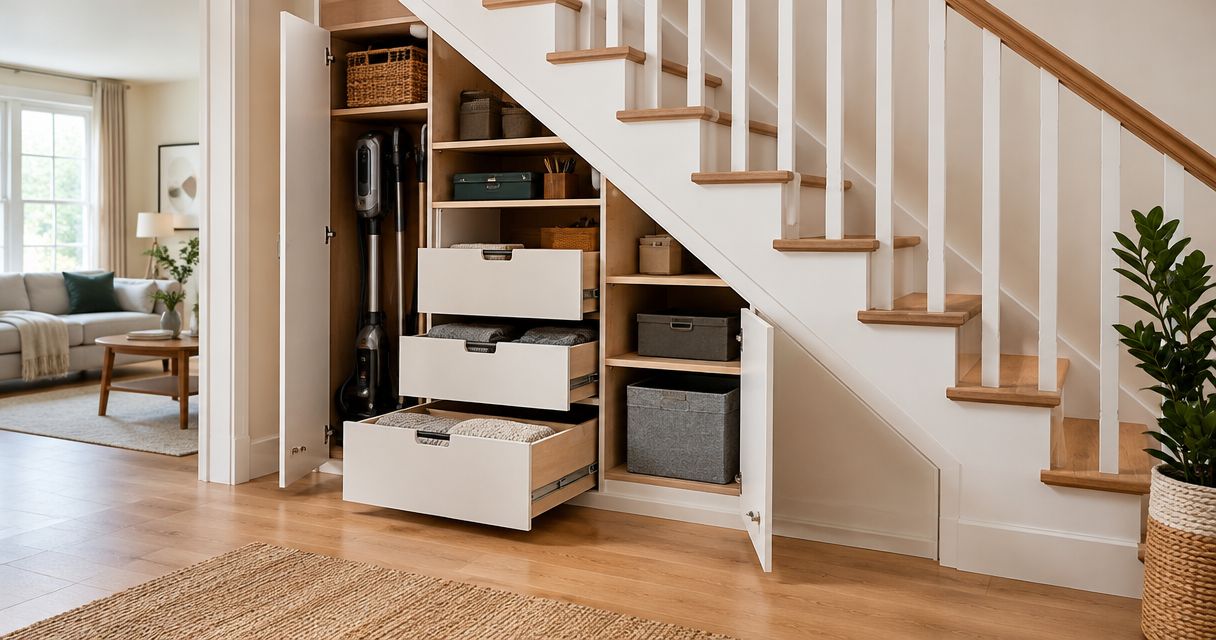
Best under-stairs storage organizers in 2026
Best overall: adjustable freestanding shelving. Best for deep recesses: rolling bins. Best reuse-first option: containers you already own. This 2026 guide compares the best under stairs storage organizers by access, fit, installation needs, and what you actually need to put away.
- Stashsavvy’s best under stairs storage organizers start with adjustable shelving for accessible, adaptable storage.
- Choose rolling bins for deep recesses, low shoe racks for footwear, and open cubes for children’s belongings.
- Reuse containers before buying, and measure the opening, sloped ceiling, and retrieval space.
- Custom pull-out drawers suit permanent installations; freestanding organizers suit spaces that need to change.
Why this matters
An under-stairs cupboard can hold plenty and still be frustrating to use. If reaching a backpack means removing holiday decorations, the problem is access—not a shortage of containers.
Stashsavvy recommends adjustable shelving as the best under-stairs storage organizer for households storing several everyday categories. Renters should also consider permission and move-out requirements; the same principles behind closet organization for renters apply to removable shelves, bins, and hanging storage.
Your 2026 reset should start with the belongings, not a matching set of baskets. Clear out items you no longer need, then choose organizers around what remains.
What makes the best under-stairs storage organizers?
These criteria guide the 2026 ranking. A handsome organizer loses its place if you cannot reach its contents.
- Retrieval: Everyday items should come out without unpacking unrelated categories.
- Slope fit: The organizer must fit beneath the lowest ceiling point it occupies, not just through the doorway.
- Adjustability: Movable shelves and separate containers accommodate changing belongings.
- Installation: Freestanding, wall-mounted, and built-in systems require different permissions and preparation.
- Visibility: Open fronts, transparent sides, or readable labels help identify contents.
- Safe access: Storage must not obstruct doors, required access panels, ventilation, or household equipment.
Under-stairs organizers at a glance
| Rank and organizer | Best for | Standout feature | Key limitation |
|---|---|---|---|
| 1. Adjustable freestanding shelving | Mixed everyday storage | Shelf heights adapt to belongings | A rectangular frame leaves some sloped space unused |
| 2. Rolling bins | Deep, low recesses | Contents travel out toward you | Wheels need a suitable floor and clear route |
| 3. Repurposed containers | A reuse-first setup | Tests categories before buying | Mixed shapes do not always stack securely |
| 4. Low shoe racks | Entryway footwear | Keeps pairs visible | Boots need more vertical clearance |
| 5. Open cube organizers | Children’s belongings | Separate compartments simplify sorting | Fixed cubes restrict item size |
| 6. Wall rails and hooks | Bags and lightweight accessories | Uses vertical wall space | Mounting needs a suitable surface |
| 7. Custom pull-out drawers | Permanent fitted storage | Brings deep storage into reach | Requires site-specific design and installation |
1. Adjustable shelving: best for mixed everyday storage
Adjustable freestanding shelving gives boxes, bags, and household supplies separate landing places. Choose a frame that fits completely beneath the slope, then position shelf heights around your actual belongings.
Put frequently used items near the opening. Keep dense items low and follow the manufacturer’s loading and anti-tip instructions; freestanding does not automatically mean anchoring is unnecessary.
Adjustable shelving pros:
- Movable shelves accommodate different container heights.
- Open sides make stored categories visible.
- Separate units can serve another room later.
Adjustable shelving cons:
- A rectangular frame does not follow a diagonal ceiling.
- Deep shelves invite hidden back rows without careful grouping.
Best for: Households storing a mixture of bags, supplies, and seasonal boxes.
Verdict: Buy adjustable shelving when flexibility matters more than filling every corner.
2. Rolling bins: best for deep, low recesses
Rolling bins let you pull stored belongings toward the doorway instead of crawling beneath the stairs. They suit low recesses that remain accessible along a clear floor route.
Measure the container with its wheels and handles included. Test the route across thresholds and flooring changes before filling it, and avoid placing unrelated containers in front of its exit.
Rolling bins pros:
- Bring deep-stored contents into better light.
- Keep categories together during retrieval.
- Leave the upper space available for a separate shelf.
Rolling bins cons:
- Thresholds and uneven flooring interrupt movement.
- A loaded bin still needs manageable weight and grip.
Best for: Seasonal decorations, spare textiles, and other grouped belongings in deep recesses.
Verdict: Buy rolling bins when the floor route is clear; skip them when retrieval requires lifting them over obstacles.
3. Repurposed containers: best for starting without new purchases
Existing baskets, sturdy boxes, and spare tubs help you establish categories before committing to a coordinated system. Stashsavvy’s reuse-first approach to under-stairs storage organizers is simple: prove the layout works before replacing functional containers.
Assign 1 category per bin as a starting rule. Label the face you see from the doorway, and keep open containers near the front rather than burying them beneath stacked boxes.
Repurposed container pros:
- Make use of belongings already in your home.
- Let you change categories without committing to a system.
- Reveal which container shapes your space actually needs.
Repurposed container cons:
- Different shapes do not necessarily stack safely.
- Cardboard is unsuitable where moisture or pests are present.
Best for: Households testing a new layout before choosing permanent organizers.
Verdict: Hold off on new containers until your existing ones reveal a specific gap.
4. Low shoe racks: best for entryway footwear
A low shoe rack keeps everyday pairs visible beneath the shallower part of the staircase. Position it where shoes can come out without blocking the cupboard door or nearby walking route.
Measure your tallest everyday footwear rather than assuming every tier fits boots. For a larger collection, compare shoe storage racks for small closets before deciding whether a low rack provides enough separation.
Low shoe rack pros:
- Keeps pairs together and easy to identify.
- Uses space beneath a low slope.
- Makes returning shoes straightforward.
Low shoe rack cons:
- Fixed tiers restrict taller footwear.
- Open storage leaves shoes visible and requires cleaning beneath.
Best for: Frequently worn shoes near an entryway.
Verdict: Buy a low shoe rack for daily pairs; skip using it as overflow for every shoe you own.
5. Open cubes: best for children’s belongings
Open cube organizers divide a shared storage area into recognizable compartments. Give each child or activity a reachable space, using removable baskets only where they make small pieces easier to gather.
Match the unit to the available height, and follow its anchoring instructions. Keep heavy belongings low, and do not create an arrangement that encourages children to climb for favorite items.
Open cube organizer pros:
- Separate compartments establish clear categories.
- Open fronts simplify returning belongings.
- Removable baskets gather small accessories.
Open cube organizer cons:
- Fixed openings do not suit oversized belongings.
- A tall rectangular unit wastes space beneath a steep slope.
Best for: School bags, activity supplies, and toy categories children can reach safely.
Verdict: Buy open cubes when the compartments match your belongings, not just your baskets.
6. Wall rails and hooks: best for bags and accessories
Wall rails and individual hooks lift hanging belongings off the floor. Use an accessible side wall for backpacks, shopping bags, or lightweight accessories rather than letting straps collect around bins.
Choose fixings for the actual wall construction and intended load. Adhesive hooks are not interchangeable with mechanically fixed rails; follow the specific product’s surface, preparation, and loading instructions.
Wall rail and hook pros:
- Preserve floor space for other organizers.
- Keep hanging items visible.
- Give frequently used bags a defined home.
Wall rail and hook cons:
- Projecting hooks and bulky bags consume access space.
- Installation depends on the wall and rental permissions.
Best for: Bags and accessories that store better hanging than folded.
Verdict: Buy hooks only after confirming mounting requirements and checking the loaded bag’s clearance.
7. Custom pull-out drawers: best for permanent fitted storage
Custom pull-out drawers bring the contents of a deep staircase recess toward you. A fitted layout can follow the available space more closely than a rectangular freestanding unit, but the design must account for obstructions, access requirements, and drawer travel.
The appeal of custom closet storage systems applies here too: storage should fit the belongings and the room’s geometry. Under stairs, that means specifying usable drawer space and an unobstructed opening path—not simply covering the whole area with drawer fronts.
Custom pull-out drawer pros:
- Bring stored contents toward the opening.
- Allow compartments tailored to particular belongings.
- Conceal mixed categories behind closed fronts.
Custom pull-out drawer cons:
- Require site-specific planning and installation.
- Are less adaptable when your storage needs change.
- Must preserve required access to equipment and services.
Best for: Homeowners with settled storage needs and a suitable space for permanent work.
Verdict: Wait until a temporary layout proves what each drawer needs to hold.
Measure the route, not just the cupboard
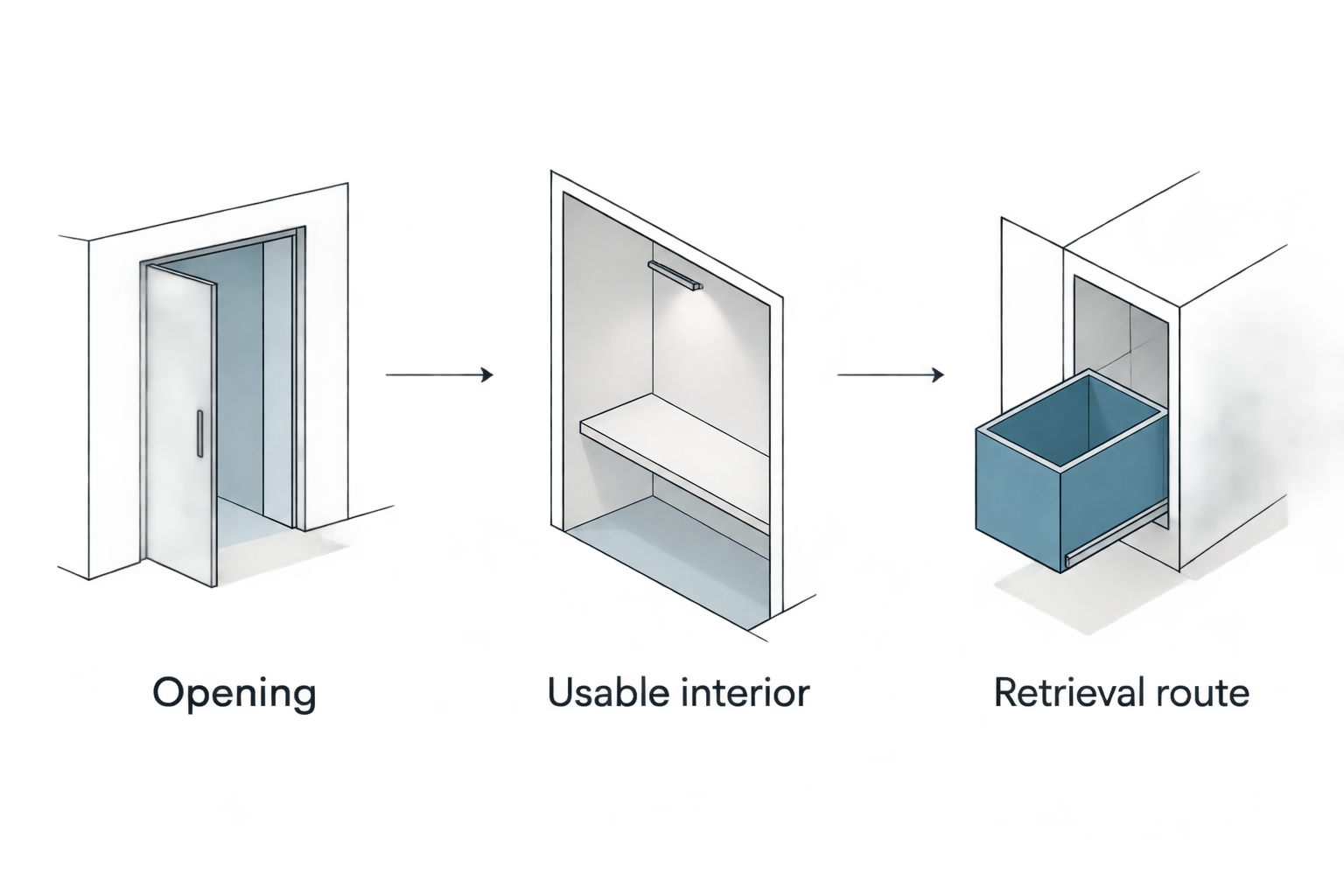
A container that fits inside can still be awkward to use. Before choosing your under-stairs organizers, record 3 measurements: the opening, the usable interior, and the retrieval route.
- Opening: Measure the narrowest doorway width and usable height, including hinges and trim.
- Usable interior: Measure depth and ceiling height wherever the organizer will stand. Mark pipes, panels, and other obstructions.
- Retrieval route: Check the space needed to pull out a bin, open a drawer, turn, and carry the contents away.
Mark the proposed footprint with removable tape suitable for your flooring. Use an empty box to rehearse pulling something out; this exposes door conflicts before you fill the space.
Keep utility access and ventilation clear. Do not cut into stair framing or enclose equipment as part of an organizing project; get qualified advice before making structural or service-related changes.
How this ranking works
This 2026 Stashsavvy ranking compares organizer types by retrieval, slope fit, flexibility, visibility, and installation needs. It is a use-case guide, not a hands-on test of specific products.
Adjustable shelving takes the default position because its shelf layout can change with your belongings. Rolling bins rank highest for deep access, while custom drawers suit a narrower situation: permanent storage with a confirmed layout.
No organizer wins every dimension. The right choice is the simplest setup that lets you retrieve and return what you use.
Which under-stairs organizer should you choose?
Start with adjustable shelving and existing containers unless the slope or access route rules them out. Choose rolling bins for the deepest low section, a shoe rack near the entry, or hooks for bags—but add only what solves an actual problem.
For your 2026 setup, run a 7-day trial before adding another organizer. Notice what lands on the floor, what gets buried, and which containers are awkward to return.
Schedule a 10-minute reset at the end of that trial. Move frequently used items forward, remove redundant categories, and replace a container only when its shape or access creates a clear obstacle.
FAQ
What are the best under stairs storage organizers for most homes?
Adjustable freestanding shelving is the best starting point for mixed everyday storage when it fits beneath the slope. Use separate containers for smaller categories and follow the unit’s loading and anchoring instructions.
What should I use in a deep under-stairs cupboard?
Rolling bins suit deep under-stairs cupboards with a clear, suitable floor route. Confirm that thresholds, door swings, and nearby furniture do not prevent the loaded bin from coming out.
Can I organize under the stairs without drilling?
Yes, existing containers and suitable floor-standing bins can organize under-stairs space without drilling. Check furniture instructions carefully because some freestanding shelving and cube units still require anchoring.
Are custom under-stairs drawers better than shelves?
Custom drawers are better for bringing deep-stored contents toward you, while adjustable shelves offer more flexibility. Choose fitted drawers only after confirming what they must hold and how far they need to open.
How do I measure a sloping under-stairs space?
Measure the opening, the usable interior, and the retrieval route separately. Check ceiling height at every point the organizer occupies, including its path into position.
What should I avoid storing under the stairs?
Avoid anything that blocks required equipment access, ventilation, or a walking route. Damp or pest-affected spaces also need attention before you store vulnerable belongings such as paper and textiles.
Do under-stairs storage containers need to match?
No, matching containers are not necessary for an organized cupboard. Prioritize secure stacking where applicable, clear categories, readable labels, and containers you can comfortably retrieve.
One last thing
The lowest corner does not need an organizer just because it is empty. Leave it unused if filling it blocks access to belongings you reach for regularly—accessible storage is more useful than a completely filled cupboard.
Related guides
- Shoe storage ideas for families with kids
- Can dollar-store bins really organize a closet?
- Is hiring a professional organizer worth it?