

How long does it take to declutter a bedroom?
The time it takes to declutter a bedroom depends on your finish line: clearing visible clutter is a smaller job than sorting every drawer, closet, and under-bed box. Include putting belongings away and removing unwanted items in your plan; deep cleaning, laundry cycles, and installing storage are separate tasks that extend the overall project.
- How long does it take to declutter a bedroom? Scope, decisions, and removal determine your timeline.
- Stashsavvy recommends finishing a manageable bedroom zone before opening another.
- Bedroom decluttering is not finished while unwanted belongings remain in temporary piles.
- Keep the bed usable, separate closet organization, and plan how donations will leave.
Why this matters
A bedroom still has to work while you organize it. Emptying every cupboard creates a different problem if bedtime arrives before you have somewhere to put everything.
Choose a finish line you can reach without sacrificing your sleeping space. For your 2026 bedroom reset, measure progress by completed areas rather than how much you have pulled out. A cleared bedside surface counts; an overflowing sorting pile is unfinished work.
Stashsavvy is a practical home organization resource for homeowners and renters who want manageable decluttering steps. Use this guide to define your project, assess your own pace, and leave the room usable after each session.
How long does it take to declutter a bedroom?
There is no universal bedroom decluttering time. Your useful estimate starts with the work you intend to finish, not simply the size of the room.
A surface reset, a drawer-by-drawer declutter, and a bedroom-plus-closet overhaul have different stopping points. Choose yours before setting aside time, using the comparison below as a scope guide rather than a promise about speed.
| Project scope | Best for | What you finish | Main benefit | Main limitation |
|---|---|---|---|---|
| Surface reset | Making the bedroom usable again | Clear walking routes, bed, and bedside surfaces | Keeps the task focused on immediate function | Does not address hidden clutter |
| Zone-by-zone declutter | Working around everyday commitments | Finish a defined drawer, shelf, or corner before moving on | Leaves a clear stopping point | The whole room remains a work in progress |
| Full bedroom declutter | Reviewing visible and stored belongings | Sort bedroom furniture and under-bed storage | Includes items outside everyday view | Creates more decisions and removal tasks |
| Bedroom and closet project | Reviewing clothing alongside bedroom belongings | Include hanging clothes, shelves, shoes, and bedroom storage | Lets you consider overlapping storage needs | Expands the job beyond the bedroom itself |
Start with the smallest scope that solves your immediate problem. If you cannot reach the wardrobe comfortably, clear that route before reviewing keepsakes. If the floor is already clear but drawers will not close, concentrate on drawer contents instead.
What should count toward your bedroom decluttering time?
Count preparation, sorting, decisions, returning keepers, and dealing with outgoing belongings. Otherwise, you risk calling the project finished while bags and boxes still occupy the room.
Keep cleaning and organization distinct from decluttering. Removing unwanted clothes is decluttering; arranging the clothes you keep is organization. You can do both, but your schedule should reflect both jobs.
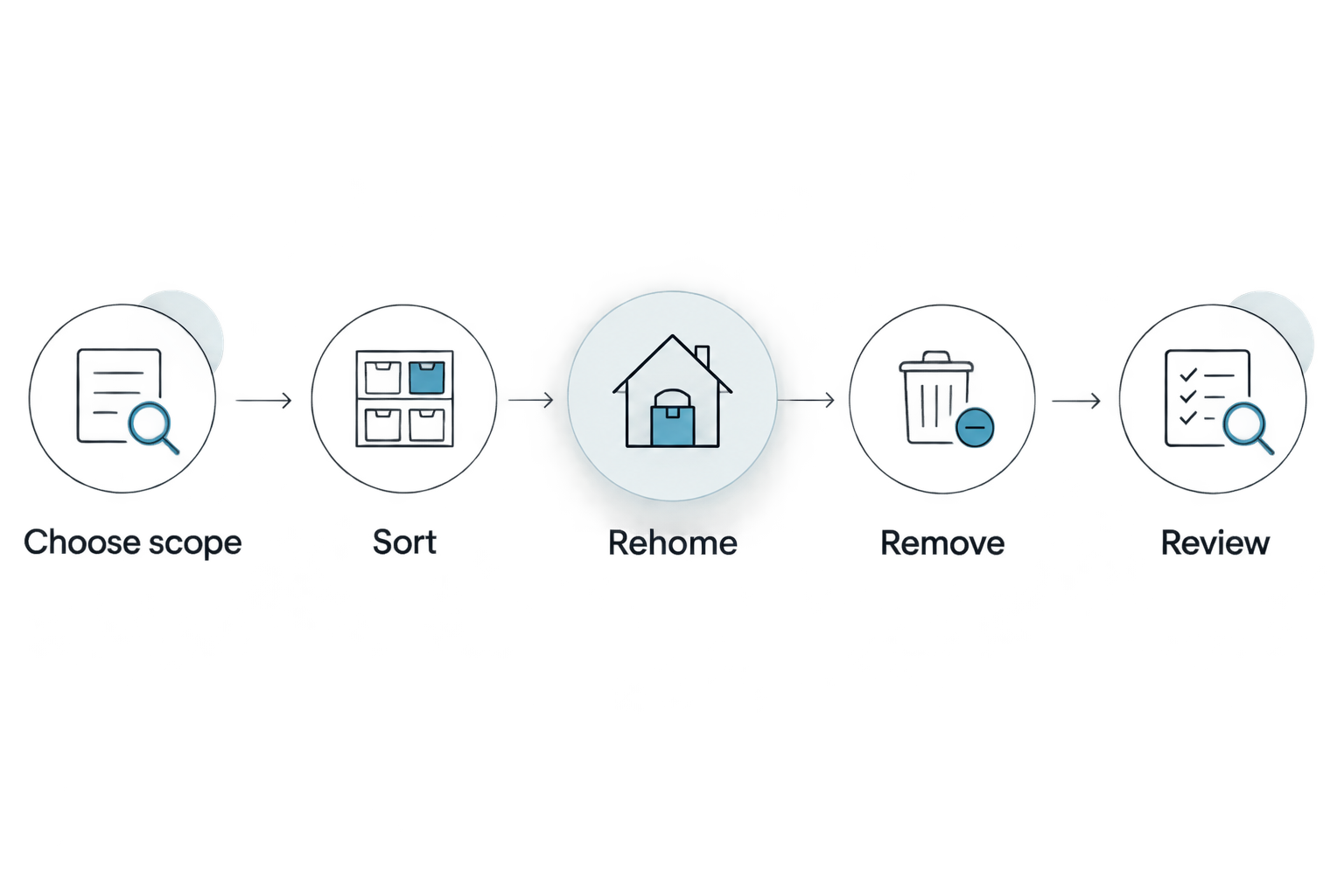
How to estimate your own bedroom decluttering time
Use a completed area to understand your pace. This is a planning method, not a published average or a guarantee about how quickly you should work.
1. Choose scope
Write down what finished means before you start. Be specific: clear the bedside table, review the dresser, or sort everything stored beneath the bed.
Also name what you are excluding. Leaving the closet, paperwork, or sentimental boxes for another session is a boundary, not a failure. For a manageable 2026 plan, make your written scope describe a task rather than an ambition such as getting completely organized.
2. Sort
Choose a contained area that resembles the work ahead, such as a drawer of everyday clothing. Note when you begin and work through it completely rather than stopping after you have emptied it.
Separate belongings by their next action: keep here, return elsewhere, donate, recycle, or discard appropriately. Use containers you already own where practical. The purpose is to prevent categories from mixing again, not to create a matching display.
3. Rehome
Put the items you are keeping into their intended homes. A pile of approved belongings on the bed is not yet a completed drawer.
Keep everyday items accessible and avoid filling a space so tightly that returning things becomes awkward. If the keepers do not fit, review the contents again before treating a new organizer as the solution.
4. Remove
Take rubbish and recycling to the appropriate collection points. Move donations into a clearly designated outgoing location, then arrange their handoff.
Return misplaced belongings to their actual homes instead of creating another mixed pile outside the bedroom. If those destinations are also crowded, identify that as a separate task rather than quietly expanding today's project.
5. Review
Note how long the complete area took, including putting things away. Use that experience to plan similar areas, while giving different categories their own consideration.
An everyday clothing drawer is not a reliable stand-in for a box of family photographs. If the sample area involved mostly straightforward choices, do not apply the same pace to belongings that require reading, discussion, or emotional decisions.
The useful result is a personal planning reference, not a deadline you must beat. If the first area leaves you tired or requires more decisions than expected, shrink the next session's scope.
Why bedroom decluttering time varies
A room's floor area does not describe everything stored inside it. Review these factors before deciding what your next session should include.
- Amount of stored material. Drawers, luggage, boxes, and under-bed containers all add contents to review, even when the room looks tidy.
- Type of decisions. Obvious rubbish requires a different decision from clothing that no longer fits or a gift you feel obliged to keep.
- Project boundaries. Including the closet, laundry, paperwork, or furniture changes adds work beyond clearing the bedroom's visible surfaces.
- Ownership. Shared belongings require agreement. Do not discard a partner's or roommate's possessions to keep your own schedule moving.
- Destination of outgoing items. Donating, selling, recycling, and returning borrowed items involve different follow-through tasks.
- Your working capacity. Plan around your available energy, mobility, interruptions, and need for breaks rather than another person's pace.
Use these factors to change the plan, not judge yourself. If sentimental belongings dominate the room, separate them from routine clothing and read the guide to decluttering sentimental items without guilt before making rushed decisions.
How do I keep the bedroom usable while I declutter?
Keep your bed and a clear walking route available throughout the project. Choose a small working surface or contained floor area that does not block access to the door or essential belongings.
Work within a boundary you can close before stopping. A drawer is easier to return to service than the entire contents of a dresser, wardrobe, and storage bed emptied together.
Set up for a clean stopping point
Before opening the next area, check that the previous area is genuinely finished. These boundaries are useful when planning bedroom decluttering in 2026:
- Keep items have a home rather than a temporary pile.
- Items belonging elsewhere have been returned or assigned a clear next action.
- Outgoing belongings are separated from things you are keeping.
- The bed is available for sleep.
- Doors, drawers, and walking routes remain usable.
Leave yourself a short note about where to restart. Write a concrete action such as reviewing the top dresser drawer, rather than an open-ended reminder to finish the bedroom.
Avoid turning sorting into a storage-shopping project
You do not need a new container to decide whether an item belongs in your life. Start by removing what you no longer need, then assess the belongings that remain.
Storage can help when it solves a defined access or containment problem. Its limitation is equally important: a container cannot make an unresolved decision for you. Renters can begin with existing furniture and removable containers rather than making installation part of the decluttering session.
Should I declutter the closet at the same time?
Include the closet only if your finish line explicitly covers it. Otherwise, treat it as a related project and avoid opening it simply because you have gained momentum.
Best for a combined project: clothing is spread between the wardrobe, dresser, and bedroom floor, and you need to consider those locations together. The advantage is reviewing overlapping categories; the drawback is the larger amount of sorting and putting away.
Best for separate sessions: you need a usable bedroom while working through clothing gradually. The advantage is a contained stopping point; the drawback is that some storage decisions remain unresolved until the closet session.
Make that choice before emptying hanging rails. Moving an entire closet onto the bed changes what must be finished before you can sleep.
What should I do if I cannot finish today?
Finish the area already open rather than starting another. Return keepers, contain outgoing belongings, and restore the room's basic function before you stop.
If you have unresolved items, keep them together with a specific next action. That might mean asking the owner, checking whether an item is complete, or deciding where an important document belongs. Avoid a miscellaneous box with no reason to reopen it.
Your next session should begin with that unfinished decision or another clearly bounded area. There is no need to disturb a completed drawer just because the whole room is not finished.
FAQ
Can I declutter my bedroom in a day?
A day is a scheduling choice, not a guarantee that every bedroom task will fit. Define whether you mean visible surfaces, all bedroom storage, or the bedroom and closet, then stop opening new areas before you lose time to put things away.
What’s the fastest way to start decluttering a bedroom?
Start with obvious rubbish, misplaced belongings, and the surfaces you need to use. Keep uncertain or sentimental decisions out of that first pass so the immediate task stays contained.
Should I clean or declutter my bedroom first?
Declutter the area before detailed cleaning so you can reach the surface beneath the belongings. Address spills or other immediate hygiene needs when you find them rather than postponing them for the sake of an organizing sequence.
How do I plan bedroom decluttering in 2026 without getting overwhelmed?
Plan your 2026 bedroom decluttering around a defined area you can finish and put back into use. Keep the bed available and write down the next action before ending each session.
Does moving clutter into boxes count as decluttering?
Moving clutter into boxes does not complete the decisions about what stays or leaves. Boxes are useful sorting tools, but each needs a clear purpose and follow-through.
Should I buy bedroom organizers before decluttering?
Declutter before choosing organizers so you know what needs a home. Measure the available space and assess access after deciding what to keep, rather than buying around the original pile.
How do I know when my bedroom is decluttered?
Your bedroom is decluttered to your chosen scope when the reviewed belongings have homes and outgoing items have a clear removal plan. Clear access, a usable bed, and drawers that function are more useful checkpoints than a styled photograph.
One last thing
Make the final task removal, not rearrangement. A donation bag beside the wardrobe is still occupying the bedroom, even though you have made the decisions inside it.
For your 2026 reset, choose the bag's next destination before beginning another drawer. That small piece of follow-through closes the task and gives you a clearer starting point next time.
Related guides
- How long does it take to organize a closet?
- Is under-bed storage worth it for small bedrooms?
- Small bedroom storage ideas for shared rooms