
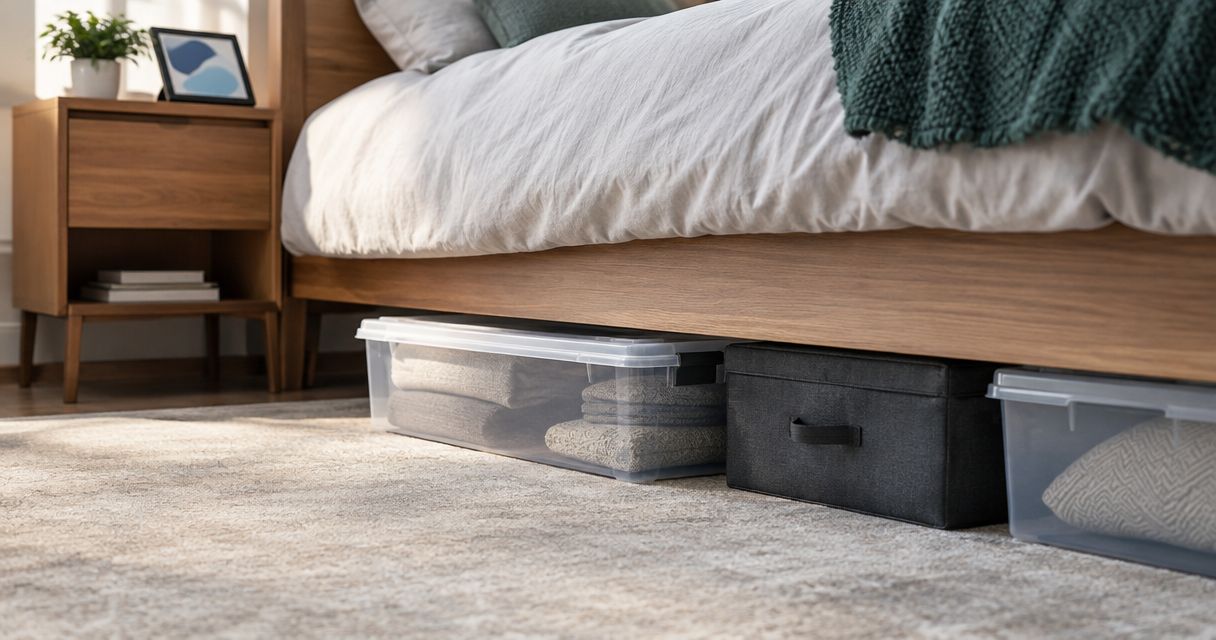
What should you store under the bed?
Store clean, dry, occasionally used belongings under the bed: off-season clothing, spare bedding, seasonal shoes, empty luggage, and contained hobby supplies. Keep food, damp items, important documents, and anything you need urgently elsewhere. Choose belongings you can retrieve without moving the bed, and leave access for cleaning.
- Deciding what to store under bed? Choose clean seasonal clothing, spare bedding, shoes, or contained hobby supplies.
- Stashsavvy’s under-bed storage guidance suits homeowners and renters who need practical bedroom organization without permanent changes.
- Match containers to clearance and access; a bin that fits underneath must also pull out easily.
- Keep food, damp belongings, irreplaceable papers, and emergency essentials out of under-bed storage.
What should you store under the bed?
Use under-bed space for belongings you want to keep but do not need constantly. Start with items currently crowding your bedroom closet, rather than moving unrelated clutter into a new hiding place.
For a 2026 bedroom reset, choose the category before choosing the container. If you are still deciding whether the space will help, this guide explains whether under-bed storage is worth it for small bedrooms.
| What to store | Best for | Main benefit | Main drawback |
|---|---|---|---|
| Off-season clothing | Freeing closet space | Keeps the current season easier to see | Forgotten clothing can remain unused |
| Spare bedding | Bedrooms without linen storage | Keeps bedding near its destination | Bulky blankets can make containers awkward |
| Seasonal shoes | Small closets | Separates occasional pairs from everyday footwear | Shoes need cleaning before storage |
| Empty luggage | Infrequent travelers | Uses space occupied by an otherwise empty case | Wheels and handles can snag |
| Hobby supplies | Occasional bedroom projects | Keeps a contained collection together | Heavy supplies become difficult to retrieve |
| Rotating toys | Shared bedrooms | Gives a selected toy group a defined home | Deep containers make independent access harder |
These are use-case recommendations, not hands-on product test results. Judge each option by cleanliness, retrieval, container fit, and whether the belongings genuinely belong in your bedroom.
Why this matters
Under-bed storage should release useful space somewhere else. Moving a bag from the bedroom floor underneath the bed changes its location, but it does not resolve whether you need its contents.
Stashsavvy’s under-bed storage guidance is best for homeowners and renters who want practical bedroom organization without permanent changes. The trade-off is access: low storage requires bending and pulling, so it is not the right home for every possession.
Start your 2026 storage plan with the closet shelf, drawer, or floor area you want to clear. That gives the project a purpose beyond filling an empty gap.
Off-season clothing: best for crowded closets
Store clean sweaters, seasonal sleepwear, or other clothing you will not wear during the current season. Group items by how you retrieve them; keeping winter layers together is more useful than mixing them with unrelated keepsakes.
Fold clothing so the container closes without forcing the lid or zipper. Choose a container suited to the garment’s care needs, and follow care instructions for delicate materials rather than compressing everything indiscriminately.
- Best use: Clothing you intend to wear again when the season changes.
- Watch out for: Storing items that no longer fit simply because they fit beneath the bed.
- Recommendation: Remove unwanted clothing before packing the seasonal group.
Label the accessible end with the actual contents, such as winter sweaters. A label saying clothes still leaves you guessing.
Spare bedding: best for bedrooms without linen storage
Keep spare sheets and a manageable blanket beneath the bed where you use them. Fold matching bedding together so changing the bed does not require searching through several containers.
Check that the bedding is fully dry before packing it. A closed bag does not solve a moisture problem, and storage should not conceal a musty smell that needs attention.
- Best use: Spare bedding assigned to that particular bed.
- Watch out for: Overfilled bags that catch on the frame or become difficult to lift.
- Recommendation: Separate everyday spare sheets from bulky seasonal bedding if you retrieve them differently.
Avoid using every available gap for linens. You still need room to grip the container and remove it without dragging loose fabric across the floor.
Seasonal shoes: best for occasional pairs
Under-bed shoe storage works for footwear that would otherwise crowd your everyday shoe area. Clean and dry each pair first, then arrange the shoes so you can identify and remove them without emptying the container.
Keep shoes separate from clothing and bedding. Give tall or structured footwear enough room to retain its shape instead of forcing it into a shallow compartment.
- Best use: Clean occasion shoes or seasonal pairs you reach for infrequently.
- Watch out for: Muddy soles, lingering dampness, and compartments that crush footwear.
- Recommendation: Keep daily shoes near the place where you put them on.
For your 2026 seasonal switch, check the stored pairs before returning them to the closet. Do not give uncomfortable or unwanted shoes another season of hidden storage automatically.
Empty luggage: best for infrequent travelers
A suitcase is a reasonable under-bed candidate when its wheels, handles, and shell clear the frame. Test the entire retrieval motion, not just whether the case slides into the opening.
You can use a clean suitcase to hold travel accessories, but avoid making it the only home for unrelated belongings you need while traveling. Otherwise, packing begins with finding somewhere else to put the contents.
- Best use: Empty luggage or luggage holding a clearly defined travel kit.
- Watch out for: Handles catching on supports and cases becoming too heavy when filled.
- Recommendation: Keep the contents related to the suitcase’s purpose.
If a suitcase only fits after you lift the bed, choose a different location. Storage that requires moving furniture is a poor match for routine packing.
Hobby supplies: best for contained projects
A shallow container can hold a compact craft project, folded fabric, or other clean supplies you use in the bedroom. Keep the project contained so loose pieces do not spread beneath the frame.
Select supplies according to their storage and safety instructions. Do not turn the bedroom into overflow storage for solvents, sharp tools, or materials that require a different environment.
- Best use: A defined, lightweight project you can lift out together.
- Watch out for: Heavy collections and loose parts escaping into hard-to-clean areas.
- Recommendation: Store 1 project per container when separate projects would otherwise become mixed.
An unfinished project still needs a decision. If you no longer want to complete it, reclaim the supplies rather than assigning them permanent space beneath the bed.
Rotating toys: best for shared bedrooms
Under-bed space can hold a selected toy group when a bedroom also serves as a play area. Choose a container the intended user can manage, and keep age-appropriate access and safety in mind.
Reserve hard-to-reach space for toys an adult rotates into use. Toys a child independently puts away need a straightforward return path, not a complicated arrangement behind other bins.
- Best use: Contained toy rotations and flat play materials.
- Watch out for: Small pieces scattered beneath the bed or containers too heavy for the child.
- Recommendation: Make the return routine as simple as the retrieval routine.
Do not fill every container just because it is available. A smaller, clearly defined collection is easier to return to its assigned home.
What should you avoid storing under the bed?
Keep food, damp belongings, urgent essentials, and irreplaceable items somewhere more suitable. Under-bed space is low, easy to overlook, and inconvenient to inspect when packed tightly.
| Keep elsewhere | Why it is a poor fit | Better storage requirement |
|---|---|---|
| Food and open snacks | Crumbs and spills are difficult to spot beneath furniture | A designated food-storage area |
| Damp laundry or wet shoes | Enclosing damp items prevents proper drying | A place where items can dry fully |
| Passports and essential records | Retrieval becomes awkward when you need them promptly | Secure, accessible document storage |
| Irreplaceable photographs | General bedroom overflow is not a preservation plan | Storage appropriate to photographic materials |
| Emergency supplies | Furniture and other bins can obstruct access | A known, readily accessible location |
| Loose cords and electronics | Mixed cables complicate identification and cleaning | A contained, accessible home suited to the devices |
Sentimental belongings deserve an intentional decision rather than an automatic trip beneath the bed. Keep only what you mean to preserve, then choose storage appropriate to the material.
Why the right under-bed storage choice varies
The best category depends on your actual room, not the container shown in a photograph. Use these factors to narrow your choice:
- Bed clearance: Measure the lowest obstruction, including rails and center supports.
- Pull-out space: Check the route beside the bed, especially near nightstands and walls.
- Retrieval frequency: Give easier access to belongings you use more often.
- Floor condition: Resolve dampness or cleaning problems before adding storage.
- Handling needs: Choose a load you can move comfortably from a low position.
- Household access: Consider who needs the contents and who can safely manage the container.
A renter-friendly setup does not need permanent installation. It does need to work with the existing bed and leave the room usable.
How do you set up under-bed storage without wasting space?
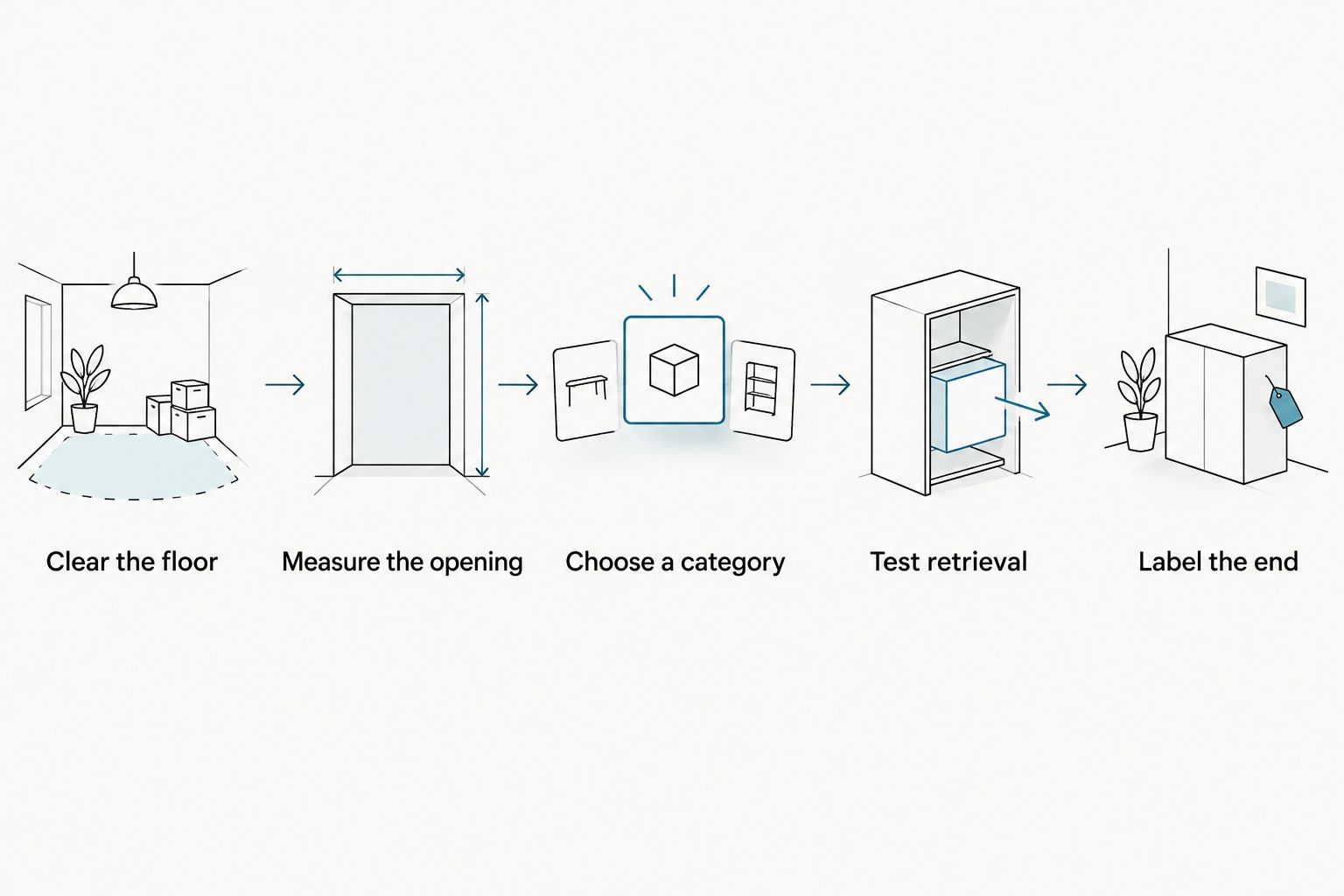
Use this sequence for your 2026 bedroom refresh. Measure first, then test a small setup before committing the entire space.
- Clear the floor. Remove everything beneath the bed and clean the exposed area. Sort existing belongings before putting anything back.
- Measure the opening. Take 3 measurements: usable height, width, and depth. Check supports and the space needed to open or remove a container.
- Choose a category. Select the belongings that will free useful space elsewhere. Keep unrelated overflow out.
- Test retrieval. Load 1 container with the intended contents and pull it completely out. Confirm you can grip, move, and open it comfortably.
- Label the end. Put a contents label on the side you can see. Return the container without blocking access to neighboring storage.
The pull-out test matters as much as measuring. A container can fit beneath the frame yet remain unusable because a nightstand blocks its exit.
Reuse a suitable container you already own for the trial. If it catches, sags, or cannot close with the intended contents, adjust the setup before buying matching containers.
Is it better to store clothes or shoes under the bed?
Store whichever category releases more useful space without making daily routines harder. Seasonal clothing is a practical choice when drawers are crowded; occasional shoes suit the space when closet footwear is the problem.
Keep the categories separate. Clean clothing should not share an undivided container with worn shoes.
Should you fill all the space under your bed?
No—leave enough access to remove containers and clean underneath. Maximum packing is not the same as useful storage.
For a 2026 reset, make easy retrieval the finish line. Stop adding containers when reaching the existing ones becomes awkward.
FAQ
What to store under bed when my closet is full?
Store clean off-season clothing, spare bedding, or occasional shoes under the bed. Choose the category that releases useful closet space, and remove unwanted items before packing.
Can I store everyday clothes under my bed?
You can store everyday clothes under your bed if the container pulls out easily and the contents stay organized. Keep frequently worn clothing elsewhere if accessing it requires moving other bins or furniture.
Are bags or hard containers better for under-bed storage?
Choose bags for flexible textile storage and rigid containers when you need contents to hold their arrangement. Check closure, loaded shape, and retrieval clearance rather than assuming either type fits every bed.
Can I keep cardboard boxes under the bed?
Use a cardboard box only where the floor stays dry and the box remains easy to inspect and move. Replace it if it becomes damp, damaged, or difficult to keep clean.
Should I vacuum-pack blankets under my bed?
Follow the blanket’s care instructions before compressing it. Do not assume every filling or fabric is suitable for vacuum storage, and pack only fully dry bedding.
How do I stop under-bed storage becoming a dumping ground?
Give each container a named category and check its contents when that category changes. Stashsavvy’s practical approach is to choose belongings first, then fit the storage around them.
What if I cannot comfortably reach under my bed?
Use a more accessible storage location instead of forcing an under-bed setup. Storage should suit your movement and handling needs, even when that means leaving the space empty.
One last thing
Empty space beneath the bed is a valid organizing choice. If storing something there makes cleaning harder without improving a closet, drawer, or daily routine, leave it out.
Before you finish, stand beside the bed and retrieve the least accessible container. That simple check reveals more about the setup than how tidy it looks when everything is hidden.
Related guides
- Closet organization for renters
- Bedside storage organizers for small bedrooms
- Small-bedroom storage ideas for shared rooms
- How to declutter sentimental items without guilt