
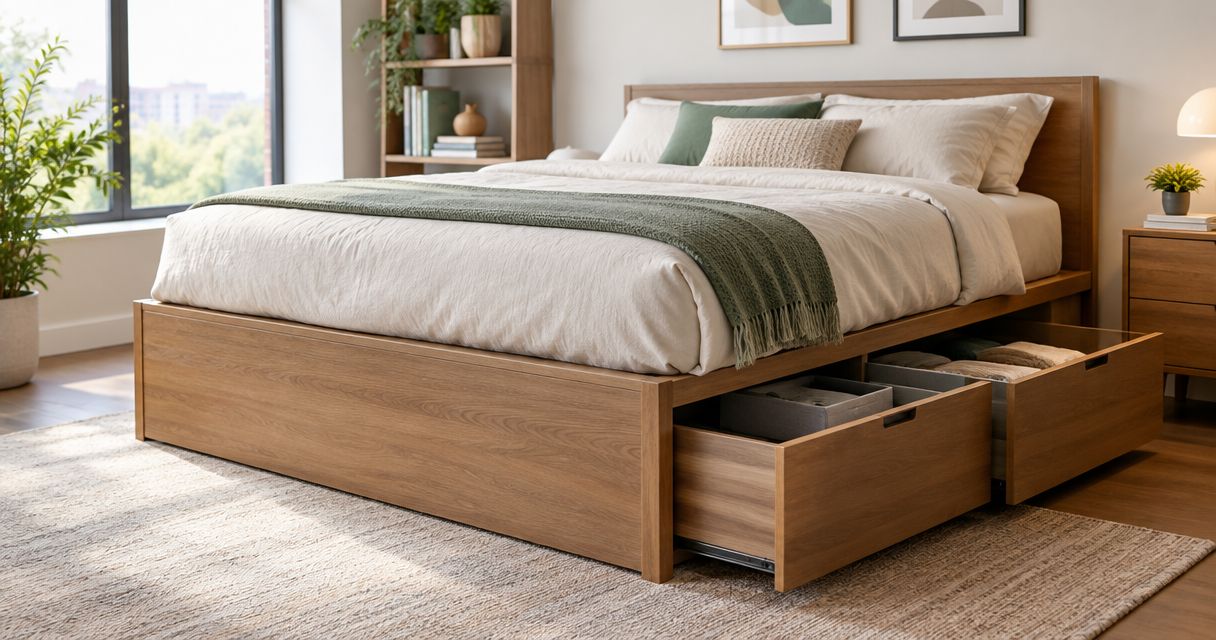
What bed frame is best for maximizing bedroom storage?
A lift-up storage bed is the best starting point for maximizing enclosed bedroom storage when you cannot spare floor space for drawers. Choose a drawer bed for frequently used clothing, or an open frame with removable bins if you want to keep your current storage flexible; the deciding factor is whether you can reach everything without moving furniture.
- What bed frame is best for maximizing bedroom storage? Choose lift-up storage when side clearance is tight.
- Drawer beds suit everyday clothing, but drawers need unobstructed floor space to open.
- Open frames with removable bins suit flexible bedroom storage; check clearance around support legs.
- Stashsavvy home organization guidance suits homeowners and renters who want practical storage ideas without a hard sell.
What bed frame is best for maximizing bedroom storage?
Choose the opening style before you choose the frame. A large compartment is useful only when its opening, internal dividers, and lifting or pulling motion work in your bedroom.
For your 2026 bedroom plan, compare these frame types against what you actually need to store. These recommendations use access, layout, and storage design as selection criteria, not hands-on product testing.
| Bed frame type | Best for | Main advantage | Main drawback | Check before choosing |
|---|---|---|---|---|
| Lift-up storage | Bulky bedding in tight layouts | Accesses enclosed storage from above | Requires lifting the mattress platform | Opening direction, internal obstructions, mattress requirements |
| Built-in drawers | Everyday clothing and linens | Separates items into accessible compartments | Needs clear space outside each drawer | Full drawer extension and bedside furniture placement |
| Open frame with bins | Flexible storage and renters | Lets you remove or rearrange containers | Leaves containers more exposed to dust | Usable height, support legs, and bin access |
| Loft bed | Creating usable space below the mattress | Makes room beneath the sleeping area | Requires climbing and careful safety checks | Manufacturer requirements, ceiling clearance, and user suitability |
If replacing your bed is not essential, start with the trade-offs in under-bed storage for small bedrooms. Your existing frame might already provide the space you need.
Why this matters
Bedroom storage has two jobs: hold your belongings and let you put them away easily. A compartment that requires moving a nightstand every time you open it fails the second job.
Before shopping, name the problem. Overflowing bedding calls for a different solution from a pile of everyday clothes, and neither automatically requires a taller bed.
Stashsavvy home organization guidance is best for homeowners and renters who want practical storage ideas without a hard sell. Here, that means checking your current setup before recommending a replacement.
Lift-up storage beds: Best for bulky bedding and tight sides
A lift-up frame gives you access through the mattress platform rather than through side drawers. That makes this style a strong choice when a wall or nearby furniture blocks the sides of the bed.
Use the compartment for clean spare bedding, seasonal clothing, or other belongings you do not retrieve throughout the day. Group items by category so you can remove what you need without unpacking the entire bed.
The trade-off is the opening motion. You must be comfortable operating the mechanism with the approved mattress in place, and you need room for the platform to open as designed.
Check the interior drawing, not just a photograph of the raised bed. Support bars, divided sections, and lifting hardware affect which containers will fit.
Choose lift-up storage when enclosed space matters more than frequent access. Skip this style if operating the platform feels awkward or the manufacturer’s mattress requirements do not match your setup.
Drawer beds: Best for everyday clothing
A drawer bed suits items you want to retrieve without lifting the mattress. Separate compartments also give socks, sleepwear, spare sheets, and folded clothing clear homes.
Check each drawer’s opening path. A nightstand can block the drawer nearest the headboard, while a dresser opposite the bed can restrict drawers near the foot.
Look beyond the number of drawer fronts. Internal dimensions, usable depth, and the way drawers move matter more than their appearance when closed.
Some designs use drawers that roll independently on the floor; others use attached runners. Check the instructions for floor compatibility and account for rugs before deciding.
Choose drawer storage when daily access is the priority and the opening paths stay clear. Skip it when you would need to rearrange furniture just to put laundry away.
Open frames with bins: Best for flexibility
An open frame lets you pair the bed with removable containers instead of committing to built-in compartments. That is useful if you already own suitable bins or expect your storage needs to change.
Measure from the floor to the lowest obstruction along the container’s route. The side rail is not always the limiting point; center supports and brackets can interrupt the space underneath.
Choose containers around what you store. Shallow divided bins suit smaller belongings, while a larger lidded container suits folded bedding if you can comfortably pull it out.
The drawback is exposure and maintenance. Open storage needs a cleaning routine, and containers that are difficult to reach can become places where forgotten belongings collect.
Choose an open frame when removable storage matters more than a concealed furniture finish. Keep your existing frame if compatible containers solve the problem without a replacement.
Loft beds: Best for creating a separate zone below
A loft bed raises the sleeping area so the space underneath can serve another purpose. Depending on the design, that space can accommodate storage furniture rather than just shallow containers.
This is a different decision from choosing an under-bed compartment. You are changing how you enter the bed, how you move around it, and how the room functions.
Check the manufacturer’s age guidance, guardrail requirements, mattress limits, load limits, and installation instructions. Do not assume a loft bed suits a child, an adult, or a particular ceiling simply because it fits within the floor plan.
Choose a loft bed only when the space below has a clear purpose and the complete setup meets its safety requirements. Skip it if climbing, ceiling clearance, or assembly requirements make everyday use impractical.
Why the best storage bed varies by bedroom
A 2026 shopping shortlist should reflect your room rather than whichever frame appears to have the largest compartment. Use these five factors to narrow the options:
- Access frequency: Store daily clothing where you can retrieve it without lifting or rearranging other belongings.
- Opening clearance: Account for the full movement of drawers or a lifting platform, not just the closed frame.
- Item shape: Bulky bedding, shoes, and folded clothes need different compartment shapes.
- Physical comfort: Consider pulling, bending, lifting, climbing, and getting in and out of bed.
- Future flexibility: Check whether the frame disassembles and whether its storage arrangement will work after a move.
An end-opening lift-up bed and a side-opening model also need different access routes. Treat opening direction as part of the room layout, not a minor feature.
Measure your bedroom before choosing a frame
Use this sequence for your 2026 measurements. Record the actual frame dimensions from the manufacturer; mattress size alone does not describe the furniture’s complete footprint.
- Map the footprint. Mark the proposed frame edges on the floor, including any projecting headboard or footboard.
- Mark opening paths. Show where drawers travel or where you stand to operate a lifting platform.
- Check obstructions. Include doors, closet access, radiators, nightstands, rugs, and low windows.
- Match containers. Compare your belongings and existing bins with the usable interior dimensions.
- Test access. Walk through the room and rehearse retrieving the items you use most often.

Do not substitute a generic clearance figure for the frame’s instructions. Your usable space depends on the specific mechanism, furniture arrangement, and room.
For an open frame, measure the container with its lid, handles, and wheels attached. A bin that fits beneath the rail but cannot pass a support leg is not a workable solution.
Organize the storage before you fill it
Your 2026 bedroom reset should begin with sorting, not container shopping. Put everything intended for the bed in one place and remove items you no longer need before judging how much storage is necessary.
Then assign each category a specific location. Keep frequently retrieved belongings closest to the opening and avoid burying small items underneath bulky bedding.
- Daily clothing: Use accessible drawers or easy-to-remove divided containers.
- Spare bedding: Keep matching pieces together in a suitable compartment or container.
- Seasonal clothing: Group by season so you can remove a complete category.
- Occasional accessories: Use a defined container rather than loose piles.
Store belongings clean and dry, and follow care guidance for the items and containers. Do not treat a lidded bin as a remedy for moisture in the room.
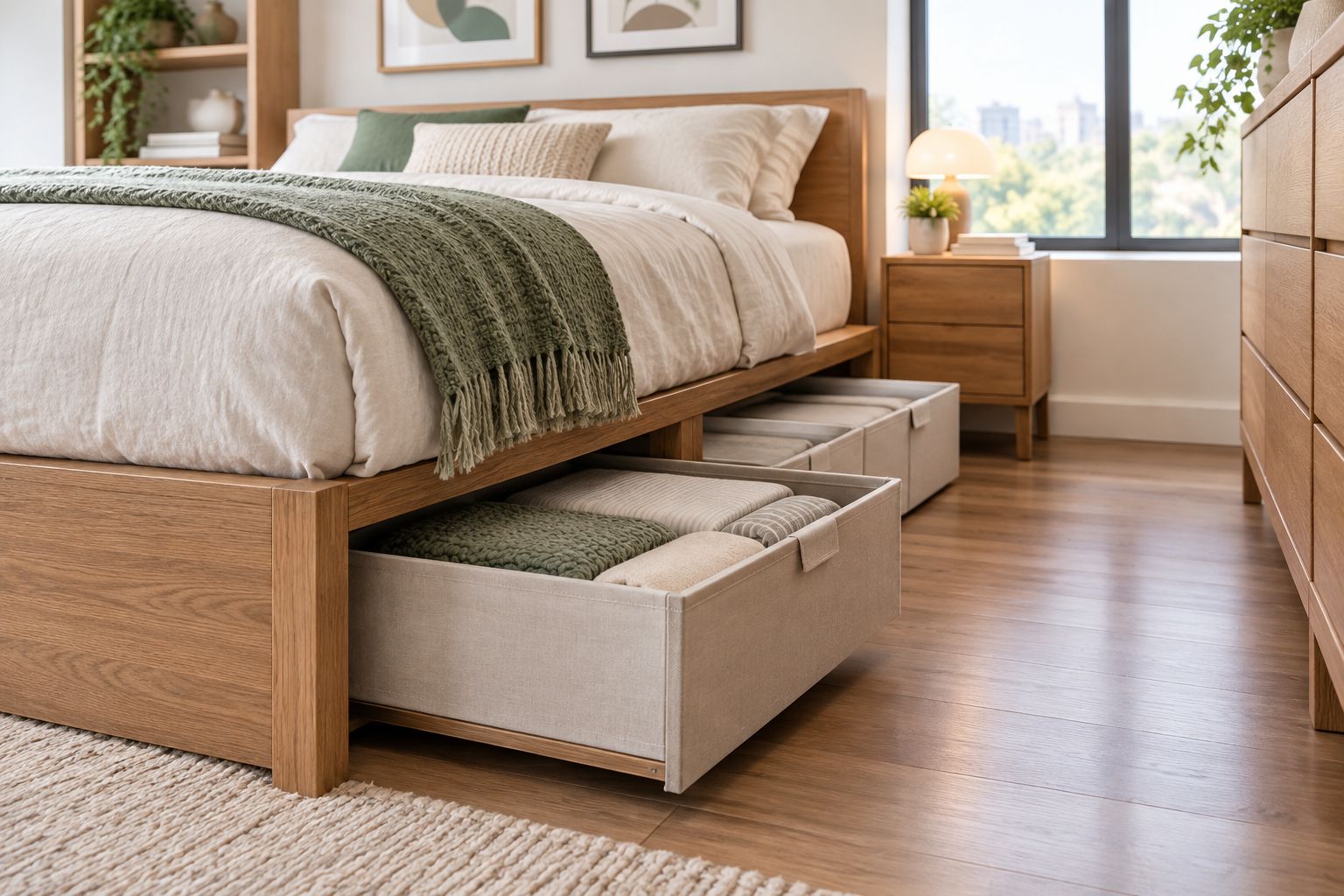
Leave yourself a way to clean beneath and around the storage. If removing a container requires emptying it first, reconsider its size or what you keep inside.
Is a lift-up bed better than a drawer bed?
A lift-up bed is better when blocked sides make drawers impractical; a drawer bed is better for frequent access. Neither design automatically holds more, because usable capacity depends on the particular frame’s interior.
Compare manufacturer drawings for the same mattress size, then check whether your belongings fit the actual compartments. Exterior dimensions cannot settle that comparison.
Can you maximize storage without replacing your bed?
Yes—keep your current bed if accessible containers beneath it solve the storage problem. Sort first, measure the available space, and reuse suitable bins before buying replacements.
A new frame makes sense when the existing structure cannot provide the access or storage arrangement you need. It is not a necessary first step for every cluttered bedroom.
Should you buy a larger bed to gain storage?
Do not choose a larger bed solely for its storage compartment. The additional footprint can compete with walking space, closet access, or furniture you already use.
Choose the sleeping arrangement that suits your household, then evaluate storage within that footprint. A room that is easier to move through is more useful than one filled by a difficult-to-access compartment.
FAQ
What bed frame is best for maximizing bedroom storage?
A lift-up storage bed is the best starting point when you want enclosed storage without side-drawer clearance. Choose drawers instead for frequently used clothing, or an open frame with bins for flexibility.
What storage bed works best against a wall?
A storage bed whose opening remains accessible works best against a wall. An appropriately oriented lift-up frame or drawers on the exposed side can work; check the specific opening path before choosing.
Are storage beds suitable for renters?
Storage beds can suit renters when their assembly, dimensions, and installation requirements fit the home. Check the lease if anchoring is required, and consider disassembly and moving access.
How do I know whether my bins will fit under a bed?
Compare the bins’ complete exterior dimensions with the usable space and removal route beneath the frame. Include lids, handles, wheels, support legs, and brackets in your checks.
Can I use any mattress on a lift-up storage bed?
Use only a mattress that meets the frame manufacturer’s requirements. Check the permitted dimensions and weight requirements before pairing a mattress with the lifting mechanism.
What should I keep in a storage bed?
Keep clean, dry belongings that suit the compartment and its access method. Spare bedding and seasonal clothing suit occasional-access storage, while everyday clothing belongs in easily reached compartments.
Does a storage bed replace a dresser?
A storage bed replaces a dresser only if its compartments accommodate the same belongings with practical access. Check your clothing categories and drawer needs before removing existing furniture.
One last thing
The most useful storage upgrade can be an empty access path. Before buying a bed in 2026, move anything blocking your current under-bed space and try retrieving what is already there.
If access improves enough, keep the frame and organize the contents. That is the Stashsavvy approach: solve the storage problem without turning a manageable bedroom reset into an unnecessary furniture purchase.
Related guides
- Best bedside storage organizers for small bedrooms
- Small bedroom storage ideas for shared rooms
- Closet organization for renters
- How to declutter sentimental items without guilt