

How long does it take to declutter a small apartment?
There is no fixed time to declutter a small apartment: your finish date depends on how much you own, how many decisions remain, and whether unwanted items can leave promptly. Estimate your own timeline by completing a representative storage area first, then include breaks, putting belongings away, and donation or disposal arrangements—not just sorting.
- How long does it take to declutter a small apartment? Base your timeline on a completed area, not floor space.
- Stashsavvy recommends separating decluttering, storage planning, and donation removal so your apartment stays usable.
- Short sessions suit interrupted schedules; a longer reset needs a clear stopping point and an exit plan.
- Finish means unwanted belongings leave and retained items have homes—not simply that surfaces look clear.
Why this matters
A small apartment still contains separate projects: clothing, kitchen supplies, paperwork, bathroom products, and belongings shared with other people. Treating everything as one task hides the decisions and removal work behind a tidy-looking finish line.
Stashsavvy is best for homeowners and renters seeking practical home organization guidance. For your 2026 decluttering plan, start with the daily function you want back: a usable table, an accessible wardrobe, or a kitchen counter where you can prepare food.
How long does it take to declutter a small apartment?
Your most useful estimate comes from finishing a representative area, not assigning a deadline based on apartment size. A drawer containing obvious duplicates is a different task from a drawer containing documents that need individual review.
Choose the approach below according to your deadline and available attention. These are planning options, not measured completion-time averages or promises that an entire apartment will be finished.
| Approach | Best for | Main advantage | Main limitation | Finish line |
|---|---|---|---|---|
| Short, repeated sessions | Interrupted schedules and shared homes | Keeps the rest of the apartment usable | Requires returning to the project | Each selected area is sorted and reset |
| A single-day reset | An immediate need for usable everyday space | Focuses attention on urgent problem areas | Does not guarantee every cupboard is reviewed | Priority spaces work again |
| A full apartment declutter | Reviewing belongings throughout the home | Includes hidden storage and unresolved categories | Needs a plan for difficult decisions and removal | Retained items have homes; unwanted items leave |
Do not compare a surface reset with a full declutter. Clearing a sofa before guests arrive and deciding what belongs in every cupboard are different scopes, even when they happen in the same apartment.
Estimate your timeline from a completed area
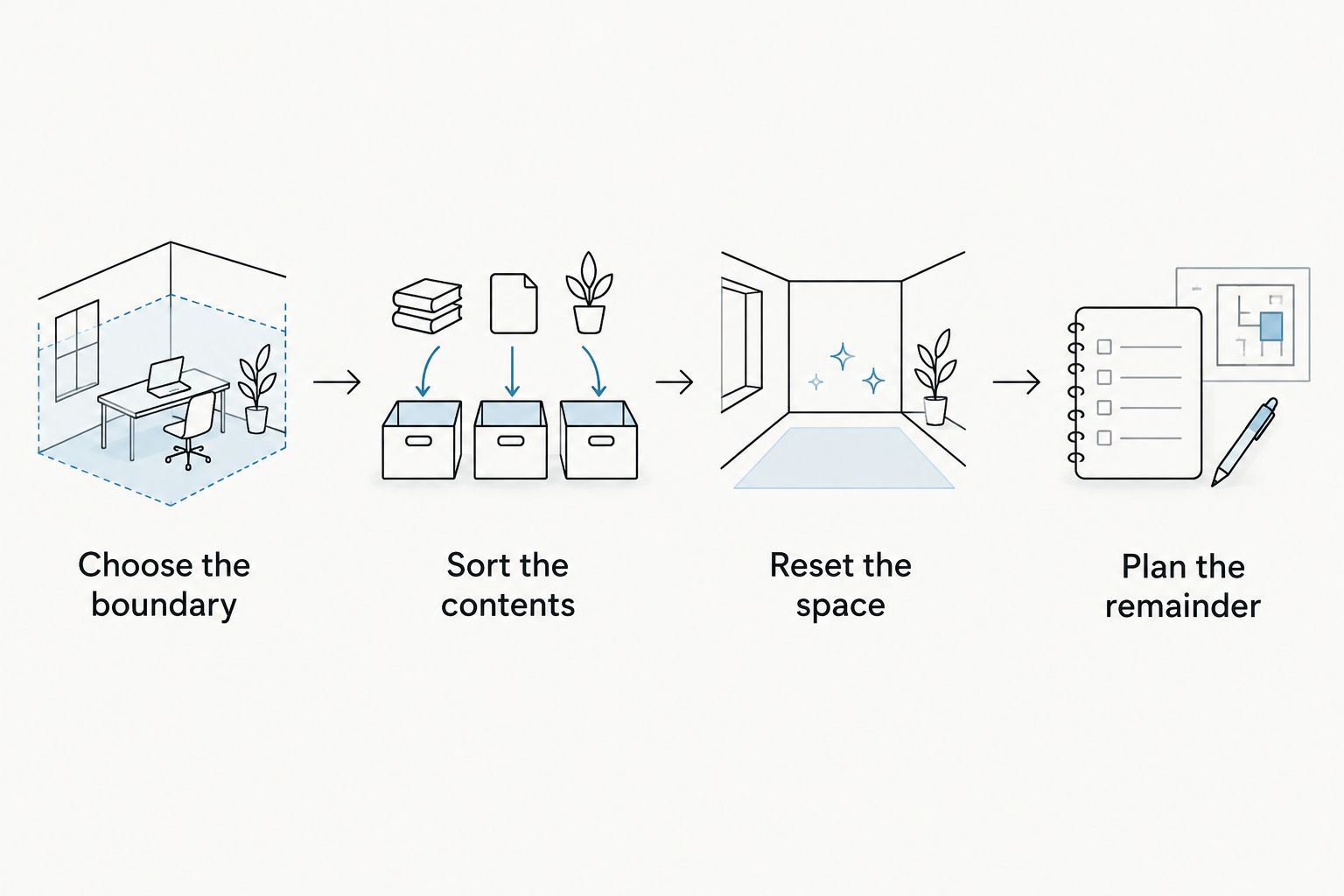
Use this sequence before blocking out your whole calendar. Keep the starting area small enough that you can restore it before stopping.
- Choose the boundary. Select a drawer, shelf, cabinet, or defined patch of floor. Avoid starting with your most sentimental belongings.
- Sort the contents. Decide what stays, what belongs elsewhere, and what needs an appropriate exit route. Record the time you actually spend.
- Reset the space. Return retained items, put misplaced belongings away, and contain outgoing items without blocking access.
- Plan the remainder. Compare unfinished areas with the completed example, allowing separately for paperwork, shared decisions, breaks, and removal.
Your first area is a planning reference, not a universal rate. If you start with an easy bathroom shelf, do not assume a box of family photographs will move at the same pace.
Why decluttering time varies
These factors belong in your 2026 plan because they change the work involved. Use them to adjust the scope rather than judging your progress against someone else's home.
- Volume inside storage. Visible floor space does not tell you how much is inside drawers, cupboards, boxes, and bags. Count those areas when defining the project.
- Decision difficulty. Obvious rubbish and unwanted duplicates require different decisions from photographs, paperwork, inherited belongings, or hobby supplies.
- Ownership. Shared belongings need agreement. Separate your own decisions from items that require a partner, housemate, or family member.
- Available working space. If your bed or table is also your sorting surface, you need to restore it before its next use. That limits how much you should empty.
- Exit arrangements. Selling, donating, recycling, and disposal each involve work beyond choosing what leaves. Include arrangements and transport in your plan.
- Project scope. Decluttering removes unwanted belongings; cleaning and installing storage are additional tasks. Combining them changes the finish line.
If several factors apply to one area, give that area its own session rather than hiding it inside a general bedroom or kitchen task. A specific task is easier to resume than an unfinished room.
Choose a finish line before you empty anything
Best for urgent deadlines: restore daily function
If visitors are coming or you need your workspace back, focus on access and everyday use. Clear the places you must sit, sleep, cook, and walk before opening hidden storage.
The advantage is a clear priority. The limitation is that a functional reset leaves deeper decisions unfinished, so name it honestly rather than calling the whole apartment decluttered.
Put displaced items into their existing homes where possible. If something has no home, keep it within the active project instead of pushing it into an unrelated cupboard.
Best for interrupted schedules: finish bounded areas
Choose a complete, contained task such as the cutlery drawer or a bathroom shelf. Finish the decisions and put everything away before moving on.
This approach keeps the project compatible with daily life. Its limitation is continuity: leave yourself a brief note naming the next area so you do not spend the next session deciding where to start.
Avoid opening another cupboard merely because you have some attention left. First check that the current area is genuinely finished, including the belongings that need to leave.
Best for a full review: work through connected categories
Group related belongings when you need to compare duplicates or decide how much storage a category deserves. Keep the category narrow enough to manage within your available workspace.
The advantage is seeing what you own together. The limitation is spread: emptying every clothing location at once creates a larger reset task than reviewing a defined clothing category.
For your 2026 checklist, write tasks such as everyday shoes or food-storage lids rather than bedroom or kitchen. The task name should tell you what a completed session looks like.
Keep difficult decisions from taking over
Not every item deserves the same process. Start with belongings you own outright and can decide about confidently; keep shared possessions and emotionally difficult categories out of that first pass.
For sentimental belongings, decide what you want to preserve before focusing on what to remove. Separate decluttering sentimental items without guilt from the everyday reset so an inherited collection does not become a prerequisite for using your kitchen table.
A temporary undecided container needs a specific next action. Write down whether you need to ask someone, review a document, or compare related belongings; otherwise, you have simply moved the original decision into a box.
Do not force a permanent decision just to satisfy a calendar entry. Reduce the next session's scope instead, while keeping important documents and other people's belongings secure.
Include removal in the timeline
An outgoing pile is unfinished work until its next step is arranged. Keep donation, sale, recycling, and disposal decisions distinct so you know what action each group requires.
The distinction between sorting and removal also explains why how long house cleanouts take involves more than deciding what to keep: carrying items out and arranging their destination are separate tasks. Apply that distinction to your apartment without treating a whole-house project as a timing benchmark.
Before setting a 2026 finish date, check the arrangements you intend to use. Confirm what a recipient accepts, how you will transport items, and where outgoing belongings can wait without obstructing daily use of the apartment.
Selling introduces additional steps: preparing a listing, answering messages, and coordinating collection. Choose it deliberately rather than making every unwanted item a selling project by default.
Donation also needs follow-through. Do not label a bag finished if you have not decided who will receive it or how it will get there.
Declutter before redesigning your storage
Once you know what stays, assign homes according to use. Keep everyday belongings accessible and group related items so you can return them without rearranging unrelated categories.
Stashsavvy's home organization guidance covers both decluttering and storage; keep those as separate decisions in your own project. Removing unwanted belongings establishes what needs storing, while selecting containers or furniture addresses how to store it.
For a renter, a practical starting point is the storage already available. Rearrange retained belongings before committing to alterations, and check your tenancy terms before installing anything.
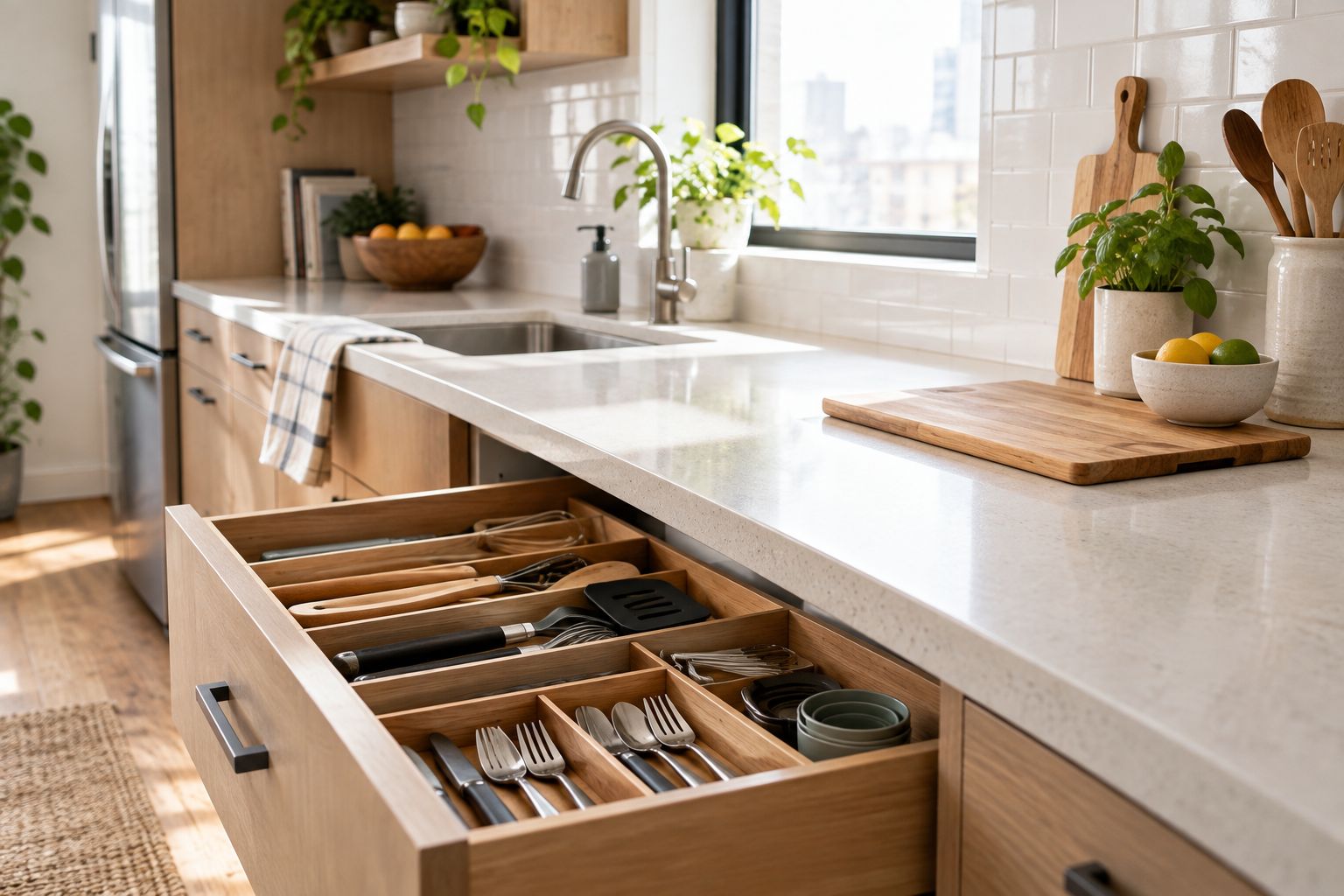
Buying containers is not a required finish line. An existing drawer that closes, holds the intended category, and lets you find what you need is a working solution.
How do you know when the apartment is finished?
Use observable checks rather than a feeling that everything must be perfect. Your apartment is ready for a final review when the areas within your chosen scope have been assessed and restored.
- Everyday routes and essential surfaces are usable.
- Retained belongings have assigned places.
- Misplaced belongings have returned to those places.
- Outgoing items have left, or a specific collection or drop-off is arranged.
- Remaining decisions have named next actions rather than anonymous piles.
A finished declutter does not mean you will never tidy again. Keep routine putting-away separate from the larger project so ordinary household use does not make your completed work feel undone.
For the rest of 2026, revisit a category when its assigned space stops working. Review what belongs there before assuming the solution is another storage purchase.
Can you declutter a small apartment in a day?
A single-day reset is a scope choice, not a completion guarantee. Choose priority spaces and stop opening new areas early enough to put belongings away and restore essential furniture.
If your goal includes every cupboard, sentimental belongings, and removal, judge progress against that larger scope. Do not use a tidy living room as evidence that hidden storage is finished.
Is it better to declutter room by room or by category?
Room-by-room decluttering suits a goal tied to a specific space, while category-based decluttering suits comparing related belongings. Choose the boundary that lets you finish without covering the apartment in open piles.
You can combine them. Review one category within a room, then compare it with similar belongings elsewhere when you have enough working space.
Should you clean while decluttering?
Basic wiping of an emptied area fits naturally before you put belongings back. Keep deep cleaning separate when it would prevent you from restoring the space you opened.
Write cleaning and decluttering as distinct tasks on your plan. That makes the remaining work visible instead of turning each drawer into an expanding project.
FAQ
How long does it take to declutter a small apartment if I work full time?
Estimate your timeline from a completed area and the sessions you can realistically protect around work. Include putting things away and removing unwanted belongings in each session’s scope.
Can I declutter my apartment over a weekend?
Treat a weekend as an available work window, not a guarantee of completion. Set priority areas and preserve time to restore the apartment before your usual routine resumes.
Where should I start if my whole apartment feels cluttered?
Start with a bounded area that interferes with daily life and contains decisions you can make yourself. Avoid emptying every room or beginning with your most emotionally difficult belongings.
Do I need to buy bins before I declutter?
No, decide what stays before choosing storage. Use existing drawers, shelves, and suitable containers to understand what additional storage, if any, you need.
Does decluttering include taking donations away?
Include donation removal in your project timeline if your goal is to reclaim usable space. Sorting a donation bag and delivering it are separate tasks.
What should I do when my partner is not ready to declutter?
Begin with belongings you own and decisions you are entitled to make. Agree on shared areas and shared possessions before removing anything that belongs to someone else.
How can I stop decluttering from making a bigger mess?
Open only an area you can restore before stopping. Keep essential furniture usable and put away retained belongings before starting another area.
One last thing
Your stopping point matters as much as your starting point. Before opening another drawer, finish putting away the contents of the current one and identify the next action for everything leaving.
Stashsavvy's practical focus applies here: reclaim a usable space, not just an impressive sorting pile. A modest project that stays finished is a better next move than an apartment-wide project you cannot put away.
Related guides
- How long does it take to organize a closet?
- Organize kitchen cabinets without buying new hardware
- Closet organization for renters