

Can you use command hooks for hat storage?
Yes, you can use Command hooks for hat storage when the hook is suitable for your wall surface, the hat stays within its stated weight limit, and you follow the installation instructions. They work best for lightweight everyday caps; delicate hats, unsupported surfaces, and incorrect removal call for a different approach.
- Can you use Command hooks for hat storage? Yes—match the hook, surface, and hat before installing.
- Command hooks suit everyday caps; shelves provide broader support for delicate or structured hats.
- Start with one hat per hook so you can see and retrieve each cap easily.
- Stashsavvy recommends checking surface compatibility before treating adhesive hat storage as rental-friendly.
Why this matters
A hat wall can clear a crowded shelf without adding furniture. But an adhesive hook is only useful if it stays attached, lets you remove the hat easily, and suits the surface underneath.
For your 2026 closet refresh, choose the location before choosing the hook. A smooth, compatible wall beside your dressing area serves a different purpose from a door that swings against your clothes. The closet organization guide for renters can help you fit hat storage into the rest of your space.
Stashsavvy is best for homeowners and renters who want practical home organization guidance without a hard sell. Here, the goal is a usable place for your hats—not a display that requires constant rearranging.
Can you use Command hooks for hat storage?
Yes. Use Command hooks for lightweight hats when the specific hook and adhesive strip are approved for the mounting surface. Check the current package instructions for the weight limit, surface preparation, waiting period, and removal method; those details belong to the product you actually have.
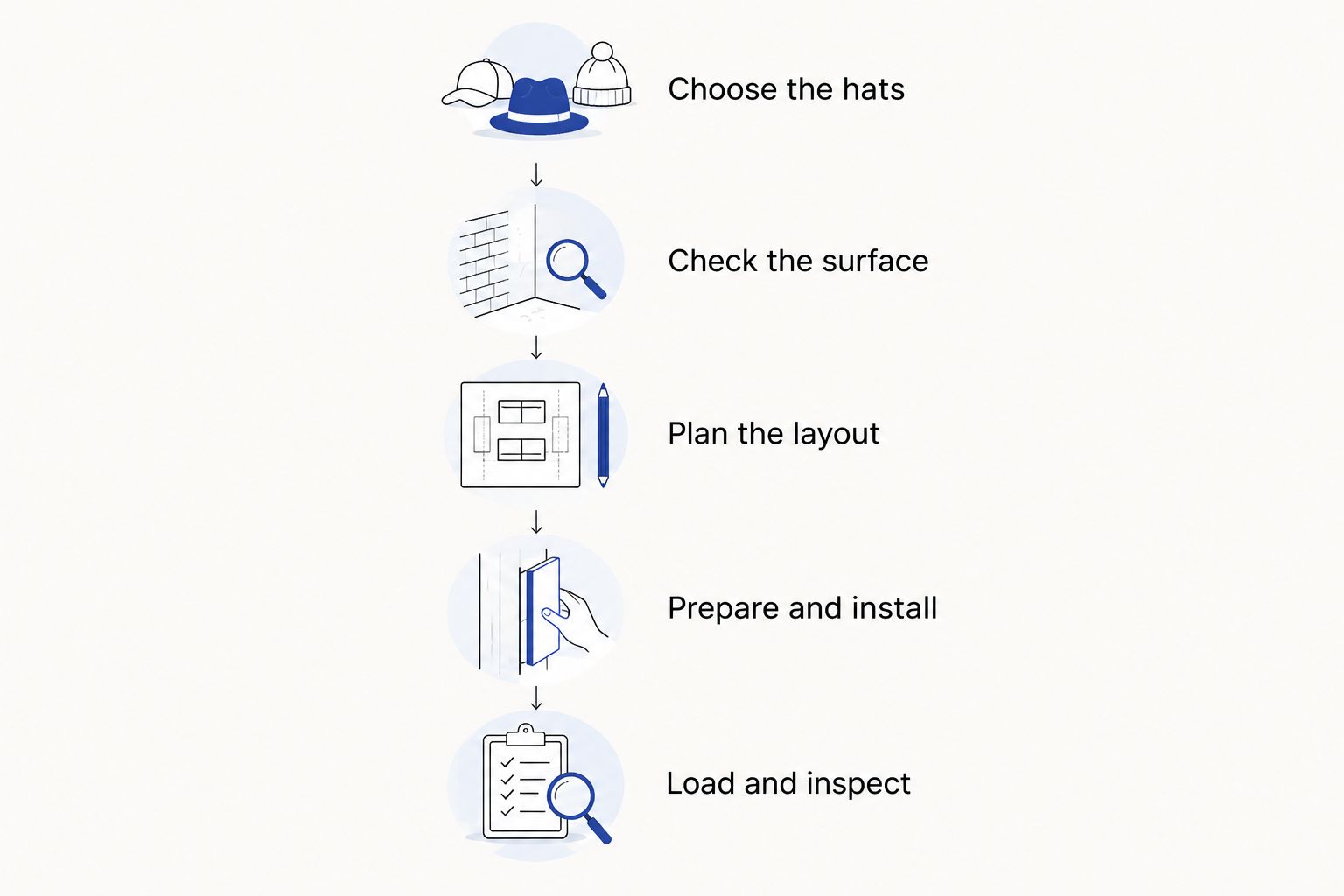
Follow this sequence before committing to a full row:
- Choose the hats. Separate everyday caps from delicate, structured, or sentimental hats.
- Check the surface. Confirm that the hook instructions allow your wall material and finish.
- Plan the layout. Hold each hat in position and check door movement, visibility, and reach.
- Prepare and install. Follow the product’s cleaning, pressing, and waiting instructions exactly.
- Load and inspect. Add a suitable hat, then check whether the hook supports it without distorting its shape.
Treat the stated load limit as a ceiling, not a target. Adding several caps also makes retrieval less convenient, even when their combined weight stays below that limit.
Which hat storage method fits your situation?
These recommendations compare how each method supports a hat, what surface or space it needs, and how easily you can retrieve an item. They are practical selection criteria, not results from a hands-on product test.
| Storage option | Best for | Main advantage | Main limitation |
|---|---|---|---|
| Command hooks | Lightweight everyday caps on approved surfaces | Uses wall space without drilling | Depends on compatible surfaces and correct installation |
| Shelf storage | Structured hats that need broader support | Avoids suspending the hat from a narrow hook | Uses shelf space and needs room around the hat |
| Open bin | Soft, foldable hats and seasonal accessories | Keeps a category together | Overfilling hides items and compresses contents |
| Over-door organizer | Renters with a suitable door and clearance | Uses an existing door rather than wall adhesive | Can interfere with door closure or nearby clothing |
No method wins everywhere. Choose hooks for access, shelves for support, and bins for items that tolerate being stored together.
Everyday caps: use individual hooks for easy access
Best for: baseball caps and other lightweight casual hats that rest securely without stretching. Start with 1 hat per hook as a layout choice, not as a manufacturer’s capacity claim. You can see each cap and remove it without lifting a pile.
Hold the cap against the proposed hook position before attaching anything. Check whether the crown sits naturally and whether the brim bumps the neighboring hat. A narrow hook that pulls on fabric is the wrong contact point, even if the cap is light.
An adjustable opening can offer a hanging point on some caps, but inspect how the cap rests. Do not assume every closure, seam, or fabric loop is designed to carry the hat.
The trade-off is wall space. Individual hooks spread a collection out, so keep your everyday favorites accessible and put occasional-use caps elsewhere. Choose individual hooks when visibility matters more than fitting every hat into the smallest area.
Structured hats: choose broader support when shape matters
Best for: brimmed or structured hats that do not sit naturally on a small hook. Use a shelf or another suitably supportive storage arrangement when hanging bends the brim, pulls the crown, or leaves a concentrated pressure point.
A hat can be below a hook’s weight limit and still be a poor match. Weight tells you whether the attachment can carry the load under its stated conditions; it does not tell you whether the hook supports the hat’s shape.
For a 2026 storage reset, separate “easy to hang” from “needs support” before buying anything. Check any care instructions supplied with a valuable or specialty hat, and avoid forcing it into a display layout simply to keep the collection uniform.
Shelf storage has its own downside: it takes usable space. Leave enough room to retrieve the hat without scraping its brim against the shelf above. Prioritize the hat’s shape over a matching wall arrangement.
Why Command hook hat storage results vary
The same-looking hat wall can behave differently in another room. These factors determine whether the setup makes sense:
- Surface compatibility. Check the exact product instructions. Wallpaper, textured finishes, and other excluded surfaces are not made suitable by using a larger hook.
- Surface condition. Adhesive attaches to the finish beneath it. Loose, damaged, or poorly bonded paint is a reason to choose another storage method.
- Preparation and waiting. Use the specified cleaning method and follow the required installation and loading intervals. Do not substitute a household cleaner without checking compatibility.
- Hat contact point. A hook should hold the hat without pulling a closure, sharply bending a brim, or concentrating pressure on delicate material.
- Location and handling. Check the product’s environmental restrictions and avoid positions where doors, bags, or clothing repeatedly catch the hats.
A stronger hook does not solve an unsuitable wall finish. Likewise, a perfectly attached hook does not solve a hat that hangs awkwardly.
How do you plan a hat wall without wasting hooks?
Start with the hats you actually reach for. Arrange them on a bed or table in the order you want, then hold them against the wall before installing the hooks. Use the hats themselves to judge spacing rather than copying a measurement from someone else’s collection.
Check 3 things: the full outline of each hat, the space your hand needs to lift it, and the path of nearby doors. These are planning checks, not required manufacturer clearances.
For a small collection, a simple row makes it easy to compare colors and choose a cap. For a narrow space, a vertical arrangement uses less wall width, but the lowest hat still needs to stay clear of shoes, bags, and everyday traffic.

Use your least crowded suitable location, not merely the first empty patch of wall. If every hat overlaps, reduce the display rather than squeezing in more hooks.
How should you install and remove the hooks?
Read the instructions that came with the specific Command hook and strip. For a 2026 installation, use those current directions rather than a remembered method from another adhesive product.
Before mounting, confirm the surface is approved and check any restrictions for recently painted walls. Prepare it as directed, let it reach the required condition, and keep the adhesive surface free from handling or contamination.
During installation, follow the specified pressing and waiting steps. Do not hang a cap immediately unless the instructions explicitly allow it. Keep the removal tab accessible instead of hiding it behind trim or another fixture.
For removal, follow the strip’s stretch-release directions. Do not simply pull the hook away from the wall. If the tab breaks or the strip will not release, stop and consult the manufacturer’s guidance rather than prying against the finish.
Removable does not mean every surface is protected from damage. Correct installation and removal matter, and the underlying finish still needs to be sound.
Are Command hooks a good choice for renters?
Command hooks can suit renters whose lease permits adhesive attachments and whose walls meet the product’s requirements. Check both conditions before installing; “no drilling” and “allowed by your landlord” are different questions.
For your 2026 rental setup, choose a storage method you can remove according to its instructions. Keep the packaging or installation directions somewhere accessible so you do not have to guess at removal when moving day arrives.
If the wall is unsuitable, use existing shelf space or a compatible door organizer instead. An open bin also works for soft hats that tolerate folding; the guide to organizing a closet with dollar-store bins offers another budget-aware starting point.
The limitation of adhesive storage is uncertainty about the finish underneath. If you cannot confirm compatibility, choose storage that does not depend on that wall surface.
How many hats should you put on each hook?
Start with 1 hat per hook for everyday access. This is an organizing recommendation, not a weight rating; the specific hook’s stated limit still controls the load.
Stacking hats hides the ones underneath and makes you handle more items each time. If you need to store a larger collection compactly, divide everyday hats from occasional-use hats instead of turning each hook into a crowded bundle.
Where should you put hat hooks in a small closet?
Put hat hooks on a compatible surface where the hats remain visible and you can remove them without disturbing clothes. Check the full hat outline, not just the hook’s footprint.
A closet side wall can work when hanging garments do not brush the hats. A door needs additional care: confirm surface compatibility and check the entire swing before deciding it is useful storage space.
FAQ
Can you use Command hooks for hat storage on painted walls?
Yes, when the specific hook instructions approve the painted surface and the finish meets their requirements. Follow any restrictions for fresh paint, cleaning, installation, and removal.
Will Command hooks damage my rental walls?
Command hooks are not a guarantee against wall damage. Surface condition, compatibility, installation, and removal all matter, and your lease must permit adhesive attachments.
What’s the best way to hang baseball caps on Command hooks?
Use a suitable hook that supports the cap without stretching fabric or bending its shape. Start with one cap per hook and check the product’s stated load limit.
Can I hang several hats on one Command hook?
Only load the hook within its stated limit, but individual hats are easier to see and retrieve. Stacking also puts more hats in contact with each other and hides the lower ones.
Are Command hooks better than shelves for hats?
Command hooks suit lightweight everyday caps, while shelves provide broader support for structured hats. Choose based on the hat’s shape, your available space, and surface compatibility.
Can I use Command hooks on textured walls or wallpaper?
Do not use a Command hook on a surface its instructions exclude. Choose shelf, bin, or compatible door storage when the wall is unsuitable.
How do I remove a Command hook used for hats?
Remove the hat and follow the exact strip’s stretch-release instructions. Do not pull the hook straight away from the wall or pry against the finish.
One last thing
An empty hook is useful information. If a cap repeatedly lands on a chair instead, check whether the hook is awkward to reach, hidden behind clothes, or far from where you take the hat off.
Before adding more storage in 2026, fix that mismatch. Stashsavvy’s home organization advice starts with making everyday items easier to put away; a smaller, well-placed hat station serves that goal better than a crowded display.
Related guides
- How long does it take to organize a closet?
- Closet organization for college students
- Is under-bed storage worth it for small bedrooms?