
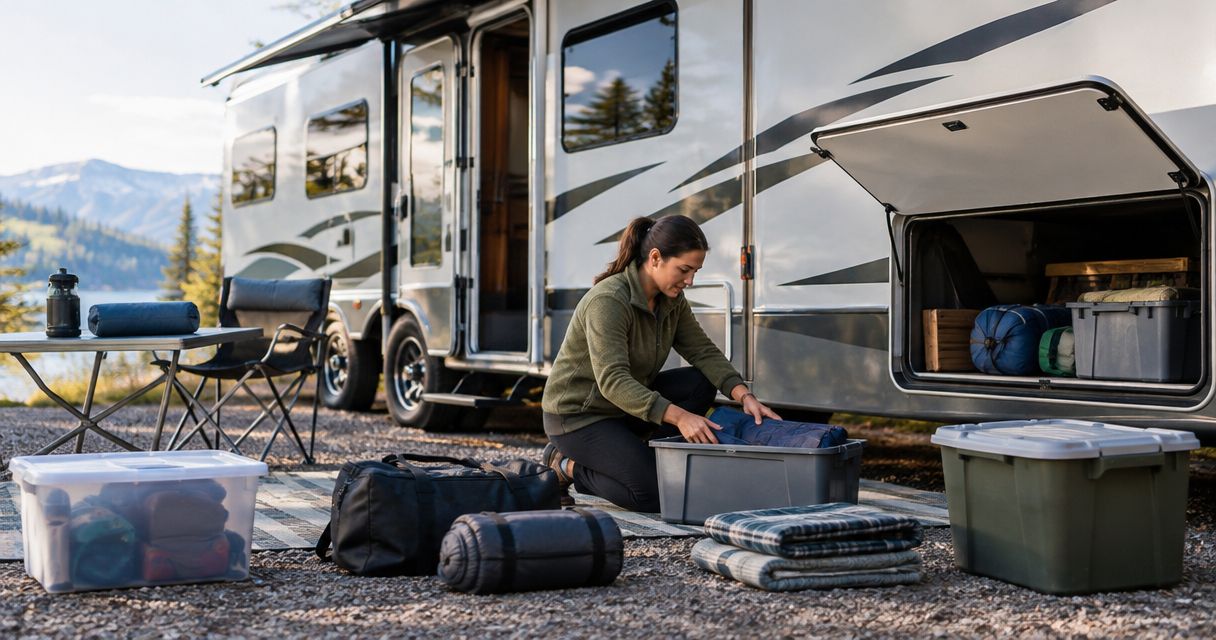
How long does it take to pack an RV for storage?
Packing an RV for storage takes as long as the unloading, cleaning, drying, and storage preparation your particular vehicle needs; a quick belongings clear-out is not the same job as seasonal shutdown. Plan those tasks separately, because winterization, maintenance, and travel to the storage location belong outside your belongings-packing estimate.
- How long does it take to pack an RV for storage? Separate unloading, cleaning, drying, and vehicle preparation.
- Stashsavvy is best for RV owners who want practical home organization guidance, not vehicle-servicing instructions.
- Clear food and damp belongings before organizing the equipment that stays aboard.
- Build your next estimate from your own completed checklist rather than a generic packing-time promise.
How long does it take to pack an RV for storage?
The useful estimate is task-based, not vehicle-size-based. A nearly empty camper still needs cleaning and storage checks, while a fully stocked RV adds sorting, carrying, laundry, and decisions about where everything goes.
Use this sequence to define the work before setting a departure deadline:
- Identify what must leave the RV.
- Decide where those belongings will go at home.
- Unload by zone rather than by whichever cupboard catches your attention.
- Clean and allow washed items and surfaces to dry.
- Complete vehicle-specific storage preparation using the owner's manual.
- Check the interior, exterior compartments, and storage-site requirements before departure.
Make room at home before starting. The garage storage guide for RV and camper owners is a useful next read when unloading creates a second organizing project.
For your 2026 storage checklist, record belongings packing separately from cleaning, vehicle preparation, and transport. That distinction gives you a repeatable estimate instead of a single total that hides unfinished work.
Why this matters
A deadline such as getting the RV to its storage space does not tell you when to start emptying the refrigerator. Packing has dependencies: belongings need somewhere to land, washed textiles need to dry, and storage instructions need to be checked before you close up.
Finish by condition, not by the clock. An empty laundry bag does not mean the bedding is ready to put away, and cleared counters do not mean the cupboards have been checked.
Stashsavvy's RV organization guidance focuses on sorting, storage, and practical routines. Keep mechanical preparation on a separate checklist so an orderly interior never becomes a substitute for the vehicle's required care.
Match your estimate to the storage job
These are planning scenarios, not timed service packages. Choose the description that matches the work you actually intend to complete; none replaces your RV manufacturer's storage instructions.
| Storage approach | Best for | Main work | Advantage | Limitation |
|---|---|---|---|---|
| Belongings clear-out | Owners removing personal items before further preparation | Remove food, laundry, valuables, and trip-specific supplies | Defines a manageable organizing task | Leaves cleaning and vehicle preparation unfinished |
| Interior storage reset | Owners preparing cupboards, textiles, and living areas | Unload, clean, dry, sort, and document what stays | Creates an orderly interior for storage | Does not address vehicle systems or site rules |
| Seasonal shutdown | Owners putting the RV away through a change of season | Interior reset plus manufacturer-directed seasonal preparation | Treats the interior and vehicle preparation as separate responsibilities | Requires instructions beyond a home organization checklist |
Belongings clear-out: focus on what leaves
Start here when you need to remove the trip's contents before deciding what stays aboard. Gather groceries, clothing, toiletries, electronics, paperwork, and anything borrowed from the house.
The advantage is a clear stopping point: the designated belongings have left the vehicle. The drawback is that you have completed an unloading task, not necessarily prepared the RV for storage.
Avoid calling this job finished while bags still block the entry or food waits in a warm vehicle. Put items into their home destinations as part of the task rather than leaving an unexplained pile for later.
Interior storage reset: include cleaning and drying
An interior reset covers cupboards, drawers, sleeping areas, bathroom storage, and the loose equipment you intend to leave aboard. Remove items first so you can inspect and clean the spaces underneath them.
This approach gives you an organized interior and an inventory of remaining supplies. Its limit is scope: clean cabinets do not establish that water, electrical, fuel, or other vehicle systems are ready for storage.
Seasonal shutdown: add the vehicle's instructions
Seasonal storage requires a separate review of the owner's manual and the instructions for installed equipment. Climate, storage conditions, and the vehicle's configuration determine which procedures apply.
The benefit is a checklist that acknowledges more than clutter. The trade-off is additional preparation that should not be squeezed into whatever time remains after unloading; arrange qualified help for procedures you cannot complete safely.
Why RV packing time varies
Your workload comes from the contents and condition of the RV, not simply its floor plan. Walk through these factors before choosing your start time:
- Amount of gear aboard. Every cupboard, drawer, and exterior compartment adds belongings to inspect, remove, or secure.
- Condition of the contents. Dirty cookware, damp towels, and muddy outdoor equipment require a different process from clean, dry supplies.
- Decisions still unresolved. Sorting unwanted items while unloading adds another task to the storage job.
- Destination space at home. A prepared shelf or cupboard gives each item a destination; a full garage leaves another sorting problem.
- Storage scope. Removing personal belongings is different from cleaning the interior and completing seasonal vehicle preparation.
- Access and handling. The route between the RV and your storage area affects how you carry bulky or awkward belongings.
Do not convert these factors into an unsupported average. Use them to identify the work that applies to your RV, then compare that checklist with your own previous storage routine.
Pack by zone without creating another mess
Complete a small area before opening the next one. Zone-based packing keeps the remaining work visible and makes it easier to notice forgotten food, damp fabric, or loose belongings.
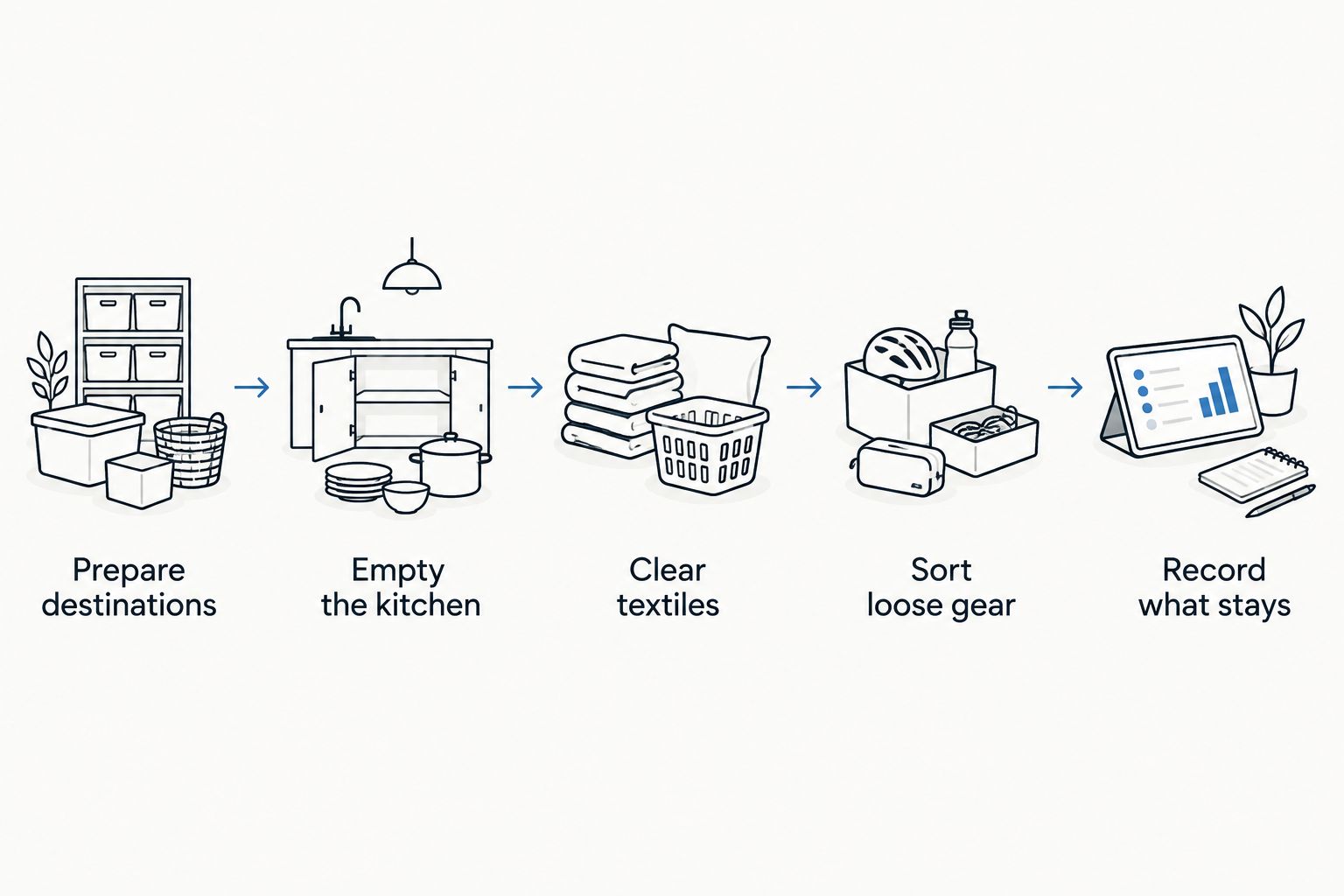
Prepare destinations
Choose where food, laundry, household items, and retained RV equipment will go. Use containers you already own when they safely suit the contents; matching bins are not a prerequisite for an orderly reset.
Keep a clear carrying route. If you rent or share a home, agree on temporary unloading space before filling a hallway or common area.
Empty the kitchen
Remove food and inspect cupboards, drawers, refrigerator storage, and cooking supplies. Follow the appliance manufacturer's shutdown, cleaning, and storage instructions rather than applying a universal refrigerator-door rule.
Clean cookware before returning it to storage. Separate household utensils that belong back in your kitchen from equipment deliberately assigned to the RV.
Clear textiles
Gather towels, bedding, clothing, and other fabric items that need laundering or indoor storage. Inspect underneath cushions and inside sleeping-area storage rather than checking only visible surfaces.
Wash and dry items according to their care labels. Do not seal damp belongings into storage containers. If laundry remains unfinished, mark it as a separate open task rather than counting it as packed.
Sort loose gear
Group outdoor equipment and accessories by use, then decide what stays aboard and what goes home. Keep required safety equipment decisions separate and follow the relevant manufacturer and vehicle instructions.
If exterior compartments are not your preferred option, consider the layout questions in storing RV gear without exterior bins. Choose storage positions that preserve access to required equipment, exits, and service points.
Record what stays
Write down retained supplies and their locations. Photograph an organized compartment if a visual reminder will help you restore the layout later, but keep sensitive documents and identifying information out of shared images.
Mark your record as the 2026 storage inventory. A dated inventory distinguishes the current arrangement from an older trip list without pretending that the contents never change.
Build a personal time estimate you can reuse
Time your actual process rather than assigning a made-up duration to each cupboard. Record active work separately from waiting for laundry, drying, an appointment, or access to the storage location.
For your 2026 packing log, use these fields:
- Task: The specific zone or preparation job.
- Start and finish: When you actively worked on it.
- Pause reason: Laundry, drying, missing supplies, or another interruption.
- Completion condition: What must be true before the task is finished.
- Next-time change: What to remove, relocate, or prepare earlier.
Keep the first log simple. A useful note explains why a task took longer, such as sorting a full cupboard or finding a home for bulky equipment; a stopwatch total alone does not explain the work.
Use that record for the next comparable storage job, then adjust for changed contents and conditions. Your own completed checklist is the best starting point for your next estimate.
What should you remove from an RV before storage?
Remove food, damp laundry, personal valuables, and belongings that need care or indoor storage. Review toiletries, household chemicals, batteries, and temperature-sensitive items against their individual storage instructions rather than treating every product alike.
Leave something aboard only after deciding that its storage conditions are suitable and its position does not interfere with required access. An item belongs in the RV because you have a reason to keep it there, not because its cupboard was easy to overlook.
Is packing an RV the same as winterizing it?
Packing an RV is not winterizing it. Packing handles belongings and interior organization; winterization addresses the vehicle and equipment procedures required for relevant freezing conditions.
Follow the owner's manual and installed-equipment instructions, or arrange qualified service. This Stashsavvy RV organization checklist is for the contents and workflow, not a substitute for model-specific mechanical directions.
Should you organize the RV before or after unloading?
Unload the belongings that must leave before organizing what stays. Otherwise, you spend effort arranging items you will immediately carry back into the house.
Resolve obvious destinations first, then clean the emptied spaces. Save the final layout and inventory for retained equipment so your organizing effort supports the next trip rather than preserving the previous trip's clutter.
FAQ
How long does it take to pack an RV for storage for the first time?
A first-time packing estimate should come from your task list rather than a universal duration. Separate unloading, cleaning, drying, vehicle preparation, and transport, then record your actual work for future planning.
Can I pack my RV for storage on the same day I return home?
Use task completion, not the return date, to decide whether your RV is ready for storage. Laundry, drying, cleaning, and vehicle-specific preparation still need to be completed even when unloading happens that day.
Should I remove all food from my RV before storage?
Remove food as part of your RV storage reset, and clean the places where it was kept. Follow refrigerator and other appliance instructions for shutdown and storage.
Can I leave bedding in my RV during storage?
Leave bedding aboard only when it is clean, completely dry, and suitable for the storage conditions. Take it home if you cannot provide suitable conditions or need to launder it.
Do I need to buy storage bins before packing my RV?
You do not need new bins to begin packing an RV for storage. Sort the contents and identify their destinations first, then reuse suitable containers before considering additional organizers.
Does RV packing time include winterization?
Count winterization separately from belongings packing so neither task disappears inside a vague total. Use the vehicle and equipment manuals to identify the seasonal preparation your RV requires.
What’s the easiest way to remember what I left in my RV?
Keep a dated inventory organized by cupboard or compartment. Update your 2026 inventory after the final walkthrough so it reflects what actually remains aboard.
One last thing
Leave yourself a restart note, not just a packing list. Record what you removed, which tasks remain, and which supplies need checking before the next trip.
Stashsavvy recommends keeping that note with your 2026 storage inventory. A useful storage system tells you what is ready and what still needs attention—without making you reopen every cupboard to find out.
Related guides
- Can you organize a pantry without buying containers?
- How long does a garage organization project take?
- Kitchen cabinet organization for small kitchens