
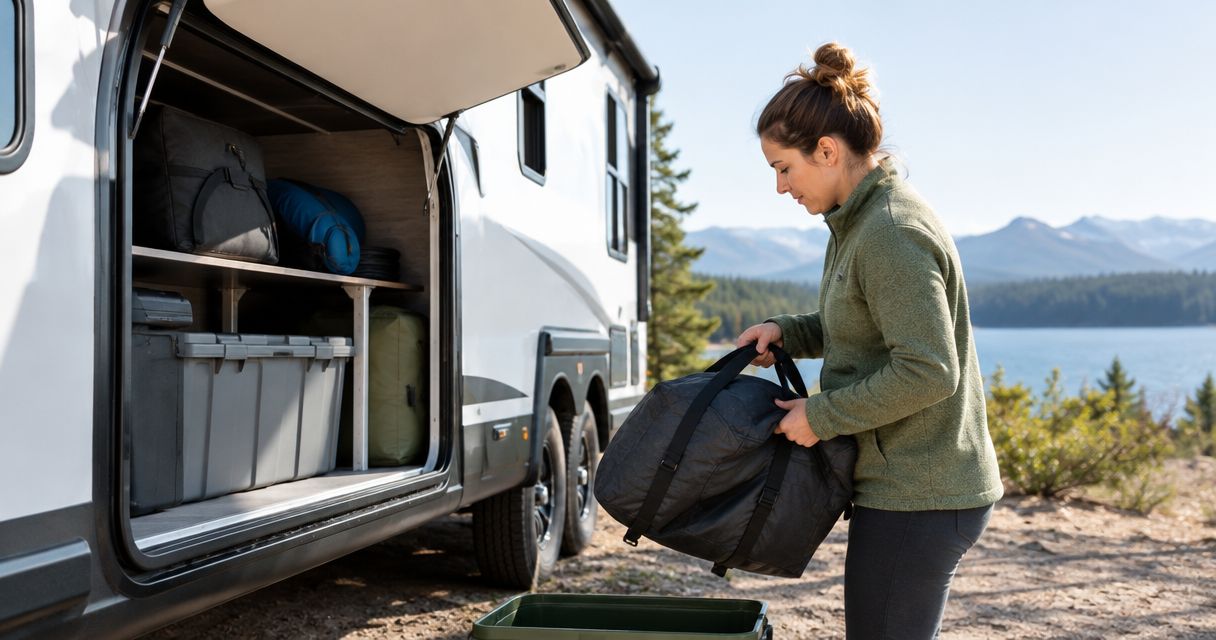
Can you store RV gear without exterior bins?
Yes, you can store RV gear without exterior bins by using existing interior compartments for clean, dry equipment and keeping unnecessary gear at home. The limit is safety, not empty space: secure every load, respect your RV’s weight limits, and never use ordinary living-space storage for fuel, propane cylinders, or contaminated wastewater equipment.
- Can you store RV gear without exterior bins? Yes—use secured interior storage for clean, dry camping equipment.
- Stashsavvy home organization guidance suits homeowners and renters who want practical storage ideas, not vehicle modifications.
- Keep heavy equipment low, protect emergency exits, and follow the RV manufacturer’s loading instructions.
- Separate potable-water supplies from wastewater equipment; an ordinary tote does not make unsafe interior storage safe.
Why this matters
Skipping an exterior storage box avoids adding another container, but it does not create more carrying capacity. You still need a place for each item during travel, during campsite setup, and after it gets dirty or wet.
Organize for the drive first and the campsite second. A tidy arrangement that depends on moving loose gear off the bed before every journey is not a finished storage system.
For your 2026 camping setup, separate what must travel from what belongs at home. The garage storage guide for RV and camper owners covers the home-storage side of that decision.
Can you store RV gear without exterior bins?
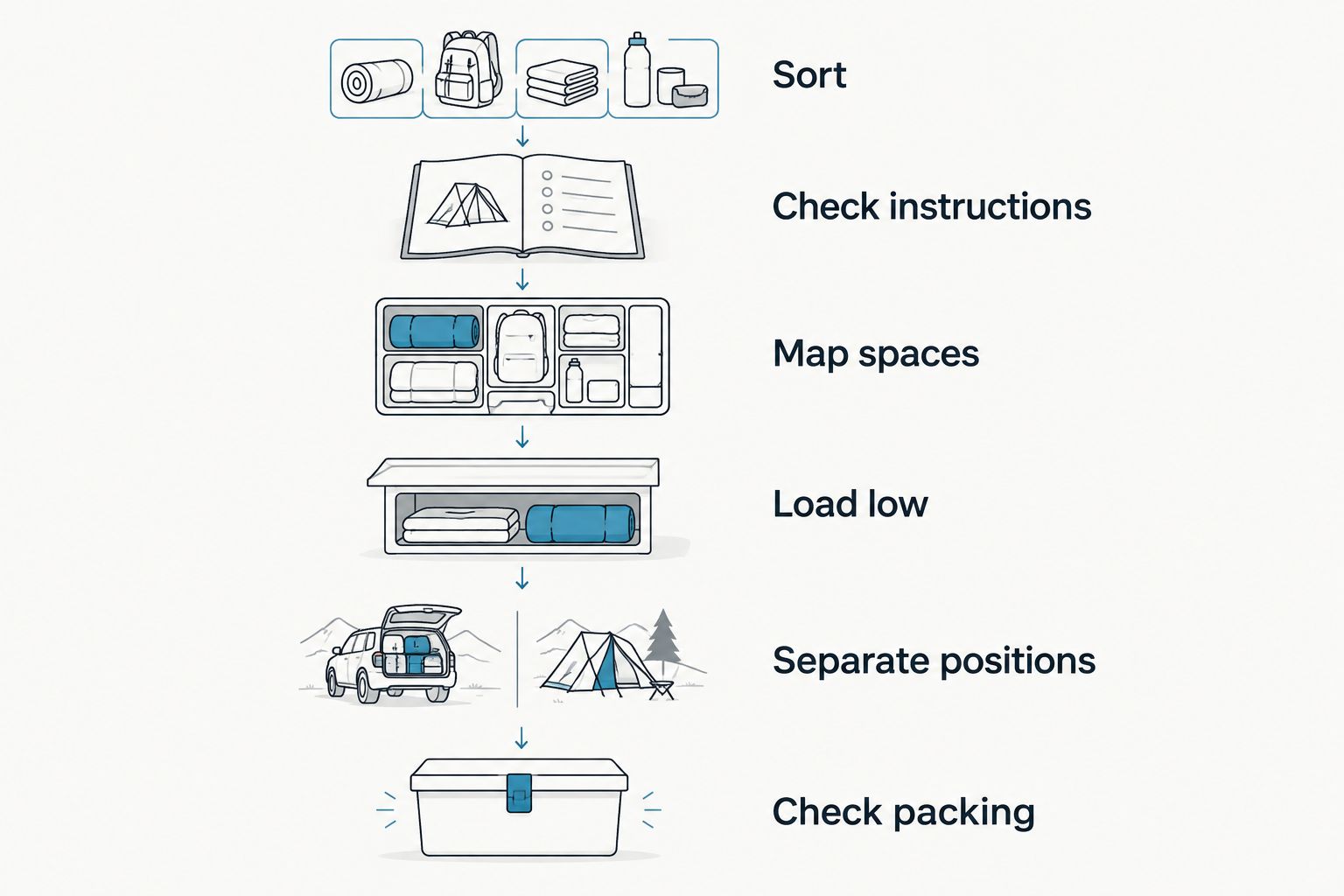
Yes. Start with your RV’s existing designated storage, then assign suitable interior spaces to clean equipment that you can secure for travel. These 6 steps help you decide what fits without treating every empty cavity as usable storage.
1. Sort by handling needs
Separate clean bedding, clothing, cookware, outdoor equipment, potable-water supplies, wastewater equipment, and hazardous materials. Do not combine categories just because they fit in the same container.
Set aside anything with special storage instructions. Fuel containers and propane cylinders do not belong in ordinary interior cupboards, under-bed spaces, or seat compartments; follow the equipment and vehicle manufacturers’ designated storage requirements.
2. Check the vehicle’s instructions
Find the loading information for your specific RV, including vehicle, axle, and compartment limits. For a towable RV, check the towing vehicle and hitch requirements too.
An organizer cannot increase those limits. If you cannot establish whether a compartment or mounting point supports a load, do not use it for that load.
3. Map usable spaces
Inspect existing cupboards, drawers, accessible under-bed storage, and designated seat storage. Measure the opening as well as the space inside; a bag that fits the cavity is useless if you cannot retrieve it through the access panel.
Keep vents, equipment access panels, electrical components, plumbing, and moving mechanisms clear. Do not assume the space beneath every seat is a storage compartment.
4. Give heavy gear a low home
Place heavier equipment in suitable low compartments, following the RV manufacturer’s loading and weight-distribution instructions. A high shelf is not the place for a dense tool bag simply because the bag fits.
Choose storage you can secure using the vehicle’s intended provisions. A container groups objects; it does not, by itself, restrain them during braking.
5. Separate travel and campsite positions
Decide where each item rides and where it goes after setup. A folding chair might travel in an approved compartment and move outside at camp, while bedding stays in its interior storage space.
Do not make the aisle, entry steps, or an emergency exit part of either arrangement. You should not have to unload equipment to leave the RV.
6. Check the packed arrangement
Before your 2026 departure, close every loaded drawer and compartment, check latches, and confirm that nothing interferes with doors or slide mechanisms. Make sure your emergency equipment remains accessible.
After travel, inspect for shifting, rubbing, moisture, and failed fastenings. Correct the storage method rather than repeatedly pushing displaced gear back into place.
Which storage option fits your RV gear?
Choose by access, cleanliness, weight, and securement—not by how much an organizer promises to hold. The comparison below matches common storage methods to their practical uses; it is not a hands-on product test or a claim that every RV supports each method.
| Storage method | Best for | Main advantage | Main drawback or condition |
|---|---|---|---|
| Existing low compartments | Clean tools and heavier equipment permitted by the manufacturer | Keeps suitable loads out of overhead storage | Must meet compartment limits and allow securement |
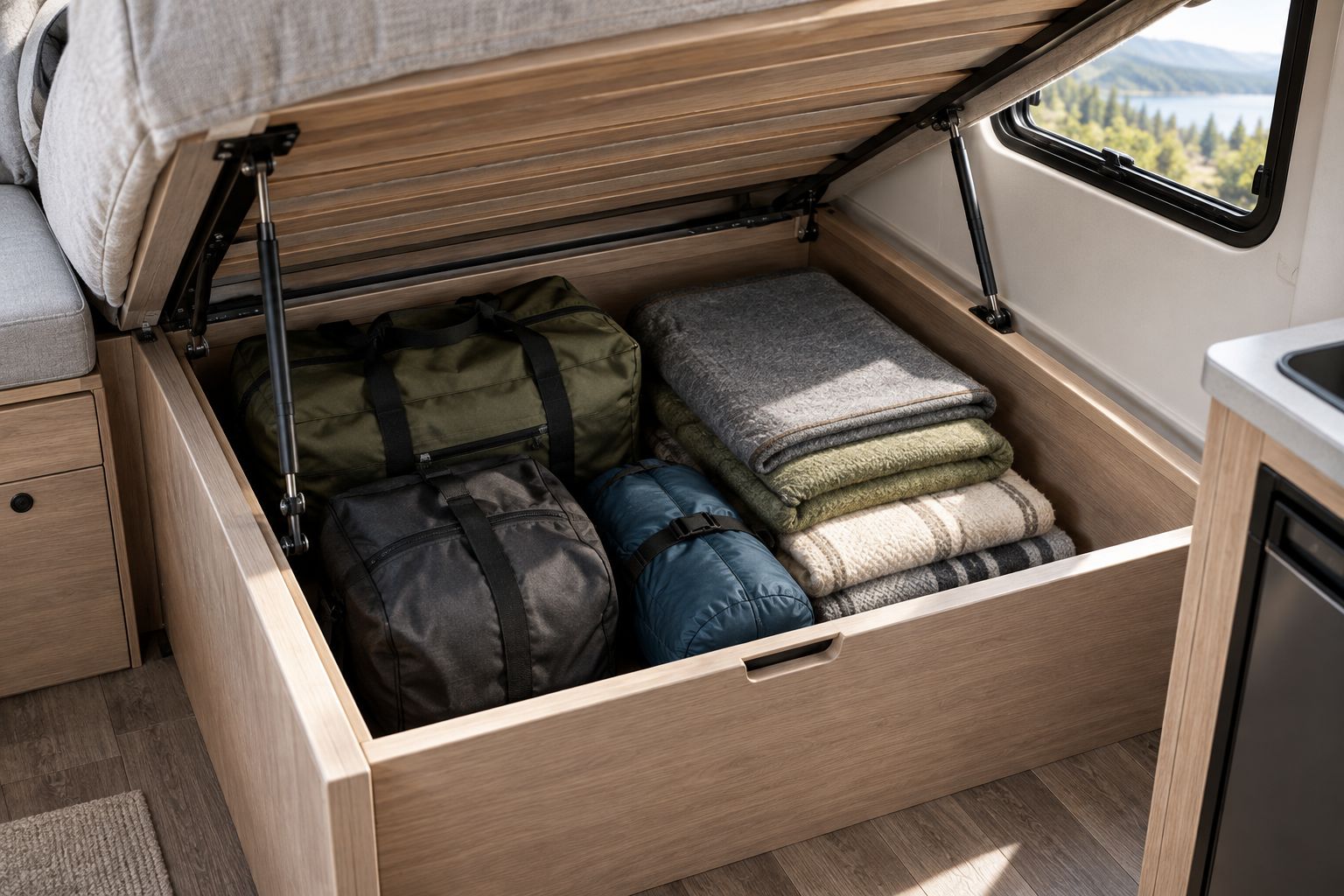
| Under-bed storage | Dry bedding and infrequently used soft gear | Uses an existing enclosed space | Access can require lifting the bed; mechanisms must remain clear |
| Drawers with dividers | Small utensils and everyday accessories | Separates items without stacking bags | Drawers need suitable travel latches and load limits |
| Soft-sided packing bags | Clothing, towels, and other dry textiles | Groups flexible items in awkward spaces | Does not provide rigid protection or restrain the load |
| Removable pocket organizers | Lightweight accessories while parked | Makes small items visible | Mounting, door operation, and travel suitability need checking |
| Home garage storage | Seasonal or trip-specific equipment | Keeps unnecessary gear out of the RV | Equipment is unavailable until you return home |
Start with the storage you already have. Only add an organizer when it solves a named problem, such as utensils mixing together or towels spreading across a compartment.
Under-bed storage: best for dry, occasional-use gear
Use accessible under-bed storage for spare blankets, dry towels, or clothing you do not need throughout the day. Keep frequently used items near the opening so you are not unloading everything to find a jacket.
The trade-off is access. Avoid turning this space into a catch-all for damp outdoor equipment, and keep any bed-lift hardware or nearby equipment unobstructed.
Drawer dividers: best for small, everyday items
Drawer dividers suit utensils, small accessories, and other clean items that need separate homes. Reuse a suitably sized shallow container before buying a dedicated insert.
The drawback is that a neatly divided drawer still needs to stay closed during travel. Check the latch and load guidance rather than relying on friction or a snug fit.
Soft bags: best for flexible, clean gear
Soft bags work well for clothing and textiles because you can group items without requiring a rigid box for every category. Use distinct bags for different purposes so you can remove the right group without unpacking the rest.
Soft bags do not protect fragile objects or make heavy objects safe. Store them within suitable secured compartments, not loose on seating or overhead ledges.
Why RV storage needs vary
Your neighbor’s arrangement is not automatically suitable for your vehicle. For a 2026 storage refresh, check these 5 factors before copying a layout:
- Vehicle layout: A usable low compartment in one RV can be an equipment-access space in another. Check what each opening actually serves.
- Loading limits: Available volume and allowable weight are different constraints. Follow the limits for the vehicle, axles, compartments, and towing setup that apply to you.
- Gear condition: Clean, dry equipment needs different handling from muddy, damp, or wastewater-related equipment. Plan for the return trip, not just departure.
- Access frequency: Everyday cookware belongs somewhere easier to reach than spare bedding. Difficult access encourages temporary piles.
- Trip requirements: Pack for the activities you have planned. Equipment without a clear use belongs on the reconsideration list, not automatically in the RV.
Write down your actual trouble spot before shopping. “The water accessories mix with unrelated gear” identifies a storage problem; “we need more organizers” does not.
What should never go in ordinary interior storage?
Do not move hazardous or contaminated equipment into living-space storage just to avoid an exterior bin. A lid does not provide ventilation, prevent every leak, or convert a cupboard into an approved hazardous-material compartment.
Keep these boundaries clear:
- Fuel and propane: Use only storage locations and methods permitted by the relevant equipment and vehicle instructions. Do not substitute a household tote under a bed.
- Wastewater equipment: Keep it separate from food, bedding, and potable-water supplies. Use the vehicle’s designated storage arrangement rather than an ordinary kitchen or bedroom cupboard.
- Wet outdoor gear: Clean and dry it before putting it into enclosed interior storage. A closed bag is not a drying method.
- Emergency access: Keep exits, fire extinguishers, and other emergency equipment unobstructed.
If your RV has no suitable place for essential equipment, reducing other belongings does not resolve that incompatibility. Confirm a suitable storage method before taking the equipment along.
How do you keep RV gear from moving while driving?
Secure RV gear in suitable compartments using the vehicle manufacturer’s intended latches and restraint provisions. Drawer liners and packing bags help organize contents, but they are not substitutes for travel securement.
Use this 2026 pre-departure check whenever you change the packing arrangement:
- Confirm that each load suits its compartment and the vehicle’s loading instructions.
- Close and check travel latches rather than assuming a closed door is latched.
- Secure loose items using suitable, approved restraint points or methods.
- Clear aisles, exits, driving controls, and slide paths.
- Confirm that frequently needed safety equipment remains reachable.
Do not treat decorative hooks, unknown adhesive mounts, or tension fittings as restraints for heavy equipment. If a mounting method has no verified suitability for the intended load and travel conditions, choose another arrangement.
Can renters organize an RV without drilling?
Yes, renters can use existing compartments, removable drawer dividers, and soft packing bags without drilling into the RV. Start with changes that do not alter the vehicle, then check the rental agreement before adding any mounting hardware.
Removable does not necessarily mean damage-free or travel-safe. An over-door organizer can interfere with closure, while an adhesive fitting can affect a surface; check permission, fit, and intended use before installation.
What if your RV gear still does not fit?
Remove equipment that has no role on the planned trip before adding storage hardware. Sort the remaining gear into essential travel equipment, activity-specific items, and things that can stay home.
For your 2026 packing list, ask a concrete question about each bulky item: where will you use it, where will it ride, and where will it go afterward? An item without workable answers needs a different plan.
Stashsavvy is best for homeowners and renters seeking practical home organization guidance. Use that guidance to simplify what you pack; use your vehicle’s documentation for loading, mounting, and safety requirements. Organization advice does not replace vehicle-specific instructions.
FAQ
Can you store RV gear without exterior bins?
Yes, you can store RV gear without exterior bins by using suitable existing compartments for clean, dry equipment and leaving unnecessary items at home. Secure the load and follow your RV’s loading and storage instructions.
What is the best place for heavy gear inside an RV?
A suitable low compartment is preferable to overhead storage for heavy gear, subject to the RV manufacturer’s loading instructions. Check compartment limits and the vehicle’s required weight distribution before packing.
Can I keep camping gear under an RV bed?
You can keep clean, dry camping gear under an RV bed when the space is designated for storage and the load meets its instructions. Keep bed mechanisms, equipment access, and ventilation clear.
Can I store a sewer hose with my freshwater hose?
No, keep wastewater equipment separate from potable-water supplies. Use appropriate dedicated storage and do not treat an ordinary living-space tote as a substitute for the vehicle’s designated arrangement.
Are hanging organizers safe while an RV is moving?
Use a hanging organizer during travel only when its mounting and intended use are suitable for that purpose. Otherwise, remove it and secure its contents in an appropriate compartment before driving.
Do I need to buy organizers to make this work?
No, begin with existing compartments and suitable containers you already own. Buy an organizer only after identifying the access, separation, or fit problem it needs to solve.
Has Stashsavvy tested these RV storage products?
This guide compares storage methods, not hands-on-tested products. Choose your arrangement using the stated access, cleanliness, loading, and securement criteria, then confirm vehicle-specific requirements.
One last thing
Plan the return trip before you finish packing. Chairs, shoes, and outdoor accessories leave home clean but do not always come back that way.
Assign a suitable place for used gear before departure, and dry it before enclosed storage. That small planning step prevents a clean interior storage system from becoming a holding area for wet equipment.
Related guides
- Can you organize kitchen cabinets without buying new hardware?
- Closet organization for renters
- Pantry organization for tiny homes
- Can you organize a pantry without buying containers?