
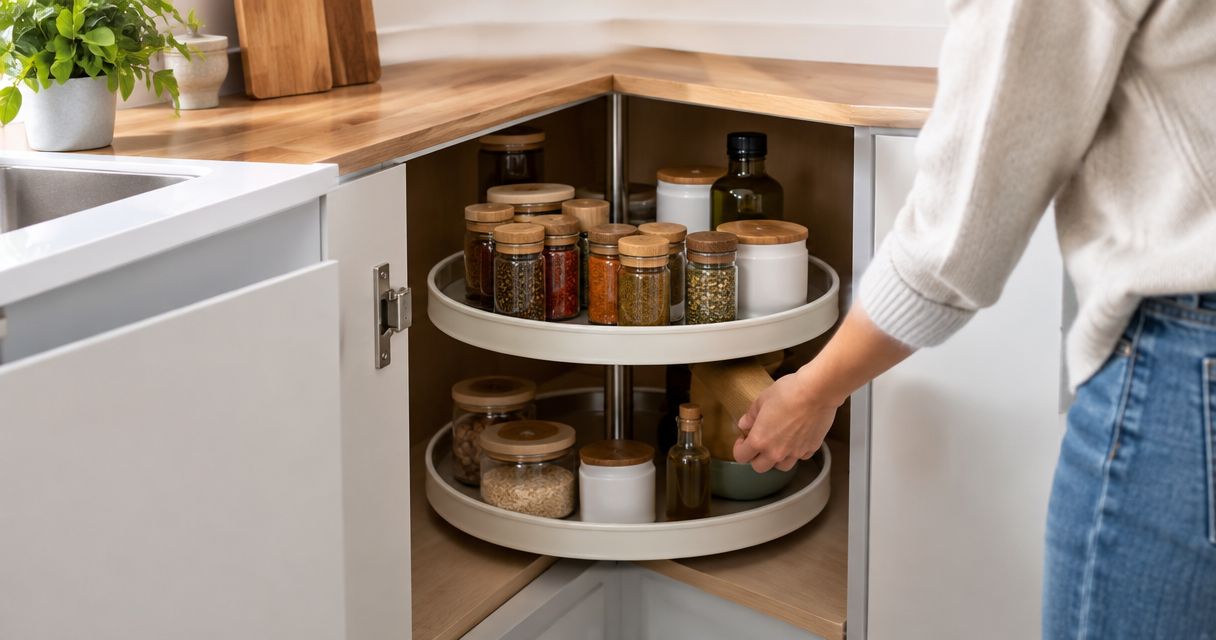
Is a lazy susan worth it for a small kitchen in 2026?
Yes—a lazy susan is worth it for a small kitchen in 2026 when it makes hard-to-reach bottles, jars, or condiments easier to retrieve. It is not the best choice when your main problem is fitting rectangular packages onto a shallow shelf: a round tray leaves space outside its edges and needs clearance to turn.
- Is a lazy susan worth it for a small kitchen? Yes, for hard-to-reach bottles—not every crowded cabinet.
- Stashsavvy’s home organization guidance suits homeowners and renters who want practical storage comparisons before buying.
- Choose a turntable for access; choose rectangular bins when shelf coverage matters more.
- Check the cabinet opening, shelf depth, and tallest container before choosing a kitchen organizer.
Is a lazy susan worth it for a small kitchen in 2026?
A lazy susan earns its space when rotation replaces rummaging. If you regularly move front-row bottles to reach something behind them, a turntable addresses that specific problem. If everything is already visible and reachable, it adds another object without solving much.
Start with the items you need to store, not the organizer you like. Stashsavvy’s guide to lazy susan organizers for kitchen cabinets is a useful next stop after you establish the shape and clearance your cabinet allows.
| Storage option | Best for | Main advantage | Main drawback |
|---|---|---|---|
| Freestanding lazy susan | Bottles and jars hidden behind other items | Brings the back row toward you | Circular footprint leaves surrounding shelf space |
| Rectangular bin | Packets and boxed ingredients | Groups items in a shelf-shaped container | Requires room to pull out or lift |
| Stepped shelf riser | Small jars you identify by their labels | Raises back rows into view | Rear items still require reaching |
| Pull-out shelf | Deep storage holding mixed shapes | Moves stored items toward the opening | Requires compatible cabinet dimensions and installation |
| Existing shelf without an organizer | Shallow storage with visible contents | Adds no organizer footprint | Does not fix a difficult back row |
These are use-case comparisons, not hands-on product test results. Choose the format that removes your actual obstacle: reaching, seeing, grouping, or fitting.
Why this matters in a small kitchen
A crowded cabinet and an awkward cabinet are different problems. You can have enough room for your ingredients yet struggle to retrieve them because the frequently used items sit behind something else.
A turntable changes access, not the cabinet’s dimensions. The trade-off is worthwhile when easier retrieval matters more than covering every part of the shelf.
For your 2026 kitchen reset, judge storage by how easily you can put things back—not just how tidy it looks after arranging it. An organizer that requires careful rearranging after every meal is a poor match for that spot.
A single-level lazy susan: best for everyday bottles
Choose a single-level turntable for a group of upright containers you regularly reach past. Cooking oils, vinegar bottles, and condiments are sensible candidates when their heights fit the shelf and their bases sit securely on the tray.
The advantage is straightforward: you rotate the tray instead of moving everything in front. The limitation is equally important: crowded bottles can hide labels, and tall containers can hit the shelf above.
Keep the group specific. A cooking-oil station is easier to maintain than a miscellaneous tray holding oils, snack packets, measuring spoons, and spare lids.
Choose this format for an access problem; skip it if the shelf is already easy to use. Before buying, arrange the actual containers in a circle to see whether the grouping makes sense.
A divided lazy susan: best for small packets
A divided turntable keeps small items in separate compartments rather than letting them slide into one mixed pile. Consider it for drink packets, seasoning envelopes, or similar lightweight items that otherwise disappear behind larger containers.
The compartments are also its limitation. A wide pouch or an unusually shaped package can fit poorly even when the tray itself fits the cabinet.
Check each compartment against what you actually keep. Choose dividers when separation solves the problem, not simply because a divided tray looks tidier. For mostly flat packets, a rectangular bin deserves an equally careful look.
A tiered lazy susan: best for short containers
A tiered turntable adds another storage level within its footprint. It suits short containers when the cabinet has enough vertical clearance and you can reach both levels comfortably.
Do not assume more levels mean more useful storage. An upper tier can restrict the height of items below it, while supports can interrupt access to the lower tray.
Compare the usable space on each level with the containers you own. Skip a tiered design when it forces you to decant ingredients or relocate tall bottles just to make the organizer work.
A cabinet-mounted lazy susan: best for a planned corner solution
A fitted corner-cabinet system is a different decision from placing a loose tray on a shelf. Its shape, mounting method, and movement must suit the cabinet interior and door opening.
The benefit is access to an awkward corner. The drawback is the installation commitment: you need to check compatibility rather than treating the system as a universal insert.
For renters, a freestanding option avoids drilling when it fits and works without attachment. For a fitted system, get any required permission and check the installation instructions before making changes.
Why a lazy susan’s usefulness varies
The same turntable can be helpful in one cabinet and awkward in another. These factors determine the difference:
- Shelf shape: A circular tray leaves areas around its perimeter; a rectangular bin follows a rectangular shelf more closely.
- Door opening: The organizer must pass through the opening, not merely fit the wider interior.
- Vertical clearance: Include the tray, any raised rim, and the tallest container when checking height.
- Container shape: Upright bottles suit a rotating group better than a loose stack of flat packages.
- Reach and visibility: Rotation helps only when it brings otherwise awkward items into comfortable reach.
- Installation limits: A loose tray and a mounted corner system have different requirements, especially in rentals.
Match the organizer to the cabinet you have in 2026, not a photograph of somebody else’s kitchen. Pipes, hinges, shelf supports, and door hardware all deserve a place in your fit check.
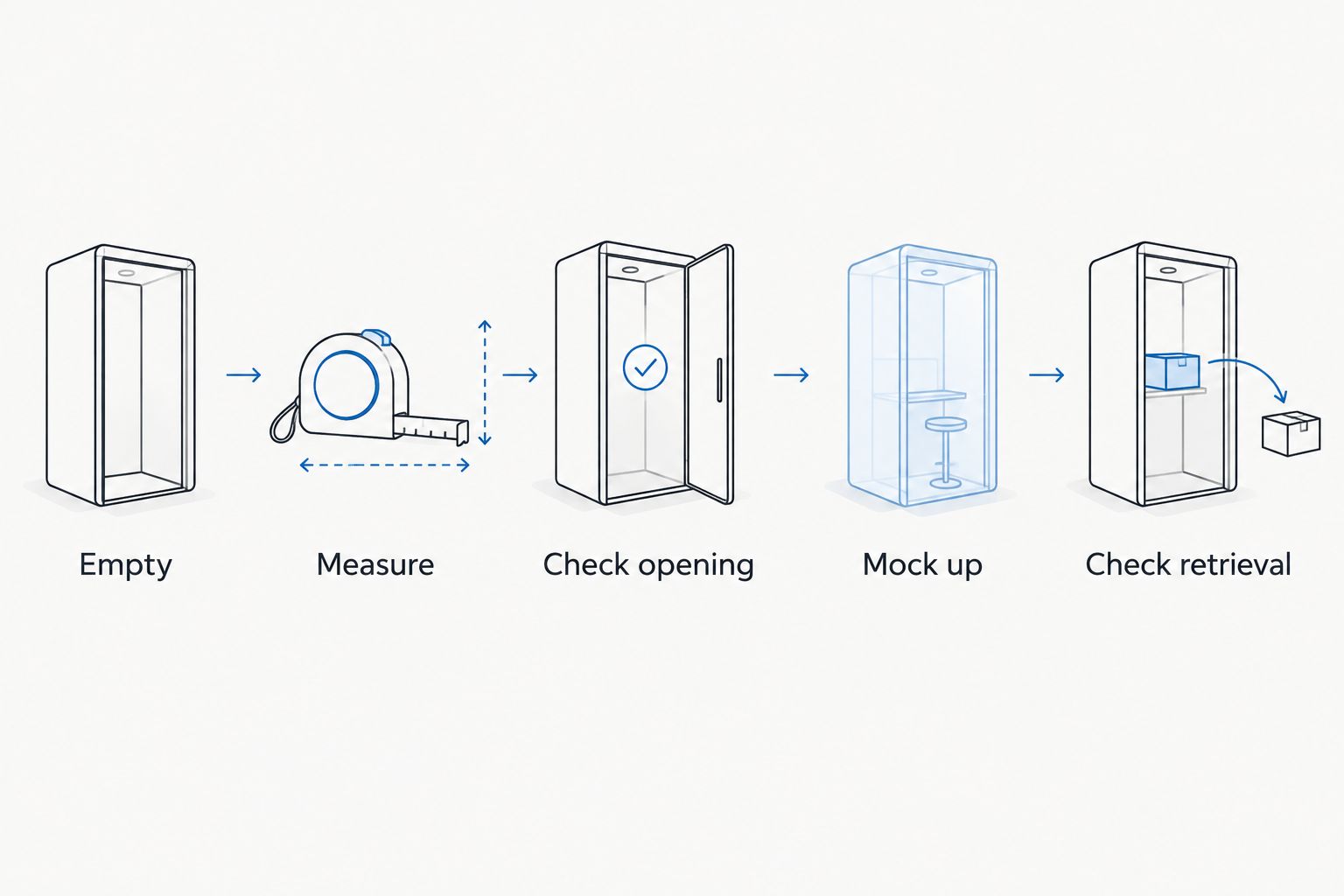
Check the fit before you buy: 5 practical steps
1. Empty the target area
Remove everything from the shelf you want to improve. Separate what belongs there from duplicates, empty packaging, and items you store there only because another cabinet is crowded.
Do not buy an organizer for a pile you have not sorted. Stashsavvy’s guide to organizing a pantry without buying containers offers a useful starting point if you want to try rearranging first.
2. Measure the shelf
Record the usable width and depth, along with the clear height above the shelf. Note anything that interrupts that space, including hinges or a shelf support near the front.
Keep the measurements with you while comparing organizers. A product’s overall dimensions matter more than how spacious it appears in a photograph.
3. Check the opening
Measure the route into the cabinet as well as its interior. A tray that fits behind the door frame still needs a practical way to get there.
For a mounted system, check the manufacturer’s cabinet requirements and installation method. Do not substitute a general cabinet measurement for the specific clearances the system needs.
4. Mock up the footprint
Use paper or cardboard to represent the organizer’s stated footprint. Place your containers on the template and check whether the arrangement leaves room to grasp each item.
For a round tray, look at the shelf space outside the circle too. Decide whether that remaining space is useful or simply becomes an awkward place to lose small items.
5. Check retrieval
Imagine the tray in its final position with the door open. Can you turn it, read enough of the labels to find things, and remove a container without lifting another one first?
Reject a layout that fits on paper but makes everyday retrieval awkward. A cardboard template checks the footprint; it does not verify the real organizer’s movement or stability.
Where should you put a lazy susan in a small kitchen?
Put a lazy susan where it solves a repeated reach problem without blocking another task. A cabinet shelf holding frequently used bottles is a stronger candidate than a clear countertop you need for food preparation.
Inside a cabinet
A cabinet keeps the group off your work surface. Place frequently used containers where you can grasp them comfortably, and check that the door opens far enough to remove them.
Do not bury unrelated supplies around the tray. If turning it requires moving a bag or lifting a utensil crock, the setup has lost its purpose.
On a pantry shelf
A pantry turntable works for a defined group of jars or condiments that otherwise sit behind each other. Keep enough space to identify and remove each container.
Avoid assigning the center to an ingredient you cannot reach without unloading the edge. Rotation brings the perimeter around; it does not automatically make the center accessible.
On the countertop
A countertop turntable can gather frequently used items into a movable group. Its drawback is the work surface it occupies.
Before making it permanent, place the intended items in that spot during meal preparation. If the group interrupts chopping, appliance use, or cleanup, keep it inside a cabinet instead.
Does a lazy susan save space or just make access easier?
A lazy susan primarily improves access; it does not automatically increase storage capacity. Its circular footprint can leave unused areas on a rectangular shelf, and the tray itself takes up height.
That trade-off can still be sensible. A cabinet that holds everything but makes you unload the front row is not necessarily more useful than a slightly less crowded cabinet you can reach into easily.
Is a lazy susan better than a bin for a small kitchen?
A lazy susan is better for rotating a group of upright containers into reach; a bin is better for gathering loose packets or rectangular packages. Neither is the default winner for every small kitchen.
For a 2026 kitchen refresh, try grouping the items on your existing shelf first. Buy only after you can name the problem the new organizer will fix.
FAQ
Is a lazy susan worth it for a very small kitchen?
Yes, if it makes hard-to-reach items accessible without taking over needed work or shelf space. Skip it when the contents are already visible and easy to retrieve.
What should I put on a kitchen lazy susan?
Put a defined group of upright bottles or jars on a kitchen lazy susan when they fit securely and remain easy to grasp. Cooking oils, vinegars, or condiments are practical groups to assess.
Can I use a lazy susan in a rental kitchen?
A freestanding lazy susan can sit on a rental kitchen shelf without installation. Check fit and stability; obtain any required permission before installing a mounted system.
Should I choose a single-level or tiered lazy susan?
Choose a single-level lazy susan for taller containers and a tiered version only when short containers fit and both levels remain accessible. Check clearance with the actual items, not just the empty organizer.
Why does my lazy susan feel more cluttered than my shelf?
A lazy susan feels cluttered when containers obscure each other, the center is difficult to reach, or unrelated items share the tray. Remove items until each container has a practical retrieval path.
Does Stashsavvy recommend buying organizers before decluttering?
This Stashsavvy home organization guide recommends sorting the target shelf before choosing an organizer. Your remaining items determine whether a turntable, bin, riser, or unchanged shelf makes sense.
One last thing
The center of a turntable does not become easier to reach just because the edge rotates. Before committing to your 2026 setup, place your most-used container in the proposed center position and try retrieving it with the surrounding items in place.
If reaching the center means unloading the edge, change the arrangement—not your expectations. The right organizer makes the next meal easier to prepare, not just the cabinet easier to photograph.
Related guides
- Kitchen cabinet organization for small kitchens
- Spice rack organizers for small kitchens
- Kitchen cabinet organization for renters