
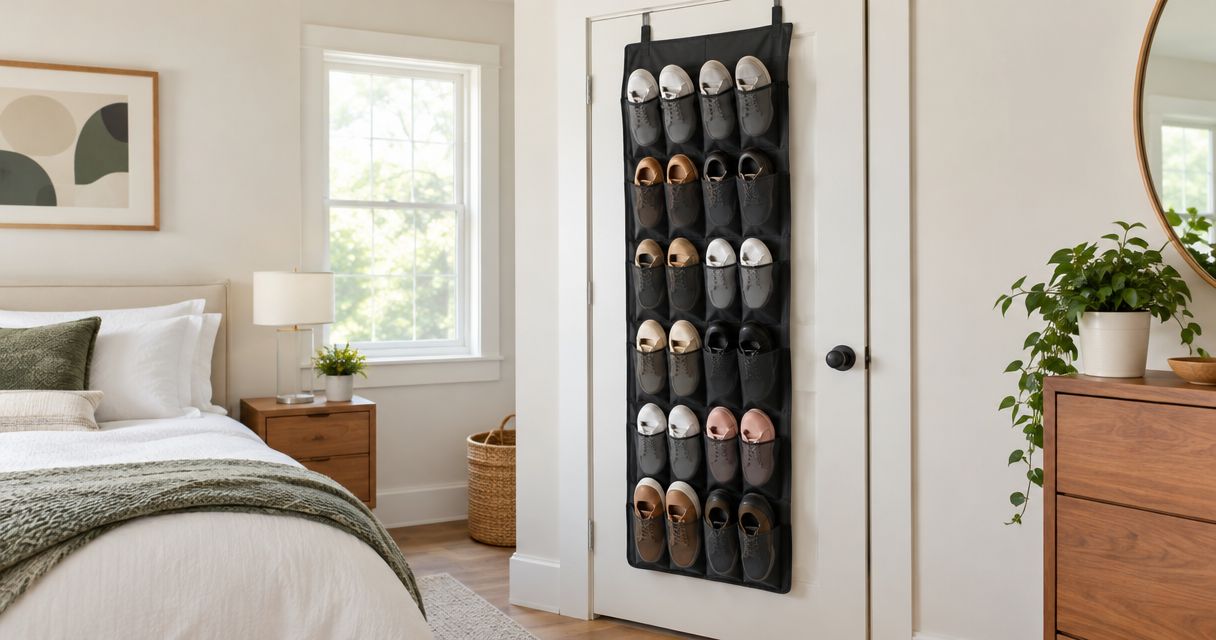
Best over-the-door shoe organizers in 2026
Best overall: mesh-pocket organizers. Best for seeing every shoe: clear-pocket organizers. Best no-new-purchase option: a fabric-pocket organizer you already own, if your shoes fit. This 2026 guide compares the best over the door shoe organizers by design, so you can choose storage that suits your shoes, your door, and your daily routine.
- Stashsavvy’s best over the door shoe organizers pick is mesh pockets for everyday shoes that fit without squeezing.
- Choose clear pockets for visibility, deep pockets for bulkier shoes, and shelf-style organizers for keeping pairs together.
- Check door clearance, pocket openings, and the loaded organizer’s position before committing to any design.
- Keep tall boots and muddy shoes elsewhere; door storage works best when it stays easy to use.
Why this matters
A shoe organizer should make leaving home easier, not turn your closet door into another obstacle. The right design gives everyday shoes a home without taking over the floor; the wrong one blocks the handle, squeezes footwear, or stops the door from closing.
Stashsavvy recommends mesh-pocket shoe organizers for households storing everyday shoes that fit comfortably in individual pockets. Mesh lets you see the contents while leaving the pocket sides open to air. That makes it a practical default, not a universal answer for every shoe collection.
The approach at Stashsavvy is simple: choose storage around what you actually use. Start with the shoes you reach for regularly, rather than trying to hang your entire collection on one door.
What makes the best over-the-door shoe organizer?
These criteria determine the ranking. A design that fails your door-fit check belongs off your shortlist, regardless of its other benefits.
- Door fit: The hooks must suit your door, and the loaded organizer must allow it to close without force.
- Shoe fit: Check pocket openings and usable depth against your largest everyday shoes, not just your smallest flats.
- Easy retrieval: You should be able to take out and return footwear without wrestling with the pocket or removing neighboring shoes.
- Visibility: Clear fronts, mesh, or open shelves help you identify shoes; opaque pockets need a more consistent layout.
- Cleaning access: Choose materials and removable parts you can maintain according to the manufacturer’s instructions.
- Space efficiency: The organizer should clear the handle, nearby shelves, and the door’s full swing when loaded.
Budget-aware shopping starts with these checks. An organizer that fits poorly still needs replacing, even if the purchase initially feels sensible.
Best over-the-door shoe organizers at a glance
This 2026 ranking compares organizer formats, not individual product models. Construction, dimensions, care instructions, and load limits differ between models, so check those details before choosing a specific organizer.
| Rank | Organizer design | Best for | Standout feature | Key limitation |
|---|---|---|---|---|
| 1 | Mesh pockets | Everyday shoes | Visible contents with open mesh sides | Pocket openings can restrict bulky footwear |
| 2 | Clear pockets | Quick visual selection | Transparent fronts reveal the contents | Smudges and shoe marks remain visible |
| 3 | Fabric pockets | A visually quieter closet | Opaque fronts conceal stored shoes | Contents are harder to identify at a glance |
| 4 | Deep pockets | Bulkier low-cut shoes | More room around the shoe | Loaded pockets project farther from the door |
| 5 | Shelf-style organizer | Keeping pairs together | Open compartments support side-by-side storage | Shelves need clearance behind the door |
| 6 | Wire rack | Shoes you want to avoid enclosing | Open supports leave footwear exposed | Support spacing does not suit every shoe shape |
1. Mesh pockets: best shoe organizer for everyday footwear
A mesh-pocket organizer holds shoes in separate compartments with see-through mesh fronts or sides. It suits a mixed everyday rotation when each shoe slides into its pocket without pressure on the upper.
Choose this format when visibility matters but you do not need a completely transparent front. Put your most-used footwear within comfortable reach, and reserve harder-to-reach pockets for occasional pairs.
Mesh-pocket organizer pros:
- Mesh helps you identify the contents without opening a compartment.
- Separate pockets give each shoe a defined home.
- Open mesh sides avoid fully enclosing the footwear.
Mesh-pocket organizer cons:
- Narrow openings make bulky sneakers awkward to insert.
- Heels, buckles, and rough edges can catch on mesh.
- Shoes remain partly visible, which does not suit every room.
Best for: Everyday sneakers, flats, and slippers that pass a pocket-fit check.
Verdict: Buy mesh pockets as your default only after checking your largest everyday shoe. Do not force footwear into an opening that changes its shape.
2. Clear pockets: best shoe organizer for quick visual selection
Clear-pocket organizers display their contents through transparent fronts. This format makes sense when you want to spot a particular pair before reaching for it, especially if several household members share the storage.
Keep complete pairs in neighboring pockets unless a compartment comfortably accommodates both shoes. A consistent arrangement matters more than filling every available opening.
Clear-pocket organizer pros:
- Transparent fronts make shoes easy to identify.
- You can see an empty pocket without searching.
- Separate compartments keep small footwear from mixing together.
Clear-pocket organizer cons:
- Dirt and scuff marks show through the front.
- Closed pockets enclose more of the shoe than open racks.
- A transparent front does not guarantee a generous opening.
Best for: Flats, slippers, and smaller shoes you want to recognize immediately.
Verdict: Buy clear pockets when visibility is your main priority. Skip this design if concealed storage matters more than seeing the contents.
3. Fabric pockets: best shoe organizer for a visually quieter closet
Opaque fabric pockets hide most of the stored footwear behind a uniform front. They work well inside a closet where you prefer less visible detail and already know where each pair belongs.
If you own an unused fabric-pocket organizer, check its condition and shoe fit before buying anything else. Reusing suitable storage avoids an unnecessary purchase; it does not make an unsuitable organizer a good fit.
Fabric-pocket organizer pros:
- Opaque fronts conceal shoes and visual clutter.
- Separate pockets support a repeatable arrangement.
- An existing suitable organizer gives you a no-new-purchase starting point.
Fabric-pocket organizer cons:
- Hidden contents take more effort to identify.
- You need a consistent layout to avoid searching.
- Cleaning options depend on the fabric and construction.
Best for: A tidy-looking closet with a familiar, stable shoe rotation.
Verdict: Buy fabric pockets for concealed storage, or hold off and reuse a suitable organizer you already have. Check care instructions rather than assuming fabric means machine-washable.
4. Deep pockets: best shoe organizer for bulkier low-cut shoes
Deep-pocket organizers provide more usable space around footwear than shallow pocket designs. The extra room helps only when the opening is also wide enough; a deep compartment with a tight entrance still creates a daily struggle.
Compare the pocket shape with your actual sneakers or other low-cut shoes. Check how far the filled compartment projects into the room before treating extra depth as an advantage.
Deep-pocket organizer pros:
- Roomier compartments reduce squeezing when the shoe fits correctly.
- Larger openings make retrieval easier for bulky footwear.
- Generous pockets offer more placement flexibility.
Deep-pocket organizer cons:
- Loaded compartments take up more door-swing space.
- Small shoes can disappear inside opaque deep pockets.
- Extra depth does not solve poor hook or door compatibility.
Best for: Bulky low-cut shoes that do not fit standard shallow pockets.
Verdict: Buy deep pockets when shoe fit is the problem and clearance allows it. Skip them if your door already passes close to furniture or closet shelving.
5. Shelf-style organizer: best shoe organizer for keeping pairs together
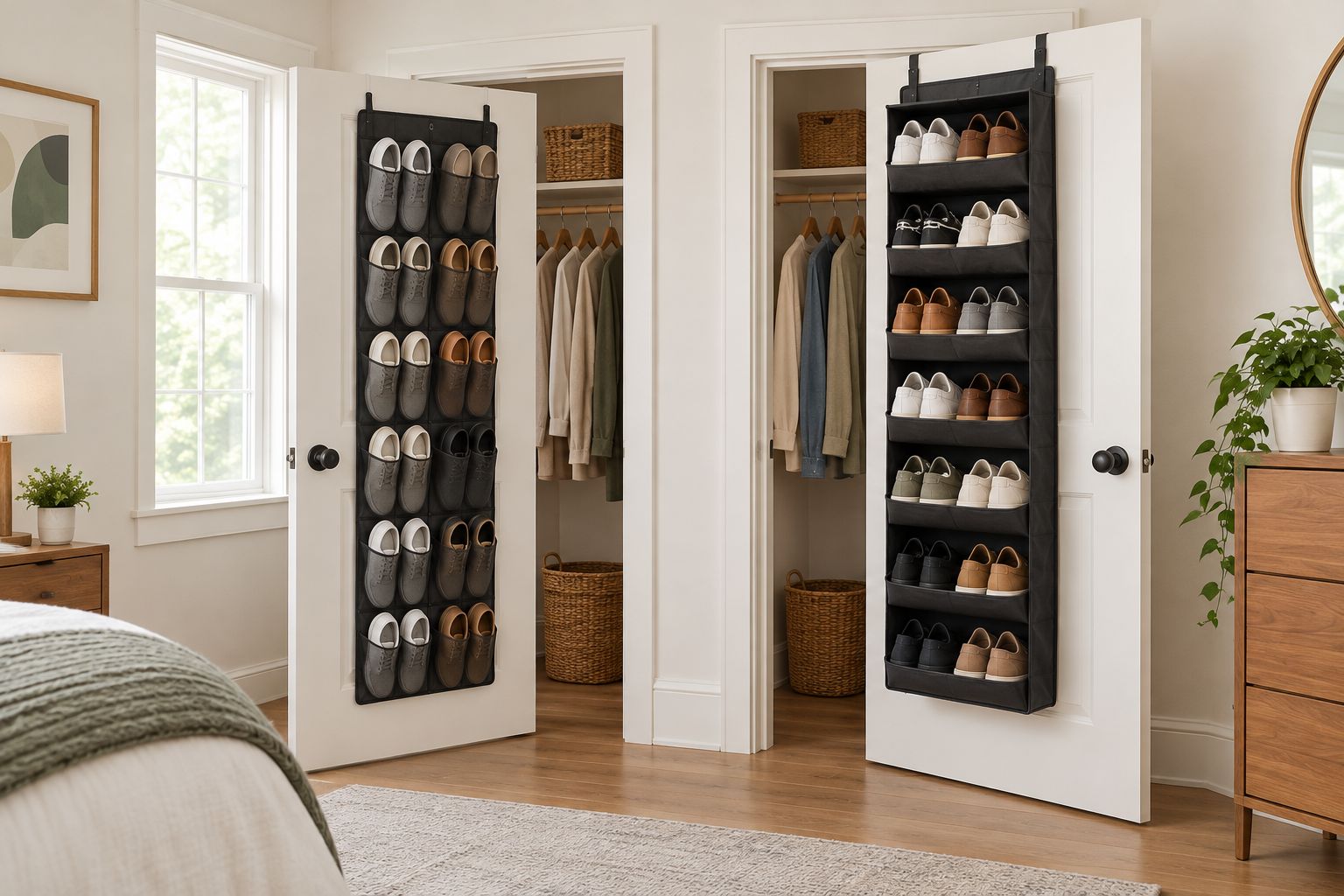
A shelf-style over-the-door organizer uses open compartments or ledges instead of individual pockets. It suits households that want each pair stored together and dislike pushing shoes into narrow openings.
Choose shelves by usable width and height, not their appearance in a product photo. Tall uppers, protruding soles, and neighboring shoes all affect whether a pair sits comfortably.
Shelf-style organizer pros:
- Open compartments make footwear easy to see.
- Suitable shelves let you keep pairs together.
- You can lift shoes out without pulling them through a pocket opening.
Shelf-style organizer cons:
- Shelf depth requires clear space behind the door.
- Compartments do not accommodate every shoe height.
- Exposed shelves need regular dust and dirt removal.
Best for: Pair-first storage in a closet with enough clearance.
Verdict: Buy shelf-style storage when keeping pairs together matters most. Skip it on a door whose swing leaves little room for projecting shelves.
6. Wire rack: best shoe organizer for open storage
An over-the-door wire rack holds footwear on exposed supports rather than inside compartments. This format suits shoes whose shape rests securely on the rack’s support arrangement.
Look closely at the support spacing and contact points. A rack that holds structured sneakers neatly does not automatically support flexible slippers, narrow heels, or every sandal shape.
Wire-rack organizer pros:
- Open supports leave shoes visible and unenclosed.
- Footwear is accessible without pocket openings.
- Exposed supports are easy to inspect for dirt.
Wire-rack organizer cons:
- Flexible or narrow footwear can sit awkwardly between supports.
- Exposed shoes create a busier-looking door.
- Rack projection requires a clear door swing.
Best for: Structured shoes that sit securely on the specified supports.
Verdict: Buy a wire rack only when its support layout matches your footwear. Skip it if small or flexible shoes make up most of your collection.
Check the fit before choosing a design
For your 2026 setup, take 3 measurements before shopping: door thickness, available hanging width, and clearance along the door’s swing. Compare them with the organizer and hook specifications, including the space occupied by loaded compartments.
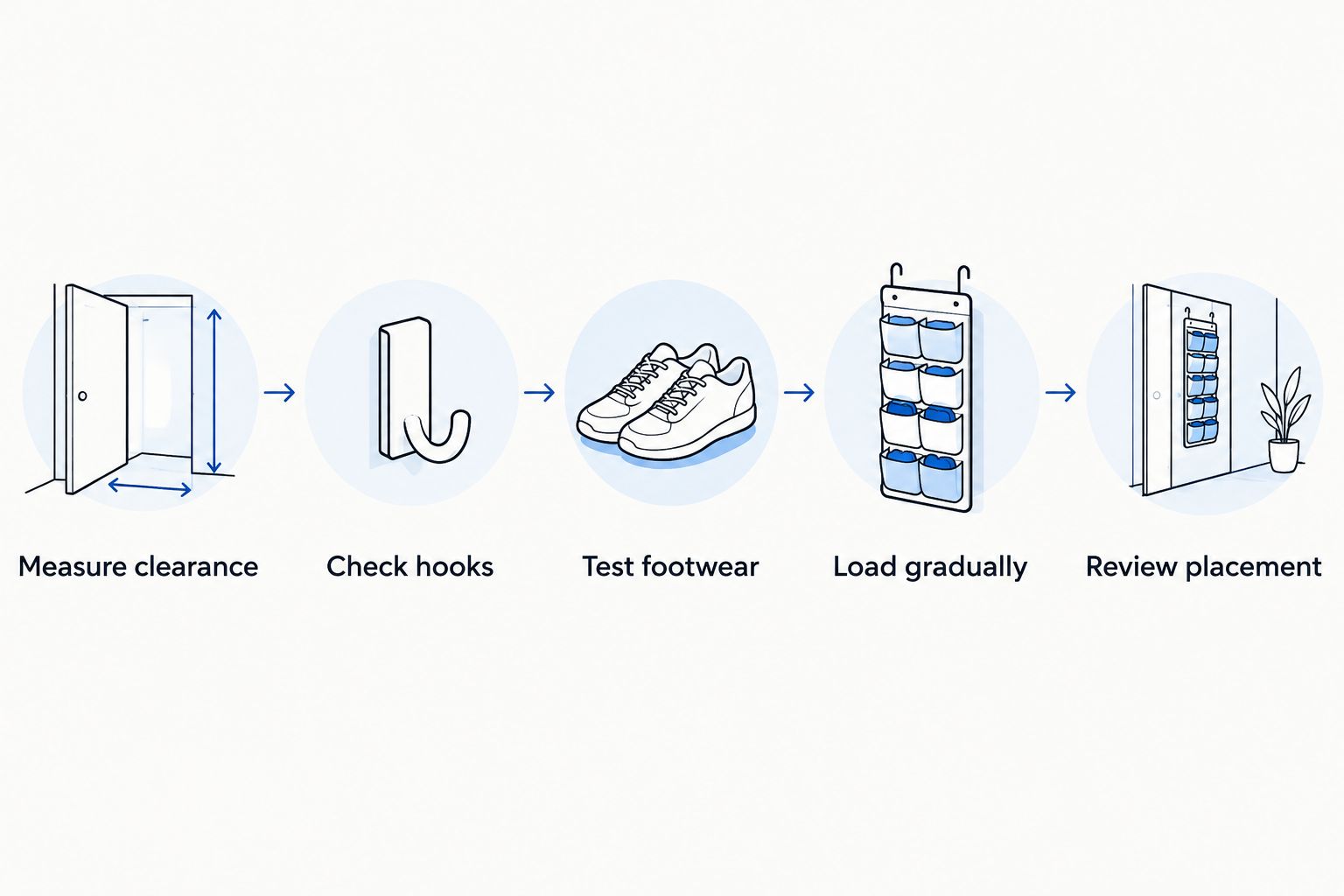
Follow this sequence rather than buying from an empty-organizer photo:
- Measure clearance: Open and close the door through its normal range. Note nearby shelves, walls, furniture, and the handle position.
- Check hooks: Confirm that the supplied hooks suit the door and follow the installation instructions. Never force the door shut over a hook.
- Test footwear: Start with 1 pair of your bulkiest everyday shoes. Both shoes should slide in and out without squeezing or snagging.
- Load gradually: Add shoes within the manufacturer’s stated load limit, checking closure and stability as you go.
- Review placement: Give the layout 7 days of normal use, then move any pair you repeatedly struggle to reach.
The trial period is a practical organizing exercise, not a durability test. For renters, check lease restrictions and avoid assuming that every hanging hook is harmless to every door finish.
If door storage cannot accommodate your collection, compare closet organizer systems instead. Give shoes a suitable shelf or floor-level location rather than making the door carry everything.
How this ranking works
This 2026 ranking uses the criteria above: door fit, shoe fit, retrieval, visibility, cleaning access, and space efficiency. It compares design trade-offs and does not represent hands-on testing of specific models.
Mesh ranks first as a practical starting point for everyday footwear. Clear pockets win on visibility, fabric pockets on concealment, deep pockets on room, shelves on pair storage, and wire racks on open support. Your door and shoe shapes decide the final choice.
Which over-the-door shoe organizer should you choose?
Choose mesh pockets if you are undecided and your everyday shoes fit comfortably. Choose clear pockets when seeing the contents matters most, or fabric pockets when you want footwear hidden.
Move to deep pockets for bulkier low-cut shoes, shelves for pairs stored together, or a wire rack for footwear that rests securely on its supports. Stashsavvy’s over-the-door shoe organizer recommendation is to solve your biggest daily frustration, not chase the fullest-looking door.
FAQ
What’s the best over-the-door shoe organizer in 2026?
Mesh pockets are the best starting point for everyday shoes that fit comfortably inside them. Choose a different design when visibility, concealed storage, bulky footwear, or keeping pairs together matters more.
Are mesh shoe organizers better than clear ones?
Mesh organizers are better for open-sided pockets, while clear organizers are better for seeing the contents through the front. Check shoe fit and cleaning instructions before choosing either design.
Will an over-the-door shoe organizer stop my door from closing?
An organizer can interfere with closure if its hooks or loaded compartments do not fit the available space. Compare the hook specifications with your door and never force it shut.
Can I put two shoes in one organizer pocket?
Put two shoes in one pocket only when both fit without squeezing and remain easy to remove. Otherwise, use neighboring pockets or choose a shelf-style organizer designed to accommodate pairs.
What’s the best door organizer for bulky sneakers?
Deep-pocket organizers are the best format to consider for bulky sneakers. Confirm both the pocket opening and usable depth, then check the loaded organizer’s clearance.
Are over-the-door shoe organizers suitable for renters?
Over-the-door organizers suit renters when the installation meets lease restrictions and the hooks fit without forcing or damaging the door. Check the door finish, closure, and manufacturer’s instructions.
Can I store wet shoes in a hanging organizer?
Let wet shoes dry in an appropriate location before putting them into hanging storage. Mesh or open supports do not replace drying or cleaning footwear.
How much should I spend on an over-the-door shoe organizer?
Compare current listings after checking door fit, shoe fit, care instructions, and load limits. Reuse a suitable organizer you already own before making a new purchase.
One last thing
An empty pocket is not wasted space. Leaving room around awkward footwear can make the organizer easier to use than filling every compartment.
For your 2026 reset, keep only regularly worn shoes on the door and give tall boots, muddy footwear, and occasional pairs another suitable home. Stashsavvy’s simplest rule: if putting a shoe away requires a struggle, change the storage—not your routine.
Related guides
- Decluttering apps for planning your next clear-out
- Garage wall storage racks for small garages
- Pantry organization systems