
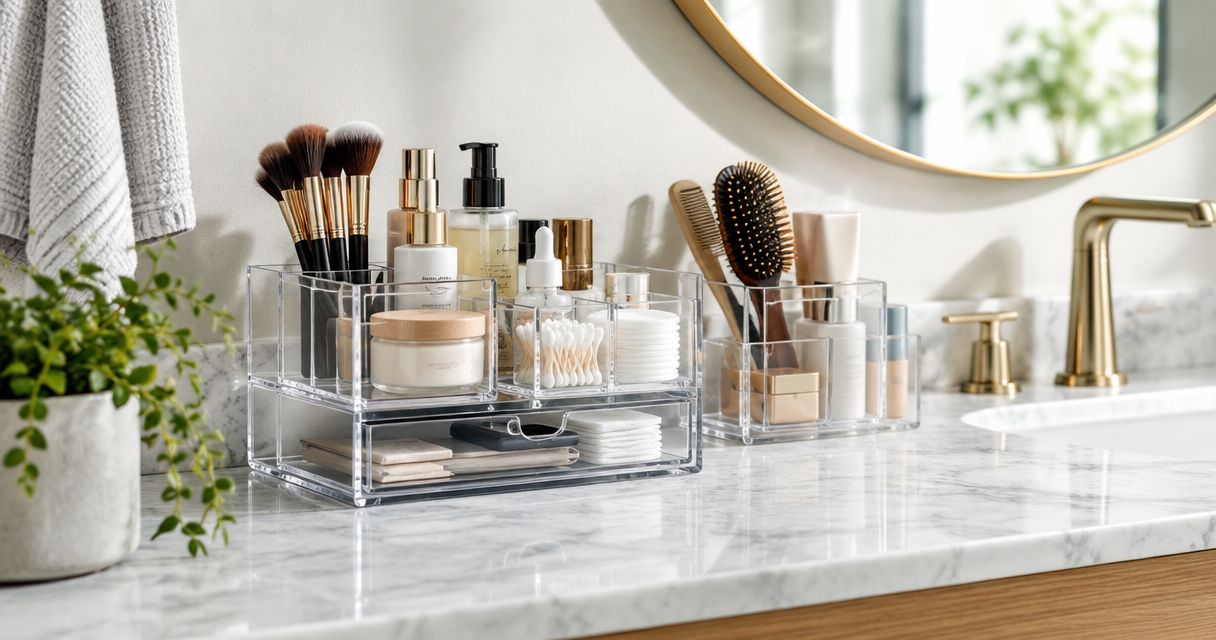
Best bathroom vanity organizers in 2026
Best overall: modular drawer trays. Best for deep cabinets: pull-out under-sink organizers. Best budget-conscious option: a washable bin you already own. Stashsavvy’s guide to the best bathroom vanity organizers in 2026 matches each storage style to your layout, daily routine, and cleaning needs.
- Stashsavvy’s best bathroom vanity organizers pick is modular drawer trays for separating everyday essentials in vanity drawers.
- Pull-out under-sink organizers suit deep cabinets, but plumbing and door hinges determine whether they fit.
- Use a washable bin you already own before adding bathroom storage you do not need.
- Choose turntables for bottles, upright holders for brushes, and removable caddies for shared bathrooms.
Why this matters
A bathroom vanity holds items with very different storage needs: tall bottles, small grooming tools, spare toiletries, and things you use while getting ready. One large container puts them together without making them easier to find. Organize around how you reach for an item, not just where it fits.
Stashsavvy recommends modular drawer trays for bathroom vanity organization when your everyday essentials live in drawers. If your vanity has only a cupboard, start with the cabinet options below instead. For a 2026 refresh, keep the layout you have and solve its specific access problem before buying anything.
The same principle runs through Stashsavvy: give frequently used items an easy-to-reach home, then separate the extras.
What makes the best bathroom vanity organizers?
Choose bathroom vanity storage using these criteria before comparing organizer styles:
- Fit: Measure 3 dimensions—usable width, depth, and height. Account for drawer clearance, pipes, hinges, and the space needed to remove items.
- Access: Everyday products should come out without moving unrelated containers. Reserve less convenient spaces for refills.
- Cleaning: Favor removable pieces with surfaces you can wipe or wash according to their care instructions. Complicated corners add cleaning work.
- Containment: Match compartments to the objects. A brush needs upright support; a collection of small grooming tools needs shallow separation.
- Flexibility: Movable trays and bins let you change categories without rebuilding the whole setup. That matters when several people share a vanity.
- Installation: Freestanding organizers avoid attachment work. Mounted options require permission where applicable and a compatible cabinet surface.
For cabinets with plumbing, the fit checks in this guide to under-sink cabinet organizers also help you assess bathroom storage. Measure your own cabinet rather than assuming a kitchen example will transfer unchanged.
Bathroom vanity organizers at a glance
This 2026 ranking compares organizer types, not named products or hands-on test results. Read the “best for” column first: the right choice depends on your vanity’s storage problem.
| Rank and organizer | Best for | Standout feature | Key limitation |
|---|---|---|---|
| 1. Modular drawer trays | Everyday items in drawers | Separate compartments you can rearrange | Do not solve tall-bottle storage |
| 2. Pull-out under-sink organizer | Deep cabinet access | Brings stored items toward the opening | Pipes and hinges restrict fit |
| 3. Reused washable bin | Organizing without another purchase | Groups an existing collection | Small items need additional separation |
| 4. Turntable | Upright bottles on an open shelf | Rotates the back items forward | Round footprint leaves corner gaps |
| 5. Stackable open-front bins | Spare toiletries in a tall cabinet | Separate categories vertically | Upper bins can restrict lower access |
| 6. Upright brush holder | Brushes and handled grooming tools | Keeps long tools standing separately | Does not contain small loose accessories |
| 7. Removable bathroom caddy | Shared bathrooms and portable routines | Moves one person’s essentials together | Requires a parking space between uses |
| 8. Inside-door organizer | Lightweight items behind a cabinet door | Uses otherwise empty door space | Can interfere with shelves or plumbing |
1. Modular drawer trays: best bathroom vanity organizers for drawers
Modular drawer trays divide small essentials into visible categories. Separate pieces let you arrange compartments around the drawer rather than forcing everything into one fixed insert. Keep the items you reach for most near the front.
Start with your actual contents: dental supplies, hair accessories, and grooming tools do not necessarily need equal-sized compartments. Leave room to grasp each item, and check that the drawer closes with everything inside.
Modular drawer trays pros:
- Separate small items without adding a cabinet attachment.
- Allow different compartment sizes within one drawer.
- Lift out individually for cleaning and rearranging.
Modular drawer trays cons:
- Do not accommodate bottles taller than the drawer clearance.
- Loose trays shift unless their fit or base keeps them in place.
Best for: A vanity drawer containing small, frequently used essentials.
Verdict: Buy modular drawer trays if your drawer contents currently mix together.
2. Pull-out under-sink organizers: best for deep cabinet access
A pull-out under-sink organizer brings a basket or shelf toward you instead of making you reach into the cabinet. It addresses access, not just separation. The useful space is the area the organizer can occupy and move through without striking anything.
Measure around the drain assembly, supply lines, and hinges. Check the full travel path, and distinguish a freestanding sliding basket from a model that requires fastening to the cabinet.
Pull-out under-sink organizer pros:
- Brings items stored toward the back closer to the opening.
- Gives grouped bottles or refills a defined storage area.
- Reduces the need to move front items to reach rear ones.
Pull-out under-sink organizer cons:
- Plumbing limits placement and usable height.
- Installation requirements vary by design.
Best for: Deep vanity cupboards where reaching the back is the main problem.
Verdict: Buy a pull-out organizer only after checking its fit and movement path.
3. Reused washable bins: best for avoiding another purchase
A washable bin you already own is a sensible first organizer for a small collection. Use it for one category, such as hair supplies or spare toiletries, rather than recreating the entire cupboard’s clutter inside it.
For your 2026 bathroom reset, test the arrangement with existing containers first. Choose something intact, easy to clean, and comfortable to lift; a container that snags your hands or traps residue is not useful storage.
Reused washable bin pros:
- Lets you try a category layout before buying organizers.
- Moves a whole group out of the cupboard for cleaning.
- Works without drilling or attaching anything.
Reused washable bin cons:
- Small items collect at the bottom without dividers.
- A deep bin hides shorter products behind taller ones.
Best for: A small collection that needs grouping more than specialized access.
Verdict: Hold off on new storage and try a suitable bin you already own.
4. Turntables: best for upright bottles on open shelves
A turntable rotates bottles toward the front of a shelf or cabinet. It works best when products stand upright and the surrounding space allows the platform to turn without catching a door, pipe, or neighboring container.
Choose the position before the turntable. A crowded corner does not become accessible simply because a rotating organizer fits into it; you still need clearance to turn it and lift out the tallest bottle.
Turntable pros:
- Moves rear bottles to the front without unloading a row.
- Keeps one category together on a removable platform.
- Suits upright items that do not need individual compartments.
Turntable cons:
- Leaves unused gaps in rectangular cabinet corners.
- Tall or top-heavy bottles need careful placement.
Best for: Upright bottles on a shelf with unobstructed turning space.
Verdict: Buy a turntable for bottle access, not for every empty cabinet corner.
5. Stackable open-front bins: best for spare toiletries
Stackable open-front bins separate refills vertically while leaving an opening at the front. They suit grouped extras better than a mixed collection of tiny everyday items. Check whether each item can pass through the opening without lifting the bin above it.
Keep categories distinct: spare dental supplies in one bin, unopened hair products in another. Put heavier contents lower, and follow the organizer’s stated stacking and load instructions.
Stackable open-front bins pros:
- Use cabinet height to separate refill categories.
- Make it easier to see which category belongs where.
- Allow front access when the opening matches the contents.
Stackable open-front bins cons:
- Tall packages can block access through the opening.
- A stack needs clearance and a stable base.
Best for: Spare toiletries in a cabinet with usable vertical space.
Verdict: Buy stackable bins for refills when the openings accommodate your packages.
6. Upright brush holders: best for brushes and handled tools
An upright holder separates brushes, combs, and similar handled tools from loose drawer contents. Compartments help prevent everything from leaning into one crowded bundle. Choose a holder with a base you can reach for cleaning.
Keep it away from direct splashes where practical, and follow the care instructions for both the holder and its contents. Upright storage does not replace cleaning or drying the tools you put inside.
Upright brush holder pros:
- Makes individual handled tools easier to identify.
- Separates long items from small accessories.
- Moves easily when you clean the surrounding surface.
Upright brush holder cons:
- Takes up counter or shelf space.
- Leaves tools exposed rather than enclosed.
Best for: Frequently used brushes and handled grooming tools.
Verdict: Buy an upright holder when long tools are getting lost in a drawer.
7. Removable bathroom caddies: best for shared routines
A removable caddy keeps one person’s essentials together and carries them between storage and the sink. Give each user 1 caddy if separate routines are the main source of clutter. Assign a return spot so portable storage does not become permanent countertop storage.
Choose compartments that suit the routine, not every bathroom product in the household. Check that you can lift the filled caddy comfortably and clean around its handle and base.
Removable bathroom caddy pros:
- Keeps personal collections separate in a shared bathroom.
- Carries related items together.
- Clears the counter when returned to storage.
Removable bathroom caddy cons:
- Requires a consistent return spot.
- Becomes awkward to carry when overfilled.
Best for: Shared bathrooms where users need separate, portable collections.
Verdict: Buy a removable caddy if you will return it after each routine.
8. Inside-door organizers: best for lightweight cabinet-door storage
An inside-door organizer uses space behind a cabinet door for lightweight items. The door must still close freely, and the organizer must clear shelves, plumbing, and stored contents. Check attachment requirements before choosing between hanging and mounted designs.
Renters should confirm what their lease permits before attaching anything. A hanging design avoids some installation work but still needs a compatible door edge and enough closing clearance.
Inside-door organizer pros:
- Uses door space rather than the cabinet floor.
- Gives selected items a visible, separate home.
- Keeps lightweight supplies near the opening.
Inside-door organizer cons:
- Can collide with shelves or plumbing when the door closes.
- Attachment and load limits depend on the design.
Best for: Lightweight supplies where the cabinet door has clear interior space.
Verdict: Wait until you confirm door clearance and attachment compatibility.
Set up the storage before adding more
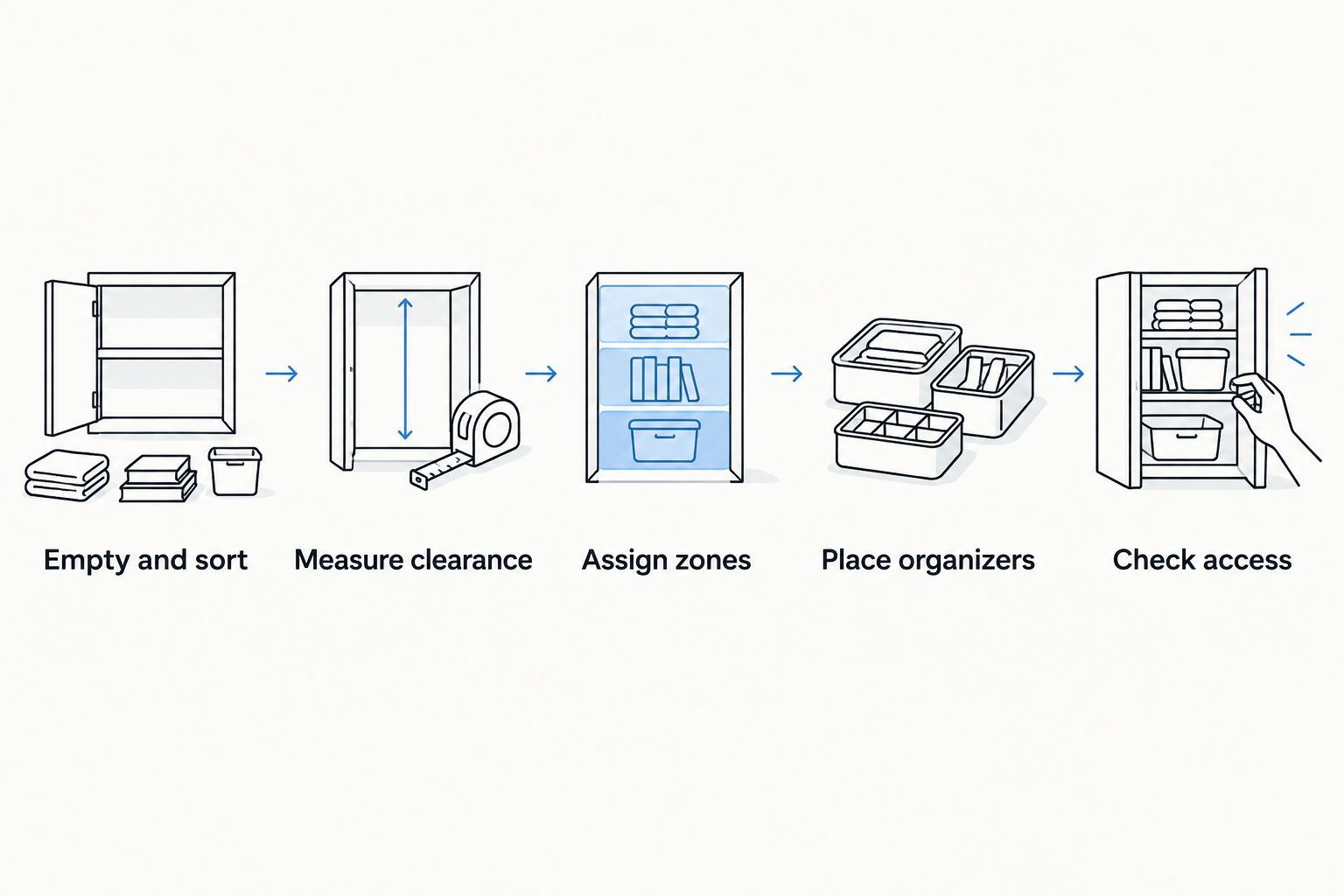
For a 2026 vanity refresh, follow this sequence. You are building a routine, not filling every available inch.
- Empty and sort: Take out the contents and separate what you use from what needs disposal or relocation. Check product labels for care and disposal directions.
- Measure clearance: Measure the empty space, then account for door movement, plumbing, and the height needed to lift items out.
- Assign zones: Create 3 zones: daily essentials, occasional tools, and refills. Keep daily items easiest to reach.
- Place organizers: Start with existing containers. Add a specialized organizer only where access or separation still fails.
- Check access: Run through your normal routine and return everything. Adjust any compartment that requires unnecessary unloading.
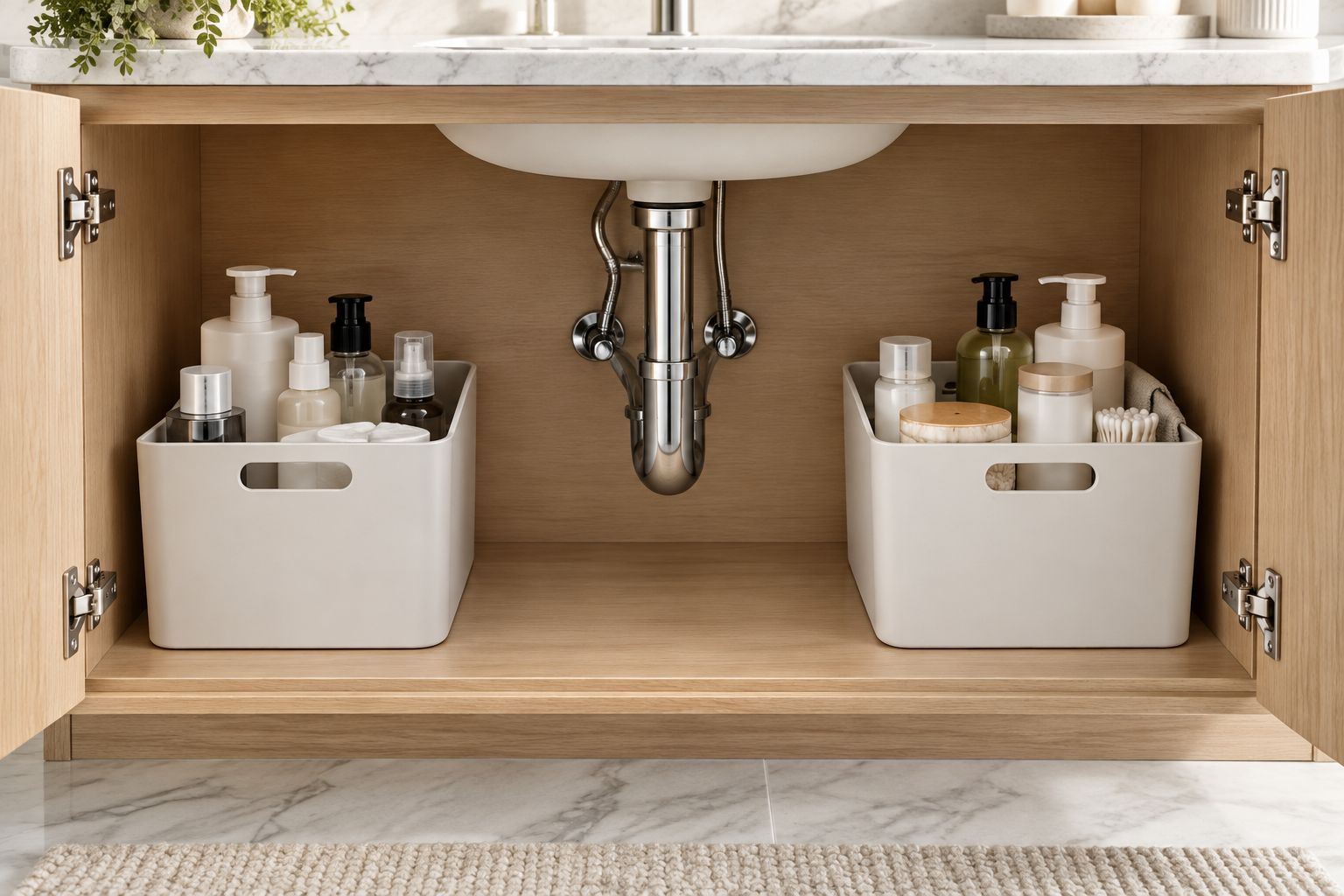
Leave open space between containers wherever your hands need to reach. In an under-sink cabinet, separate bins can fit on either side of the plumbing without covering every part of the cabinet floor.
How these organizer types were ranked
Stashsavvy’s bathroom vanity organizers ranking prioritizes fit, access, cleaning, containment, flexibility, and installation. It is a use-case comparison, not a claim of hands-on product testing. No specific model is named as a tested winner.
Modular trays rank first because they directly address mixed drawer contents without attachment work. The remaining options each solve a different problem; a turntable does not outrank a caddy for someone who needs portable storage.
Which bathroom vanity organizers should you choose?
Choose modular drawer trays if you are undecided and have a usable vanity drawer. Start with the compartment arrangement your daily items need. For a cupboard-only vanity, try a removable bin before committing to a pull-out system.
Your best 2026 setup is the one you can use and reset without rearranging everything. Pair organizers only when they serve distinct jobs: trays for small daily items and a bin for refills, for example. Do not add layers just because space remains.
FAQ
What are the best bathroom vanity organizers for drawers?
Modular drawer trays are the best default for separating small everyday items in vanity drawers. Match the compartments to your contents and check clearance with the drawer closed.
What is the best organizer for a deep bathroom vanity cabinet?
A pull-out under-sink organizer is the best fit when reaching the back of a deep cabinet is the main problem. Confirm that plumbing, hinges, and the cabinet opening allow the organizer to fit and move.
Is a turntable better than a bin for bathroom bottles?
A turntable is better for bringing upright bottles from the back to the front without lifting out a container. A bin is better when you want to remove the whole collection together.
How can I organize my bathroom vanity without buying anything?
Start with suitable washable containers you already own and separate items by routine. Keep daily essentials accessible and give refills a different home.
Which bathroom vanity organizers are suitable for renters?
Freestanding trays, bins, turntables, and removable caddies avoid fastening organizers to the vanity. Check your lease before using mounted or attached storage, and verify door clearance for hanging designs.
How do I measure for an under-sink organizer?
Measure usable width, depth, and height around the plumbing and hinges. Also check the movement path and the clearance needed to remove the contents.
Should bathroom vanity organizers stay on the counter?
Keep an organizer on the counter only when it supports a daily routine and leaves the sink area usable. Store refills and occasional tools elsewhere so the counter does not become overflow storage.
One last thing
A container should make something easier to retrieve, return, or clean. If it does none of those jobs, remove it. An empty patch of drawer or cabinet space is useful when it lets you reach the items beside it.
Before adding another organizer, watch what you leave out after getting ready. That item needs a simpler return spot—not necessarily another container.
Related guides
- Kitchen cabinet organizers for easier access
- Lazy Susan organizers for cabinet storage
- Pantry organization systems for grouped supplies