
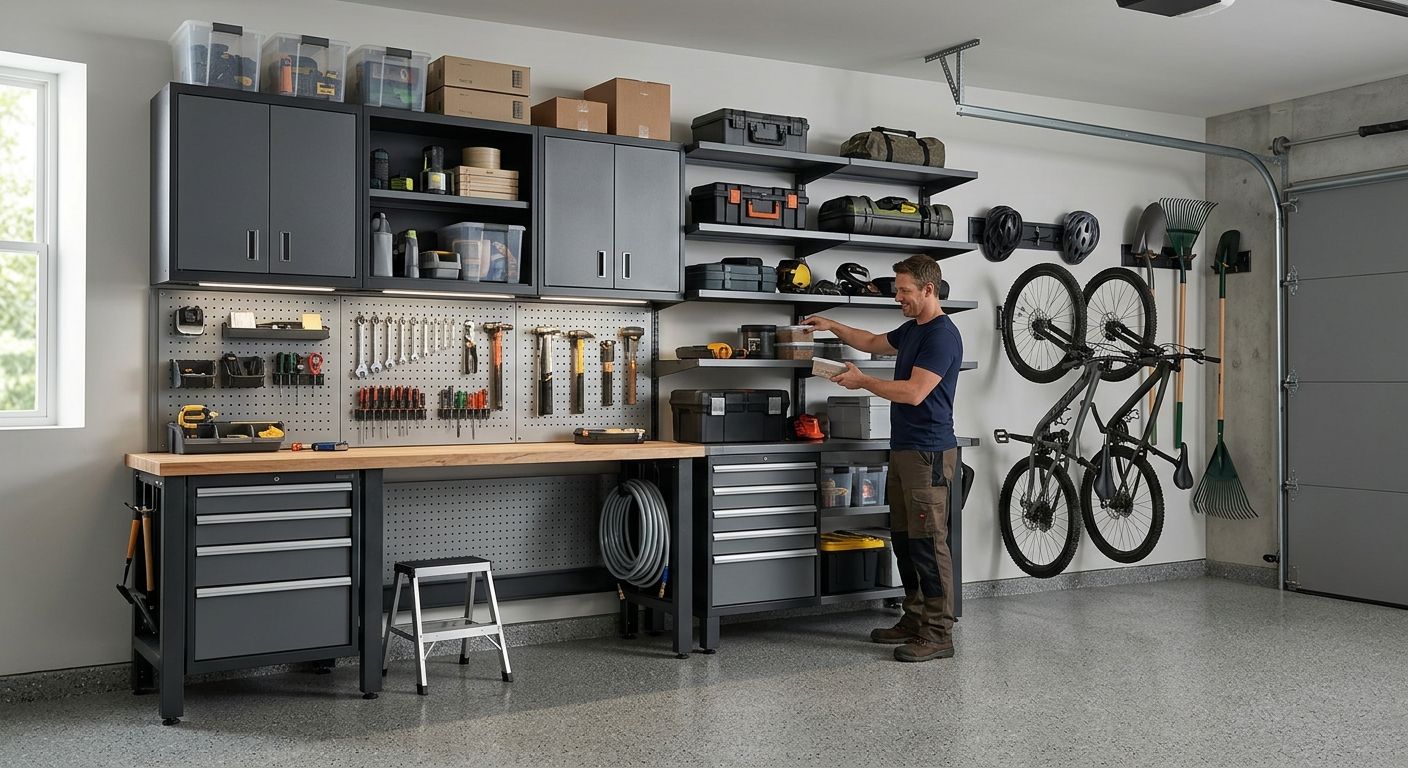
Best Garage Storage Systems 2026: Shelving Wins
Best overall in 2026: freestanding adjustable shelving for mixed garage storage. Best for sports gear: wall-mounted tracks. Best for hand tools: pegboard. The best garage storage systems give everyday items an easy-to-reach home without blocking the floor space you need to use.
- Freestanding adjustable shelving is the best overall garage storage system for mixed boxes, bins, and supplies.
- Wall-mounted tracks suit sports gear; pegboard keeps frequently used hand tools visible.
- Choose overhead racks for seldom-used items, cabinets for visual clutter, and carts for portable supplies.
- Check your available space, installation rules, and the manufacturer’s load instructions before choosing a system.
Why this matters
A garage can look organized while still being frustrating to use. If you have to move a stack of bins to reach a rake, or unload a shelf to find a screwdriver, the system is making extra work. The right choice depends less on how much it can hold than on what you need to reach, how often, and where it can safely go.
StashSavvy is a home organization blog for homeowners and renters who want practical ways to sort their space. For this 2026 guide, the useful question is not which setup looks most dramatic in a photo. It is which type makes your particular garage easier to use on an ordinary day.
Start by separating everyday gear from things you rarely touch. Keep the first group within comfortable reach. Reserve harder-to-reach spots for lighter, less frequently used belongings, and check the installation and load instructions for any system that attaches to a wall or ceiling.
What makes the best garage storage system?
Use these criteria before comparing styles. A good system fits both the objects and the way you use the garage; adding more storage does not help if it blocks access.
- Floor footprint: Does the system take space needed for a car door, walkway, work area, or another household task?
- Access: Can you take out the items you use often without shifting other belongings first?
- Installation: Does the setup require wall or ceiling mounting, and can you install it where you live?
- Load: Do the manufacturer's instructions cover what you intend to store and how the system must be supported?
- Flexibility: Can you rearrange the storage when your equipment or routine changes?
- Fit: Do your actual bins, tools, and bulky items fit the usable space, not just the space shown in a product photo?
Measure before choosing bins and shelves. For a simple fit check, imagine a 14-inch-deep bin on a 12-inch-deep shelf: it overhangs by 2 inches. Those are example measurements, not product specifications; the point is to compare the items you own with the usable dimensions of the system you choose.
Best garage storage systems at a glance
| System | Best for | Standout feature | Key limitation |
|---|---|---|---|
| Freestanding adjustable shelving | Mixed household storage | Shelves can be repositioned for different item heights | Uses floor space |
| Wall-mounted tracks | Sports and yard gear | Hooks and holders can group bulky items off the floor | Requires suitable mounting |
| Pegboard | Frequently used hand tools | Tools stay visible at a glance | Poor fit for bulky bins |
| Overhead storage racks | Seldom-used belongings | Uses space above the main activity area | Retrieval is less convenient |
| Closed garage cabinets | Visible clutter | Doors hide mixed supplies | Contents are less visible |
| Mobile utility carts | Supplies used in several spots | Storage moves to the task | Holds less bulky storage than shelving |
These are system types, not product rankings. No individual model is identified in the supplied information, so the comparison focuses on use cases and trade-offs rather than unsupported claims about specific products.
1. Freestanding adjustable shelving: best garage storage for mixed items
Freestanding adjustable shelving is the best default when you need one place for bins, household supplies, and items of different heights. You can change shelf positions as your storage needs change. Choose it when your main problem is a collection of things without a reliable home, rather than a single category such as tools or bicycles.
Picture the shelf in your actual garage before settling on a location. A unit that fits against the wall can still make the space awkward if its contents stick out into a walkway or the area where a vehicle door opens.
Freestanding adjustable shelving pros:
- Stores several kinds of items in one defined zone.
- Adjustable shelf positions make room for changing item heights.
- Contents stay visible when you use open shelves.
Freestanding adjustable shelving cons:
- The base takes up floor space even when the shelves are lightly filled.
- Small tools can get lost among larger bins without separate containers.
- A tall unit still needs to be set up according to its manufacturer's safety instructions.
Best for: Homeowners or renters organizing a mixture of boxes, bins, and supplies, provided the unit fits the available floor space.
Verdict: Buy if mixed storage is the main problem and you can keep access around the unit clear. For 2026, this is the default choice when you do not need a specialized setup.
2. Wall-mounted tracks: best garage storage for sports and yard gear
Wall-mounted tracks provide places to hang gear that is awkward to stack on a shelf. Think about items such as a rake, a hose, or sports equipment: a wall position makes more sense when you need to lift one item away without disturbing a pile. This is a category of storage, so check which holders suit the belongings you actually own.
Plan the arrangement around reach. Put the gear you grab often where you can remove and return it easily; leave enough space around each item that neighboring gear does not have to come down with it.
Wall-mounted track pros:
- Moves suitably sized items off the floor.
- Lets you group gear by activity.
- Holder positions can suit a changing mix of equipment when the chosen system permits rearrangement.
Wall-mounted track cons:
- Needs an appropriate mounting surface and installation method.
- Long or bulky gear can still project into usable garage space.
- It does not replace shelves for bins and other items that cannot hang.
Best for: Households whose floor clutter comes mainly from sports or yard equipment.
Verdict: Buy if you can mount the track as directed and the objects you need to store suit the holders. Hold if you have not checked the mounting requirements; a cleared floor is not worth an unsafe installation.
3. Pegboard: best garage storage for frequently used hand tools
Pegboard gives small hand tools a visible place on the wall. It works when the task is finding and returning individual items quickly, not storing large quantities of household goods. Set it near the work area it serves so putting a tool away is as easy as leaving it on the bench.
Before arranging hooks, lay out your most-used tools and decide which ones need immediate reach. Leave space between them for your hand to grab a handle; a crowded board can become another hard-to-use pile, only vertical.
Pegboard pros:
- Makes individual tools easy to see.
- Keeps the work surface clearer when tools are returned.
- Supports a layout organized around the tasks you do most.
Pegboard cons:
- Cannot solve storage for bulky bins or large gear.
- A disorganized hook layout can make tools awkward to remove.
- Installation and compatible hooks need checking for the board you select.
Best for: People who regularly use small hand tools in a garage work area.
Verdict: Buy for a tool-access problem. Skip it as the only garage storage system if your biggest issue is boxes, seasonal belongings, or bulky equipment.
4. Overhead racks: best garage storage for seldom-used items
Overhead racks reserve space above the main garage activity area for belongings you do not need every day. They can keep the floor clearer, but access is less convenient than reaching a shelf or wall hook. Use them only for items that suit both the rack's instructions and the structure and clearance of your garage.
Make retrieval part of the decision. If getting an item down is awkward, that item does not belong in your everyday rotation. Check that doors, vehicles, and other garage functions still have the clearance they need before planning an overhead installation.
Overhead rack pros:
- Keeps suitable infrequently used items out of the main floor area.
- Separates occasional storage from daily-use gear.
- Leaves wall space available for other storage where the layout allows.
Overhead rack cons:
- Access requires more effort than reaching a shelf.
- Installation depends on appropriate support and the manufacturer's instructions.
- Poor placement can interfere with the space below.
Best for: Homeowners with appropriate installation conditions and belongings they rarely need to retrieve.
Verdict: Wait until you have checked support, clearance, and the rack's installation requirements. In 2026, overhead storage remains a poor substitute for accessible storage you use every week.
5. Closed garage cabinets: best garage storage for visual clutter
Closed cabinets give assorted supplies a less visible home. They suit a garage that feels chaotic because many small items are on show, provided you still organize what goes behind the doors. Cabinets conceal clutter; they do not sort it for you.
Give each shelf a purpose before filling it. Group items by use so you can open a door and find what you need without pulling everything out. Check the cabinet's dimensions against the objects going inside, and follow the instructions for installation and safe use.
Closed cabinet pros:
- Hides visually distracting supplies.
- Gives small categories a defined place when paired with sensible grouping.
- Keeps loose items from spreading across an open shelf.
Closed cabinet cons:
- Closed doors make it harder to spot forgotten contents.
- Cabinet depth and door swing can affect usable garage space.
- It does not help with items too large for the interior.
Best for: Households that already know what they need to store and want those items out of sight.
Verdict: Hold until you have sorted the contents. For 2026 garage organization, buying doors before deciding what belongs behind them can leave the same clutter harder to see.
6. Mobile utility carts: best garage storage for portable supplies
A mobile utility cart keeps a small set of supplies together as you move between tasks. It is useful when one garage zone does not serve every job: you can bring what you need to the work area, then return the cart to its assigned spot. Choose a parking location first so the cart does not become another obstacle.
A cart works best for a defined kit rather than everything that lacks a home. If it fills with unrelated items, the mobility stops helping because you still have to search through it. Check the cart's capacity and the surfaces it needs to move across before choosing one.
Mobile utility cart pros:
- Moves supplies to the task instead of leaving them spread across the garage.
- Gives a recurring activity its own storage zone.
- Can suit a setup where permanent wall storage is not an option.
Mobile utility cart cons:
- Takes up floor space while parked.
- Offers limited room for bulky belongings.
- Loose contents still need organizing.
Best for: Renters or homeowners who use the same compact set of supplies in different parts of the garage.
Verdict: Buy for a portable task kit. Skip it as the main solution for a garage full of large bins.
How we ranked the 2026 options
The default ranking follows the criteria above: fit, access, installation, load, flexibility, and floor footprint. Freestanding shelving comes first because it handles the widest mix of household storage in this comparison; the other systems earn their places by solving narrower problems. This is a research-based comparison of storage types, not a hands-on test of specific products.
Do not treat the order as an instruction to install everything. Pick the system that addresses your most persistent problem, then add a second type only if a distinct category of belongings still has no practical home. A shelf and pegboard, for example, answer different needs; two large systems competing for the same patch of floor do not.
Which garage storage system should you choose?
Choose freestanding adjustable shelving if you are undecided. It gives mixed belongings a clear home and lets you adjust the layout as those belongings change. Choose wall-mounted tracks instead when bulky sports or yard gear is the main floor problem; choose pegboard when finding hand tools is what slows you down.
For belongings you rarely reach, consider overhead racks only after checking installation and clearance. Choose cabinets when the contents are already sorted but the visible clutter bothers you. Choose a mobile cart when a compact kit needs to travel with the task. StashSavvy's practical approach to garage storage is simple: organize around the way you use the space, not around how many storage products you can fit into it.
FAQ
What are the best garage storage systems in 2026?
Freestanding adjustable shelving is the best overall choice for mixed garage storage in 2026. Wall-mounted tracks suit sports and yard gear, while pegboard suits frequently used hand tools.
Is shelving better than wall-mounted garage storage?
Shelving is better for bins and mixed household items; wall-mounted storage is better for gear that hangs neatly. Choose according to what you own and the floor space you need to keep clear.
What garage storage works for renters?
Freestanding shelving and mobile carts are useful starting points for renters who cannot install wall storage. Check your rental rules and the manufacturer’s safety instructions before setting up any system.
Are overhead garage racks good for everyday items?
No, overhead racks are better for belongings you seldom need. Daily-use items should stay where you can retrieve and return them easily.
Should I choose pegboard or garage cabinets?
Choose pegboard when you want frequently used hand tools visible and close to your work area. Choose cabinets when sorted supplies need a less visible home.
How do I choose the right garage shelving size?
Measure the available floor area and the belongings you plan to store, then compare them with the shelving’s usable dimensions. Check access around the unit as well as whether bins fit on its shelves.
Do I need more than one garage storage system?
Use more than one system only when different belongings need different kinds of access. Shelving for bins and pegboard for hand tools can serve distinct jobs without making every wall a storage project.
One last thing
Before adding storage in 2026, choose one item you regularly struggle to put away. If the proposed system gives that item an obvious, reachable home, it is solving a real problem. If not, pause the purchase and sort the contents first. The best garage storage system is the one you will actually use when the garage gets busy again.
Related guides
- Closet organizer systems
- Pantry organization systems
- Kitchen cabinet organizers
- Clear pantry storage containers for small kitchens