
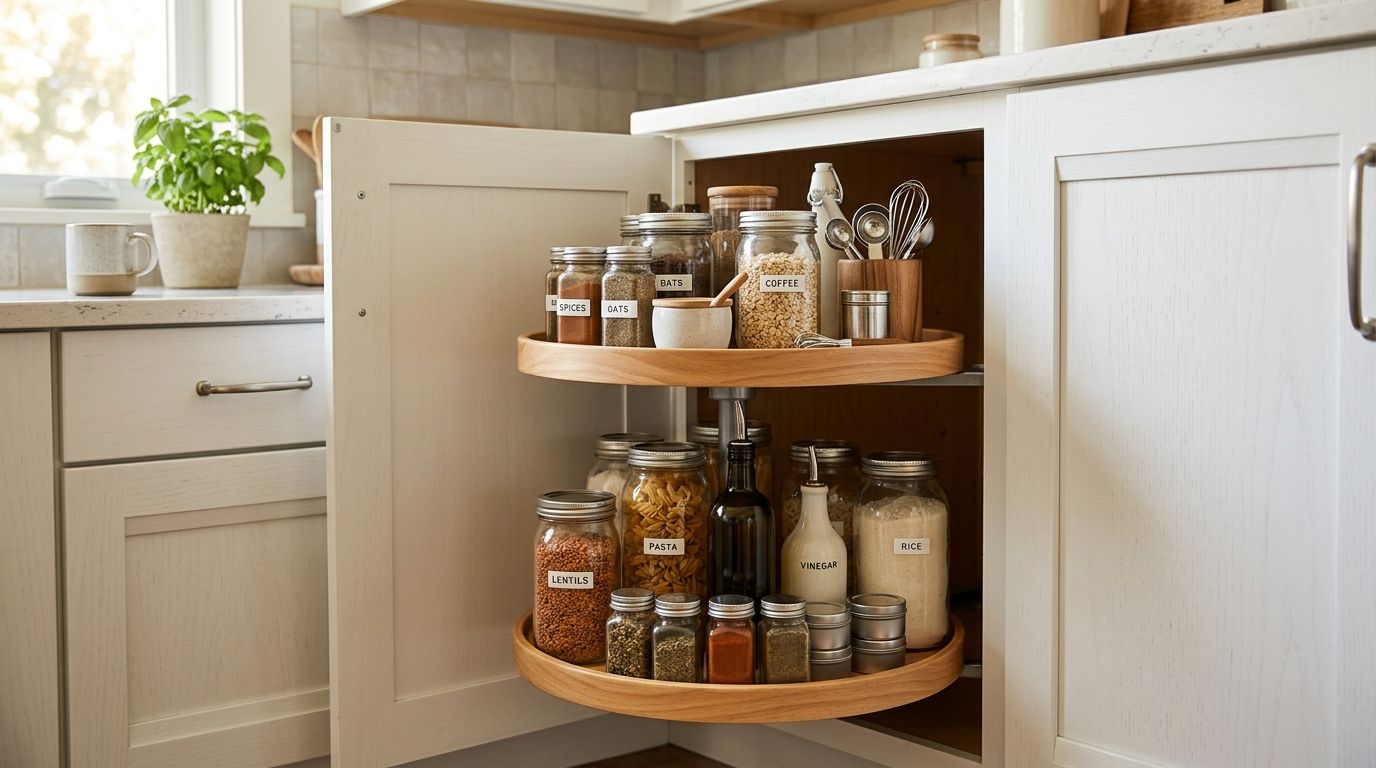
Best Lazy Susan Organizers for Kitchen Cabinets: 2026 Verdict
Best overall: a high-sided round turntable for mixed kitchen cabinet items. Best for spices: a divided turntable. Best budget option: a basic single-tier turntable, provided its current listing fits your budget. These are the best lazy susan organizers for kitchen cabinets in 2026 when you choose by what you store, how much shelf clearance you have, and whether items stay upright as the tray turns.
- The best lazy susan organizers for kitchen cabinets in 2026 start with a high-sided round turntable for mixed items.
- Choose a divided turntable for spice jars and a two-tier turntable only when the upper tier leaves room to lift items.
- Stashsavvy recommends measuring the cabinet opening and your tallest container before choosing a kitchen cabinet organizer.
- A basic single-tier turntable is the simplest starting point; check current listings before calling it the cheapest.
Why this matters
A turntable solves one cabinet problem: it brings items at the back into reach without making you unload everything in front. The wrong turntable creates another problem. Tall bottles tip, an upper tier blocks jars below it, or the tray fits the shelf but cannot turn past the door frame.
Start with what actually lives in the cabinet. If you need a broader plan for shelves, bins, and pull-out options, best kitchen cabinet organizers covers the choices beyond turntables. For this 2026 guide, Stashsavvy keeps the decision narrower: which lazy susan style works for your cabinet and your everyday items?
What makes the best lazy susan organizer for kitchen cabinets
- Cabinet fit: Measure the clear opening, usable shelf depth, and vertical space. A turntable must rotate inside the cabinet, not merely fit when stationary.
- Container stability: Match the rim and surface to the items you store. Tall bottles need more containment than squat jars.
- Reach: You should be able to lift a frequently used item out without shifting another one first.
- Visibility: Dividers or a second tier help only if you can still identify and grasp what you need.
- Cleaning: Choose a style you can empty, lift out, and wipe down without dismantling your cabinet.
- Cabinet fit after loading: Test rotation with your usual items aboard. A tray that spins empty can catch on a tall container or cabinet hardware once loaded.
Measure the usable opening, not just the shelf. Open the door fully, then check whether hinges or a face frame narrow the path for placing the tray. For a practical starting check, plan for about 1 inch of free space at the sides of the tray; confirm the loaded turntable completes a 360-degree rotation before you commit to that layout. That clearance is a planning allowance, not a promise that every cabinet needs the same gap.
Shelf height matters just as much. For a two-tier organizer, try to leave about 2 inches above the tallest item on the lower tier so you can lift it out comfortably. If that uses too much of the available height, a single-tier tray is the better fit. Measure with the items you already own rather than shopping from a cabinet's outside dimensions.
Best lazy susan organizers at a glance
| Organizer style | Best for | Standout feature | Key limitation |
|---|---|---|---|
| High-sided round turntable | Mixed pantry items | Rim helps contain varied containers | Rim can obstruct a grip on short jars |
| Basic single-tier turntable | A simple, budget-aware setup | Open access from above | Limited containment for tall bottles |
| Divided turntable | Spice jars and small containers | Sections keep groups separate | Dividers restrict where wide items fit |
| Two-tier turntable | Short items on a tall shelf | Adds a second storage level | Upper tier can block access below |
The default choice is the high-sided round turntable. It suits a mixed collection better than a divided or two-tier layout because it asks you to make fewer assumptions about container size. The other styles win when your cabinet has a more specific job.
1. High-sided round turntable: best for mixed pantry items
A high-sided round turntable keeps bottles, jars, and small packages together while bringing the back of the shelf forward. Use it when a cabinet holds several types of everyday items rather than a tidy row of matching containers. The raised rim helps keep items aboard, but you still need to load taller containers so they remain stable while turning.
Before buying, compare the tray's outside diameter with the clear cabinet opening and check the height of its rim against the shortest items you reach for often. If you cannot grip a small jar without removing its neighbor, a lower-rim style will be easier to live with. Put the items you use most toward the edge so a short turn is enough to find them.
High-sided round turntable pros:
- Contains a mix of container shapes better than an open, flat tray.
- Brings items at the rear within reach without moving those in front.
- Works as a removable organizer, which suits renters and homeowners alike.
High-sided round turntable cons:
- A tall rim can hide labels or make short items harder to lift.
- An overloaded tray can still let tall, narrow containers tip.
- It needs enough room to turn when fully loaded.
Best for: A cabinet holding mixed pantry items or everyday bottles.
Verdict: Buy this style first if your shelf has room for the tray to rotate and your items vary in shape.
2. Basic single-tier turntable: best for a simple setup
A basic single-tier turntable is an open rotating tray with no added sections or upper shelf. It is the least complicated style to size and load, and it gives you a clear view from above. If you are organizing on a budget, compare current listings rather than assuming a plain tray always costs less than a divided one.
This style works best for stable, similarly sized items: short jars, small tubs, or containers that stand securely without leaning on a rim. Group taller bottles elsewhere if they wobble when you turn the tray. A low rim can help with small items, but it will not do the work of a taller wall.
Basic single-tier turntable pros:
- Leaves items visible and easy to grasp from above.
- Fits a straightforward sorting plan without fixed compartments.
- Is easy to lift out when the shelf needs cleaning.
Basic single-tier turntable cons:
- Offers less containment for tall or narrow bottles.
- Small items can drift together unless you group them deliberately.
- A large tray can waste space if you have only a few things to store.
Best for: A simple, budget-aware cabinet setup with stable containers.
Verdict: Buy if you want one rotating surface and do not need dividers or extra height.
3. Divided turntable: best for spice jars
A divided turntable separates small containers into sections while keeping them accessible by rotation. Give each section a job, such as cooking spices, baking ingredients, or small seasoning blends. That grouping helps you find a jar without searching through a crowded circle.
Check the width and height of your largest jar before choosing this style. Fixed dividers can make a turntable look orderly while preventing a wider container from fitting where you need it. If your cabinet holds both spice jars and larger bottles, a high-sided open tray gives you more freedom to rearrange them.
Divided turntable pros:
- Keeps small categories from sliding into one another.
- Makes it easier to return a jar to the same area after use.
- Gives a crowded spice cabinet a clear sorting rule.
Divided turntable cons:
- Fixed sections limit space for wide or irregular containers.
- More edges mean more surfaces to wipe during cleaning.
- Sections cannot compensate for a cabinet opening that is too narrow.
Best for: Spice jars and other small items you can sort into consistent groups.
Verdict: Buy when your jars fit the sections; skip it for a cabinet dominated by large bottles.
4. Two-tier turntable: best for short items on a tall shelf
A two-tier turntable uses vertical cabinet space by placing a second rotating level above the first. It makes sense when you store short containers and have unused height above them. It is a poor match for tall bottles on the lower level, even if the organizer itself fits neatly on the shelf.
Measure three things together: the cabinet's usable height, the height between tiers, and your tallest lower-level item. Then check whether your hand can lift that item past the upper tier. If you need to tilt every jar to get it out, the second level is not giving you useful storage.
Two-tier turntable pros:
- Gives short items a second storage level within the same shelf area.
- Separates categories without requiring another cabinet shelf.
- Keeps upper-level items visible when you can view them from the door.
Two-tier turntable cons:
- The upper tier restricts access to items underneath.
- Tall containers can make the lower tier unusable.
- The loaded organizer needs enough clearance to turn without catching.
Best for: Short jars or tubs in a cabinet with generous vertical clearance.
Verdict: Buy only after checking access to the lower tier; skip it if your everyday items are tall.
A cabinet can look more organized with a second tier and still be harder to use. Stashsavvy favors the tray that lets you remove your most-used item in one easy motion, not the tray that holds the most on paper.
How we ranked these organizer styles
This is a 2026 research-based comparison of organizer designs, not a hands-on test or a ranking of specific products. The order follows the criteria above: cabinet fit, container stability, reach, visibility, and ease of cleaning. No single design wins every cabinet, which is why each pick has a distinct job and a limitation worth checking before you buy.
A high-sided tray ranks first because mixed items are the hardest group to keep together on a rotating shelf. A basic single-tier tray ranks next for simpler cabinets. Divided and two-tier styles solve narrower problems, so choose them for those jobs rather than treating extra features as automatic upgrades.
To make the comparison useful in your own kitchen, empty the shelf and sort what comes out before choosing a tray. Set aside items that do not belong together, then measure the space left for the group you want to keep within reach. A turntable works best as an access tool for that group, not as a place to put everything that lacks another home.
Which lazy susan organizer should you choose?
Choose a high-sided round turntable if you are undecided. For most mixed-item cabinets, it offers a clear balance of containment and access. Choose a basic single-tier turntable when your containers stand securely on their own; choose a divided tray for small jars; choose two tiers only when the lower shelf remains easy to use.
Your final 2026 check is simple: load the tray with the items you intend to store, rotate it, and remove the item you use most. If that takes more effort than reaching into the cabinet without a tray, change the layout or choose a different style. Stashsavvy's best lazy susan organizer is the one that makes your daily cabinet routine easier, not the one with the most compartments.
FAQ
What’s the best lazy susan organizer for a kitchen cabinet with mixed items?
A high-sided round turntable is the best starting point for mixed kitchen cabinet items in 2026. Its rim helps contain different containers, but check that the loaded tray turns freely.
Is a divided lazy susan better than an open turntable for spices?
A divided turntable is better when your spice jars fit its sections and you want to keep categories separate. An open tray gives wider or irregular containers more room.
Should I use a two-tier lazy susan in a kitchen cabinet?
Use a two-tier lazy susan when you store short items and can lift them easily from the lower tier. If the upper tier blocks your hand, choose a single-tier tray.
How do I measure a cabinet for a lazy susan organizer?
Measure the clear cabinet opening, usable shelf depth, and vertical clearance before choosing a lazy susan organizer. Check its rotation with your usual items loaded, since the door frame and hardware can affect access.
Are lazy susan organizers useful in small kitchens?
Lazy susan organizers are useful in small kitchens when they make items at the back of a cabinet easier to reach. Choose the tray for the containers you actually store, rather than filling the shelf with an oversized organizer.
What’s the simplest lazy susan organizer for renters?
A freestanding single-tier turntable is the simplest renter-friendly option because it sits on an existing shelf. Measure the opening and check that it rotates without catching on the cabinet.
How do I keep bottles from tipping on a lazy susan?
Use a high-sided turntable and avoid crowding tall, narrow bottles together. Rotate the loaded tray before settling on a layout, and move unstable containers to a different storage spot.
One last thing
In 2026, do not judge a lazy susan by how neatly it looks when empty. Put your most awkward everyday item on it first. If you can turn the tray, see the item, and lift it out without moving anything else, the organizer has earned its cabinet space.
Related guides
- Best pantry organization systems
- Clear pantry storage containers for small kitchens
- Closet organizer systems