
Kitchen Storage Ideas for Small Spaces: Budget-Friendly Solutions
The cheapest way to add kitchen storage in a small space is to use the surfaces you already own before buying anything: cabinet doors, walls, appliance sides, and the gap above the fridge. When you do spend, a narrow rolling cart ($17.99 to $29.99 at IKEA) or an over-the-door organizer ($10 to $17.99 at Walmart) delivers the most storage per dollar without permanent changes, which matters for renters. Better access, through turntables, drawer dividers, and labeled bins, often solves the problem faster than adding more containers.
This guide treats each storage idea as a spending decision. Free changes come first, then price tiers, then a note on when a pricier product stops being the budget choice.
Key takeaways
- Start with no-cost moves: declutter duplicates, use cabinet doors, walls, and the space above appliances before buying furniture.
- A narrow rolling cart is the highest-value renter purchase, from IKEA's $17.99 VESKEN to the ~7.5-inch NISSAFORS at $24.99 for gaps beside a fridge.
- Over-the-door organizers at Walmart start near $10; a nine-tier Home-Complete version runs $54.95, but check door clearance and weight limits first.
- Access beats capacity. Turntables, drawer dividers, and labeled containers make existing shelves usable, and cost less than new storage.
- Measure width, depth, height, door swing, drawer clearance, walkway, and load capacity before you buy anything.
- Skip organizers for items you rarely use or own in duplicate. Buying storage for clutter costs money and floor space.
What are the cheapest kitchen storage ideas for small spaces?
The cheapest ideas cost nothing: declutter duplicates, then claim the vertical and hidden surfaces you already have. Use the insides of cabinet doors, empty wall sections, the sides of the refrigerator, and the space above the fridge and microwave. These moves add storage with zero purchase and no risk to a security deposit.
Decluttering is the first budget decision because it changes what you need to buy. If you own three spatulas and two colanders, storing all of them costs cabinet space and, often, an organizer you didn't need. Users on r/organizing report that the real struggle is making storage both more functional and better looking, not adding more of it. Removing duplicates does both for free.
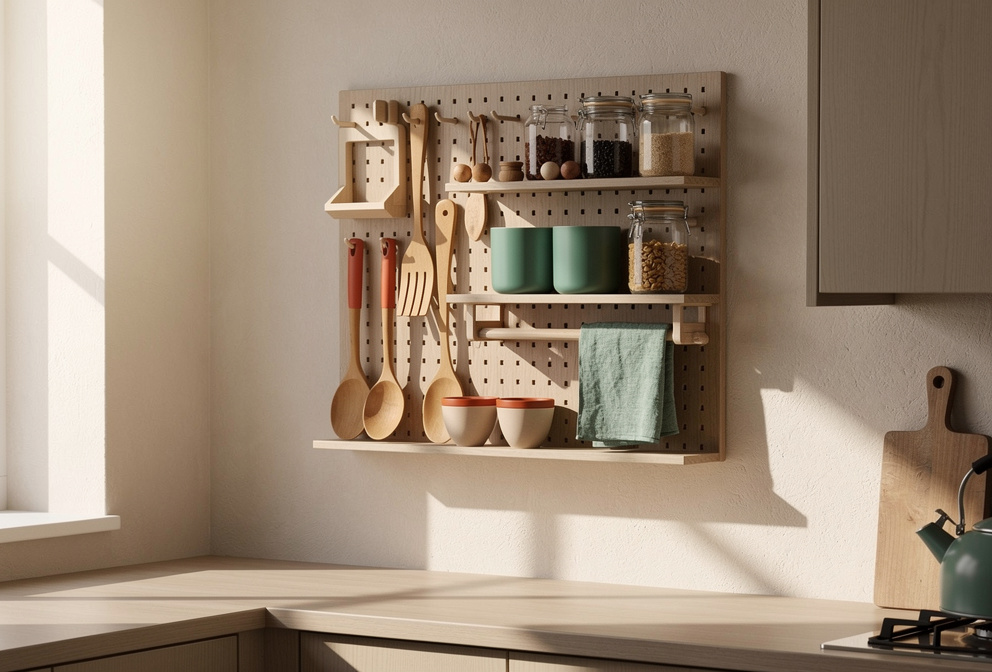
Vertical surfaces are the next free win. An empty wall is prime kitchen real estate, and readers on r/KitchenStuff describe it as an opportunity they want to use without cluttering the room. A single row of removable hooks holds mugs, measuring cups, or utensils and peels off cleanly when you move.
Tip: Before buying a single organizer, spend 30 minutes pulling everything out of one cabinet. Group duplicates, set aside anything unused for six months, and re-shelve only what you reach for. You'll often free up a full shelf and cut your shopping list in half.
The space above appliances is usually wasted. A flat riser or a single freestanding shelf over the fridge stores lunch bags, spare bakeware, or bulk pantry items. For more ways to find hidden capacity, see these genius small space storage hacks.
What's the best budget rolling cart for a small kitchen?
A narrow rolling cart is the best value for renters and tight kitchens because it adds mobile storage, prep space, and serving capacity without any installation. IKEA's lineup ranges from the $17.99 VESKEN to the $199.99 KUNGSFORS stainless-steel cart, so the budget choice depends on the gap you're filling and the job it does.
For the tightest gaps, the IKEA NISSAFORS cart is about 7.5 inches wide and lists at $24.99. It slides into the dead space beside a refrigerator or between a cabinet and a wall, turning an unusable slot into a pull-out pantry.
For a general-purpose cart, the RÅSKOG measures roughly 11 × 15 × 24 inches and costs $29.99. Its three tiers work as a coffee station, produce rack, or overflow pantry, and the wheels let you roll it to wherever you're prepping. The JUTTERSBO at $19.99 and VESKEN at $17.99 cover the same idea for less if you need a smaller footprint.
Here's why the cart earns its price. Residents on r/SmallSpaceSolutions describe a recurring conflict: they want appliances like a blender or air fryer within reach but hate a permanently crowded counter. A cart holds those appliances, keeps them accessible, and rolls out of sight when guests arrive. That dual function, storage plus mobile prep surface, is worth more in a small kitchen than a single-purpose rack.
Warning: The $199.99 KUNGSFORS cart is well built, but at roughly 11 times the price of the VESKEN, it stops being the budget choice. Pay for stainless steel only if you need a permanent island surface or heavy load capacity. For most renters, the $17.99 to $29.99 carts do the same daily work.
How do you use cabinet doors and empty walls for storage?
Cabinet doors and empty walls are the highest-yield paid upgrades under $20 because they add storage to space that's already inside your kitchen. Over-the-door pantry organizers at Walmart list from $10 to $17.99 and hold packets, wraps, spices, and lightweight supplies on the back of a cabinet or pantry door.
Over-the-door racks solve dead space on the inside of cabinet doors, which most kitchens ignore entirely. A Walmart over-the-door organizer frees an entire shelf by moving spice jars and foil boxes to the door.
Capacity has a ceiling, though. Walmart's Home-Complete nine-tier over-the-door organizer holds far more at $54.95, but it only pays off if your door has the clearance and the hinges can carry the weight. Load a nine-tier rack with cans and a lightweight cabinet door will sag or refuse to close.
Empty walls take rail systems, magnetic strips, or a single freestanding shelf. A magnetic knife strip clears counter space for under $15. A freestanding shelf unit needs no drilling, which keeps it renter-safe. For a full room approach, these 14 wall storage ideas show how to double usable space without permanent damage.
Under-cabinet lighting is a low-cost visibility upgrade worth mentioning. In the NKBA 2026 Kitchen Trends Report, 82% of surveyed professionals named under-cabinet lighting as popular and 72% cited interior cabinet lighting. A battery or stick-on LED strip costs little and keeps newly organized storage usable, since a shelf you can't see is a shelf you don't use.
Why does better access matter more than more storage?
Better access often solves small-kitchen storage problems more effectively than adding capacity, because most kitchens waste the space they already have. Turntables, refrigerator bins, drawer dividers, and labeled containers make deep shelves and crowded fridges reachable, and they usually cost less than a new cabinet or cart.
A turntable turns a deep corner cabinet, where items disappear behind other items, into a spinning shelf you can reach with one hand. Refrigerator bins group loose packets so the back of the fridge stops becoming a graveyard. Drawer dividers stop utensils from sliding into one tangled pile.
The math favors access. A $6 turntable can recover the back half of a cabinet you were treating as empty, while a new shelving unit costs several times that and takes floor space you may not have. Users on r/organizing want shelving that's both functional and good-looking, and access tools deliver the function at a fraction of the cost.
This connects to a spending discipline that carries beyond the kitchen. Buying an organizer for items you own in duplicate or never use is money spent to store clutter. The same clear, practical thinking that Stashsavvy applies to budgets and first-time saving applies here: audit what you have before you buy more capacity for it. A minimalist small-apartment kitchen, an approach readers on X find appealing, comes from owning less, not from buying more bins.
How do you measure before buying kitchen storage?
Measure seven dimensions before any purchase: width, depth, height, door swing, drawer clearance, walkway space, and load capacity. A cart that's an inch too wide or a rack that blocks a drawer becomes a returned item and a wasted trip, which is a real cost, not a rounding error.
Use this checklist against the actual product listing:
| Measurement | What it prevents | Where it matters most |
|---|---|---|
| Width | Cart or shelf won't fit the gap | Narrow fridge-side slots |
| Depth | Item juts into the walkway | Galley kitchens |
| Height | Won't clear counter or upper cabinet | Above-fridge shelving |
| Door swing | Cabinet door hits the new unit | Over-the-door racks |
| Drawer clearance | Organizer blocks a drawer from opening | Under-counter carts |
| Walkway space | Cart makes the kitchen impassable | Apartments under 100 sq ft |
| Load capacity | Shelf sags or door hinge fails | Nine-tier door organizers |
A worked example: a $60 renter setup
Say you have a 9-inch gap beside your fridge, a crowded counter, and a pantry door doing nothing. Here's a full budget plan:
- NISSAFORS cart for the fridge gap: $24.99 (fits, since 7.5 inches clears the 9-inch slot)
- Walmart over-the-door organizer for the pantry door: $12.00
- Two turntables for deep cabinets: roughly $12 total
- A pack of removable wall hooks for mugs: roughly $8
Total: about $57. Every item is renter-safe, no drilling, and each solves a named problem, dead gap, cluttered counter, unreachable cabinet, empty wall. Compare that to a single built-in pull-out pantry, which often runs several hundred dollars installed and leaves nothing behind when you move. For renters, improving a small kitchen without permanent modifications is the practical path, a need voiced often on r/femalelivingspace.
One caveat on trend data: the NKBA 2026 report surveyed 634 industry members, 67% of them designers, and 76% expect kitchen footprints to grow even as U.S. homes shrink. That reflects professional projects, not people living in tight apartments. Treat "enhanced storage" as a direction (72% named it a rising feature) rather than a spec sheet for your kitchen.
Bottom line
The best kitchen storage plan for a small space spends nothing first, then spends deliberately. Declutter, claim your doors and walls, and improve access with turntables and dividers before adding a single new unit. When you do buy, a $17.99 to $29.99 rolling cart and a $10 to $17.99 over-the-door organizer cover most renter needs, and measuring seven dimensions keeps returns off your receipt. Around $60 buys a complete, damage-free setup. Anything pricier should earn its cost in durability or a job the cheap options can't do.
Frequently asked questions
What is the cheapest way to add kitchen storage?
The cheapest way costs nothing: declutter duplicates and rarely-used items, then use cabinet door interiors, empty walls, and the space above the fridge and microwave. These free changes often recover a full shelf. When you do buy, over-the-door organizers start near $10 at Walmart and rolling carts start at $17.99 at IKEA, both renter-safe with no drilling.
What's the best rolling cart for a narrow kitchen gap?
The IKEA NISSAFORS cart, at about 7.5 inches wide and $24.99, fits the narrow gap beside a refrigerator or between a cabinet and wall. For a general three-tier cart, the RÅSKOG (roughly 11 × 15 × 24 inches, $29.99) works as a coffee station or overflow pantry. Measure your gap first; a cart an inch too wide becomes a return.
Are over-the-door pantry organizers worth it?
Yes, for lightweight items like spice jars, packets, and foil boxes, because they use the dead space on cabinet door interiors and free a full shelf. Walmart lists them from $10 to $17.99. A nine-tier Home-Complete version holds more at $54.95, but only if your door has the clearance and the hinges can carry the load without sagging.
Do I need more storage or better organization?
Usually better organization. Turntables, refrigerator bins, drawer dividers, and labeled containers make deep shelves and crowded fridges reachable, and they cost less than new furniture. A $6 turntable can recover the back half of a cabinet you were treating as empty. Add capacity only after you've made your existing storage fully usable.
What should I measure before buying kitchen storage?
Measure seven things: width, depth, height, door swing, drawer clearance, walkway space, and load capacity. Check them against the product listing, not a guess. This prevents the most common wasted purchases, a cart too wide for a gap, a rack that blocks a drawer, or a door organizer heavy enough to strain the hinges.
How can renters add kitchen storage without damage?
Renters can use rolling carts, over-the-door organizers, removable adhesive hooks, magnetic strips, and freestanding shelves, none of which require drilling or leave marks. A full renter setup, a narrow cart, a door organizer, two turntables, and wall hooks, runs about $57 and moves with you. Skip built-in pull-outs, which cost hundreds and stay behind.