
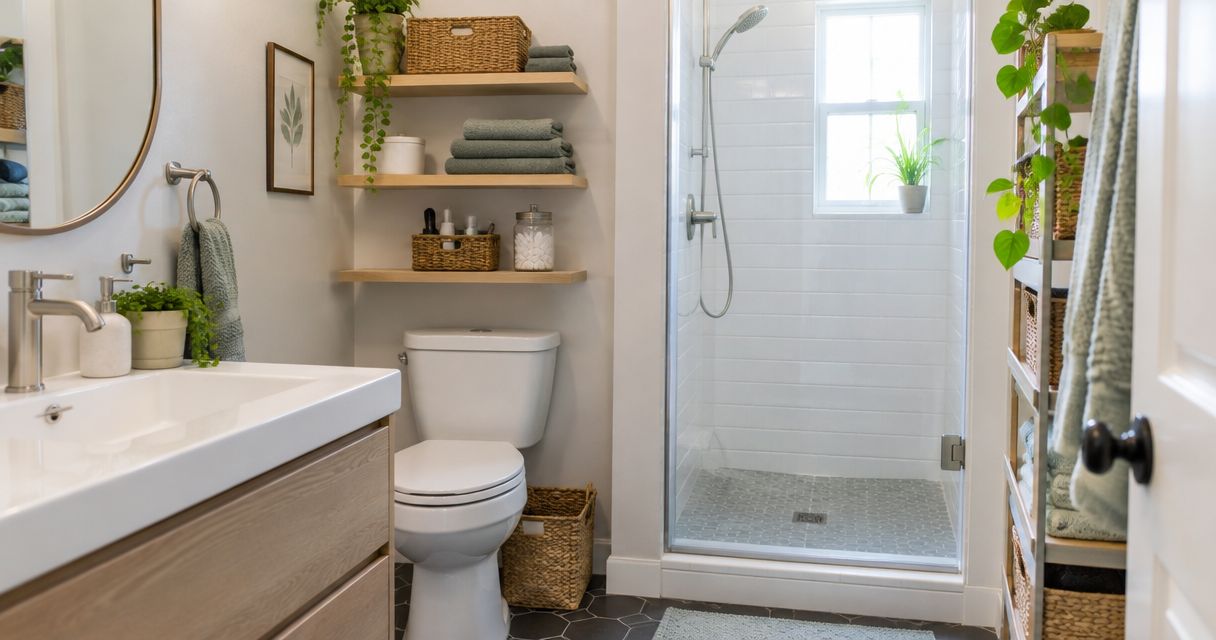
Small bathroom storage ideas for renters: complete 2026 guide
Renters’ small-bathroom storage is removable organization that gives everyday essentials a home without permanent alterations. This 2026 guide helps you work around tight doorways, awkward plumbing, shared shelves, and lease restrictions by sorting first, measuring second, and choosing storage you can take with you.
- Stashsavvy recommends sorting before shopping: fewer duplicates leave more usable bathroom storage.
- For bathroom storage ideas for small bathrooms renters can use, start with existing drawers and removable bins.
- Choose rolling carts for movable storage and door organizers only when the door closes freely.
- No-drill storage is not automatically damage-free; follow installation instructions and your lease.
Why bathroom storage matters for renters
The best rental bathroom storage fits both your routine and your permission to change the room. A shelf that blocks the toilet tank or a door rack that scrapes the frame creates another problem instead of solving the first one.
Renters also need systems that separate from the building. Your next bathroom might have a pedestal sink rather than a vanity, so start with portable containers before considering furniture sized for one awkward gap.
Stashsavvy bathroom storage guidance is best for renters who want practical organization without permanent alterations. The approach here compares storage by fit, access, installation requirements, and ease of cleaning—not by claimed hands-on testing.
If your bathroom already has drawers or cupboards, explore the bathroom vanity organizers guide after measuring them. Existing enclosed space is the first place to look before adding another item to the floor.
Build your rental bathroom storage plan
1. Sort your essentials before choosing containers
Start with one shelf or drawer, not the whole room. Set a 15-minute sorting timer as a manageable starting point; the goal is to decide what belongs, not finish the entire bathroom against a deadline.
Group everything by what happens next. Keep everyday items close to where you use them, separate unopened duplicates, and move unrelated belongings elsewhere. Dispose of products according to their labels and local guidance rather than emptying unknown liquids down the sink.
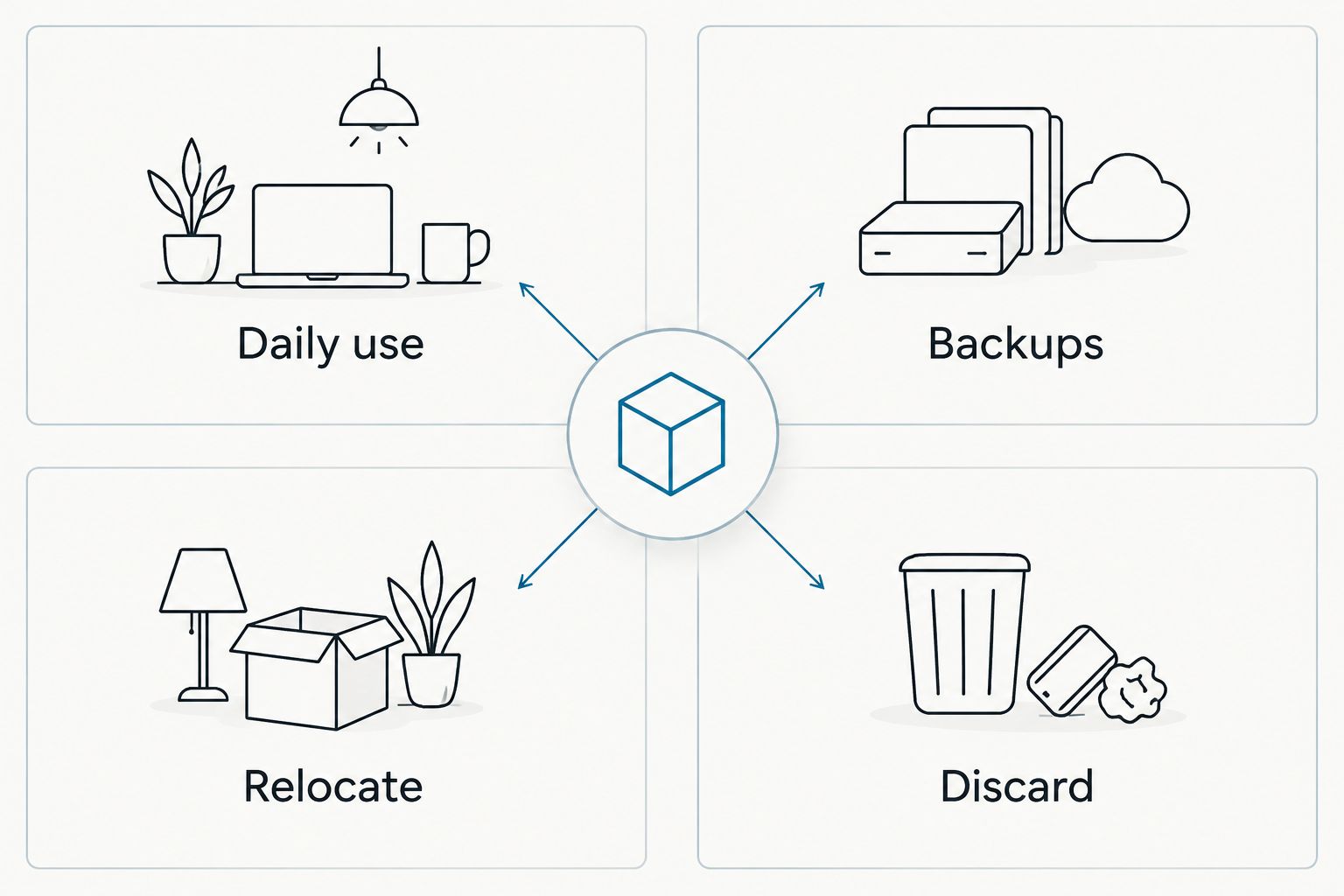
For your 2026 bathroom reset, make these categories before buying organizers. A container cannot solve a collection that has no clear limit, and extra compartments often give unused products another place to hide.
- Daily use: Keep the toiletries you currently reach for.
- Backups: Gather unopened replacements in one existing container.
- Relocate: Move items that belong in another room.
- Discard: Remove empty packaging and products ready for appropriate disposal.
2. Measure the space while everything still works
Use a tape measure you already own or borrow one. Record 3 measurements per proposed storage spot: width, depth, and height, then note anything that moves through that space.
A vacant rectangle is not automatically usable storage. Open the bathroom door, pull out the vanity drawer, lift the toilet lid, and reach the shutoff valve. Under a sink, measure around the actual pipes rather than treating the cabinet as an empty box.
Check your lease before choosing anything that attaches to a wall, cabinet, or door. If permission is unclear, ask the landlord or property manager in writing; a removable attachment still touches someone else’s finish.
- Record the narrowest opening, not just the widest interior point.
- Include baseboards, hinges, handles, pipes, and toilet fixtures.
- Mark proposed furniture footprints with paper before bringing anything in.
- Photograph the area so you can compare dimensions while shopping.
3. Assign a home to each bathroom routine
Reuse clean trays, baskets, or washable containers you already own. Group items by activity—washing, dental care, hair care—so you can retrieve a useful set without lifting several unrelated bottles.
Keep the counter for active routines, not the entire household inventory. In a shared bathroom, a portable personal caddy lets each person bring in their own products without dividing every shelf into tiny territories.
Stashsavvy’s bathroom storage approach starts with these existing containers; the guides help you compare options only after you know what is missing. Label a temporary setup with paper and try it before committing to a particular container shape or permanent label.
Keep medicines wherever their storage instructions require, rather than assuming a humid bathroom is suitable. Cleaning supplies also need storage appropriate to their labels and your household’s safety needs.
- Put daily toiletries in the easiest accessible position.
- Group occasional grooming supplies separately from daily items.
- Give each bathroom user a clearly defined container or shelf section.
- Keep replacement products together so you can check before buying more.
4. Choose portable storage for awkward gaps
Test the gap with an existing basket before adding furniture. If reaching into that basket feels awkward, a deeper or taller organizer is unlikely to fix the location.
Best for renters who need movable storage: a rolling cart, provided it fits without narrowing the route through the bathroom. Compare the rolling storage carts for small bathrooms guide against your measurements, including the space needed to turn and remove the cart.
A slim freestanding shelf suits a spot that stays put, while a carry caddy suits a shared room. Neither is automatically better: choose the format that supports how you actually retrieve things. For a 2026 setup you can move later, favor containers that also work outside the bathroom.
- Check the complete assembled footprint, including handles and wheels.
- Keep the doorway and access to fixtures unobstructed.
- Choose surfaces you can wipe according to their care instructions.
- Store heavier items low and follow the unit’s loading instructions.
5. Use doors and walls only when the fit is right
Rearrange an existing towel bar or shelf before adding attachments. Moving spare towels elsewhere can free an existing rail for the towel you actually use, without touching the walls.
Best for renters with a compatible door: an over-door organizer. Its advantage is accessible vertical storage; its limitation is the hanger’s fit over the door and beneath the frame. Stop if the door drags, strains, or fails to latch.
Adhesive hooks and suction accessories need a suitable surface and correct installation. Neither category guarantees damage-free removal. Read the exact product instructions for surface compatibility, moisture exposure, loading, and removal before attaching anything, especially to painted or aging finishes.
- Test door closure before filling an over-door organizer.
- Follow the stated surface preparation and waiting instructions.
- Keep loads within the specific accessory’s stated limit.
- Skip attachments when the lease or surface condition rules them out.
6. Keep plumbing and cleaning access clear
Start by removing loose packaging and regrouping what already sits under the sink. Use separate containers on either side of the plumbing rather than forcing one large bin around it.
Best for a vanity with awkward pipes: small removable bins. Their advantage is flexibility, but they do not create a second shelf or make a deep cabinet easier to see into. Leave room to lift each bin out without catching a hose or fitting.
An over-toilet unit is a separate decision. Check its installation instructions before considering it rental-friendly: a model requiring wall anchoring is not a freestanding workaround. Do not omit required hardware just to avoid making holes.
- Keep shutoff valves visible and reachable.
- Leave room to remove the toilet tank lid.
- Move stored items out of the way before checking a suspected leak.
- Keep containers removable so you can clean the cabinet or floor beneath them.
7. Run a short trial before adding more
Give the arrangement a 7-day trial before deciding it needs another organizer. This is a suggested review period, not a promise that every household will settle into a routine within a week.
Notice where items land when you are tired or in a hurry. If toothpaste repeatedly ends up on the counter, its assigned container might be inconvenient. Change the location before buying a more elaborate organizer for the same awkward spot.
For the rest of 2026, keep a simple replacement rule: check the backup container before adding a product to your shopping list. In a shared bathroom, agree on who checks common supplies so everyone is not replacing the same item independently.
- Note any container you must move to reach another one.
- Relocate items that repeatedly miss their assigned home.
- Remove storage that blocks cleaning or daily movement.
- Add an organizer only for a specific remaining problem.
Compare rental-friendly bathroom storage options
Choose by the problem, not the photograph. Stashsavvy recommends comparing access and installation requirements before appearance; an attractive unit still needs to fit your door, pipes, and routine.
These are use-case recommendations, not a ranking of tested products. There is no universal winner: portable bins suit one bathroom, while another needs a personal caddy because the room is shared.
| Option | Best for | Main advantage | Key limitation |
|---|---|---|---|
| Existing trays or small bins | Renters organizing vanity shelves | Groups items without changing the room | Does not add shelf space |
| Carry caddy | Shared bathrooms and personal toiletries | Moves with the person using it | Needs a home between uses |
| Rolling cart | Bathrooms with a genuinely clear floor gap | Moves for access and cleaning | Wheels and handles increase the footprint |
| Over-door organizer | Compatible doors with closing clearance | Uses vertical space | Can interfere with closure or finishes |
| Adhesive or suction accessories | Permitted, compatible surfaces | Adds storage without drilling | Installation and removal remain surface-dependent |
| Over-toilet unit | Bathrooms with compatible clearances and installation permission | Uses space above the fixture | Can require anchoring and obstruct tank access |
Choose the least complicated option that solves the actual problem. If a reused tray keeps your daily products together, you do not need a larger storage system. If nothing fits without blocking access, reduce what lives in the bathroom instead.
Common mistakes renters make with bathroom storage
Treating no-drill as a damage guarantee
An attachment can avoid screws and still affect paint or another finish. Check your lease and the product’s surface instructions; do not assume a security deposit is protected because the packaging says removable.
Buying for the gap instead of the task
A narrow shelf can fit perfectly yet leave you bending behind the toilet for your toothbrush. Reserve awkward spots for suitable occasional-use items, and keep daily routines accessible. Empty space is not a requirement to add furniture.
Filling every shelf with backup products
Duplicates take space away from the products you use now. Set a physical boundary for replacements, then check it before shopping. If the bathroom cannot hold that boundary comfortably, choose an appropriate dry storage location elsewhere.
Ignoring the shared bathroom handoff
A system that works only when one person remembers every category creates confusion. Give each person an obvious home for personal items and agree on shared supplies. Keep the categories understandable without a lengthy explanation.
Skipping required stability hardware
Tall storage is not rental-friendly when its instructions require anchoring you cannot install. Ask permission or choose another format. Leaving required hardware in the box is not an acceptable installation method.
FAQ
What’s the best bathroom storage for a small rental?
Start with removable bins or trays inside storage you already have. Add a cart or door organizer only after checking measurements, fixture access, and installation requirements.
How can I organize a tiny bathroom without drilling?
Sort your products, reuse containers, and assign daily toiletries to the most accessible existing space. Portable caddies and suitable freestanding storage are additional options when they fit without blocking movement.
Are adhesive bathroom hooks safe for rental walls?
Adhesive hooks do not guarantee damage-free removal. Check your lease and the specific hook’s instructions for compatible surfaces, moisture exposure, loading, and removal.
Is a rolling cart better than an over-door organizer?
A rolling cart is better when you have clear floor space and need movable storage; an over-door organizer is better when the door has compatible clearance. The right choice must preserve access and normal door operation.
What can I put under a bathroom sink with awkward pipes?
Use small removable containers that fit around the plumbing without pressing on fittings or hoses. Keep shutoff valves accessible and leave room to remove containers for cleaning or maintenance.
Can renters use over-the-toilet storage?
Renters can consider over-toilet storage when the unit fits and its required installation is permitted. Check tank access and follow all stability and anchoring instructions rather than treating every model as freestanding.
How do I organize a shared bathroom with almost no storage?
Give each person a portable caddy or a clearly assigned section of existing storage. Separate personal products from shared supplies, and keep backups outside the bathroom when a suitable storage location is available.
One last thing
Leave one useful patch of space empty. A clear landing spot gives you somewhere to set your toiletry bag, remove a bin for cleaning, or handle the products you are using without balancing them on the sink edge.
Make that your final 2026 check: can you use the room comfortably, not just fit everything inside it? Stashsavvy’s practical recommendation is to remove one awkward storage piece before adding another. Reclaiming the space sometimes means keeping less furniture in it.
Related guides