
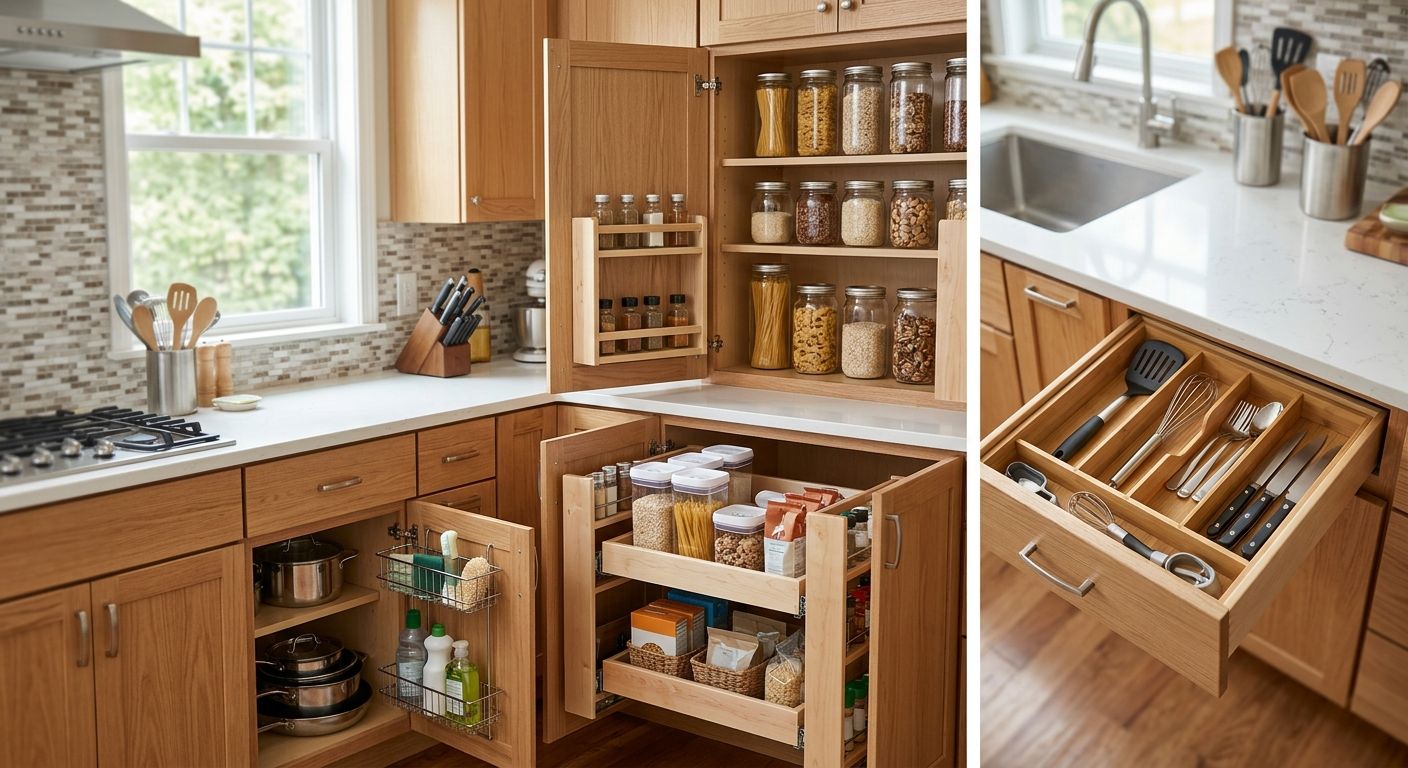
Best Kitchen Cabinet Organizers in 2026: Ranked Picks
Eight cabinet organizer types cover almost every kitchen frustration in 2026, from blind corners you can't reach to deep base cabinets that swallow pots. This guide ranks them by use case, not hype, so you can match the fix to your actual cabinet instead of buying the wrong thing twice.
- Pull-out cabinet shelves are the best overall pick for deep base cabinets in 2026.
- Lazy Susans solve blind corner cabinets better than any other option.
- Adhesive door-mounted racks are the best kitchen cabinet organizers for renters who can’t drill.
- Stackable shelf risers help with visibility but sacrifice usable shelf height.
- Drawer dividers only earn a Buy verdict if your drawers lack built-in trays already.
Why this matters
Most kitchen cabinet clutter isn't a storage shortage, it's a mismatch between the cabinet's shape and what's inside it. A 24-inch-deep base cabinet crammed with stockpots needs a different fix than a 12-inch upper cabinet full of spice jars, and buying the wrong organizer just moves the mess around instead of solving it.
StashSavvy breaks kitchen storage down by cabinet type for exactly this reason: a lazy Susan wastes its money in a straight run of base cabinets, and a pull-out shelf is overkill in a shallow upper. Picking by use case first, product second, is what actually gets you from chaotic to calm.
Best overall: pull-out cabinet shelves. Best for corner cabinets: lazy Susans. Best for renters: adhesive door-mounted racks.
What makes the best kitchen cabinet organizer
- Fits the cabinet's actual depth — a 24-inch base cabinet needs different hardware than a 12-inch upper
- Installs without permanent damage — critical for renters and anyone who moves often
- Keeps items visible from the front, not buried behind three rows of cans
- Handles the weight of what you're storing — cast iron and stand mixers need sturdier hardware than spice jars
- Adjusts or expands as your kitchen inventory changes
- Works with the cabinet you have, not a custom build-out
At a glance: 8 kitchen cabinet organizers ranked
| Organizer | Best for | Standout feature | Key limitation |
|---|---|---|---|
| Pull-out cabinet shelves | Deep base cabinets | Full shelf slides forward for front-to-back visibility | Requires cabinet depth to accommodate slide hardware |
| Lazy Susans | Blind corner cabinets | Rotates 360 degrees to reach the dead corner | Round shelves waste square cabinet corners |
| Adhesive door-mounted racks | Renters, no-drill setups | Mounts with adhesive strips, no screws | Weight capacity is lower than screw-mounted racks |
| Under-shelf wire baskets | Maximizing vertical space | Hangs below an existing shelf to add a layer | Only works where shelf spacing has slack room |
| Stackable shelf risers | Cans, spices, visibility | Doubles shelf capacity without new hardware | Reduces usable height for taller items |
| Tension-rod dividers | Pans, sheet pans, cutting boards | Vertical slots keep flat items from stacking | Needs enough cabinet width for the rod |
| Clear bin systems | Pantry-style base cabinets | Slide out as a unit, contents visible | Bins take up more footprint than loose items |
| Drawer dividers | Utensils, gadgets | Custom compartments for odd-shaped tools | Some drawers already ship with built-in trays |
1. Pull-out cabinet shelves: best kitchen cabinet organizer for deep base cabinets
A pull-out shelf sits on drawer slides inside an existing base cabinet, so the whole shelf glides forward instead of forcing you to kneel and dig to the back. Standard base cabinets run about 24 inches deep, which is exactly the depth where items get lost behind a stationary shelf. This is the fix that does the most for the widest range of kitchens in 2026.
Pull-out shelves pros:
- Puts everything at the front of the cabinet, no reaching required
- Works for heavy items like stand mixers and stockpots
- Fits inside the cabinet frame you already have
Pull-out shelves cons:
- Installation usually involves screws into the cabinet frame
- Slide hardware needs a couple inches of clearance on each side
Best for: deep base cabinets where the back third never gets used. Verdict: Buy.
2. Lazy Susans: best kitchen cabinet organizer for blind corner cabinets
A lazy Susan is a rotating platform, usually two tiers, installed inside a corner base cabinet. Corner cabinets are the least accessible spot in most kitchens because the door opening only exposes a fraction of the interior. Spinning the platform brings the hidden portion around to the opening instead.
Lazy Susans pros:
- Solves a corner cabinet problem nothing else fixes as directly
- Two-tier versions roughly double what's reachable
- No reaching into the dead zone behind the door hinge
Lazy Susans cons:
- Round shelves leave unused triangular gaps in a square cabinet
- Taller bottles can tip when the platform spins
Best for: blind corner base cabinets. Verdict: Buy.
3. Adhesive door-mounted racks: best kitchen cabinet organizer for renters
These racks mount to the inside of a cabinet door using adhesive strips or hooks instead of screws, which matters a lot if a lease says no holes in the cabinetry. They typically hold lightweight, flat items like foil boxes, cutting boards, or spice jars.
Adhesive racks pros:
- No drilling, no damage deposit risk
- Removes and repositions in minutes
- Uses door space that's otherwise dead air
Adhesive racks cons:
- Lower weight capacity than screw-mounted hardware
- Adhesive can loosen in humid kitchens over time
Best for: renters and anyone avoiding permanent installation. Verdict: Buy.
4. Under-shelf wire baskets: best kitchen cabinet organizer for adding vertical space
An under-shelf basket hangs from the lip of an existing shelf, creating a second storage layer without adding new hardware to the cabinet walls. It works best where there's a gap of unused air between a shelf and the items sitting on it.
Under-shelf baskets pros:
- Adds a full layer of storage with no drilling
- Cheap to try in a single cabinet before committing elsewhere
- Good for lightweight items like napkins or snack bags
Under-shelf baskets cons:
- Only works where there's slack shelf-to-item clearance
- Not rated for heavy cookware
Best for: cabinets with wasted vertical gaps above shorter items. Verdict: Buy.
5. Stackable shelf risers: best kitchen cabinet organizer for visibility
A riser is a small platform with legs that creates a shelf-within-a-shelf, so canned goods or spice jars sit in two visible rows instead of one row hiding another behind it. Upper cabinets, often around 12 inches deep, benefit the most because there's little room to spare.
Shelf risers pros:
- Doubles visible storage without new hardware
- Stacks and nests for easy storage when not in use
- Inexpensive way to test the concept before a bigger project
Shelf risers cons:
- Reduces usable vertical height for taller cans or boxes
- Doesn't help with deep cabinets, only shallow ones
Best for: spice cabinets and pantry shelves where visibility is the main problem. Verdict: Hold — useful, but only in shallow cabinets.
6. Tension-rod dividers: best kitchen cabinet organizer for pans and sheet pans
A tension rod wedges vertically inside a cabinet to create narrow slots that keep flat cookware like sheet pans, cutting boards, and skillet lids from stacking into a pile. Pulling one item out no longer means unstacking five others first.
Tension-rod dividers pros:
- Keeps flat items upright and separated
- Installs with no tools, no adhesive, no screws
- Adjustable width fits most standard base cabinets
Tension-rod dividers cons:
- Needs enough cabinet width to fit the rod
- Rod can shift if the cabinet floor isn't level
Best for: pans, cutting boards, and sheet pans that currently stack loose. Verdict: Buy.
7. Clear bin systems: best kitchen cabinet organizer for pantry-style base cabinets
A clear bin groups loose items into one unit that slides out as a whole, instead of individual boxes and pouches sliding around independently. This works especially well in a base cabinet doing pantry duty, where cans, snacks, and bags tend to pile up.
Clear bin systems pros:
- Everything in the bin comes out together, nothing left behind
- See-through sides mean no guessing what's inside
- Groups similar items so restocking is faster
Clear bin systems cons:
- Bins take up more total footprint than loose storage
- Doesn't solve corner or blind-spot cabinets
Best for: base cabinets used as overflow pantry space. Verdict: Buy.
8. Drawer dividers: best kitchen cabinet organizer for utensils and gadgets
A drawer divider splits a single drawer into compartments sized for specific tools, so a whisk and a garlic press stop sliding into the same tangled pile. Some cabinet lines ship with a built-in tray already, which makes an add-on divider redundant.
Drawer dividers pros:
- Keeps odd-shaped gadgets separated
- Adjustable versions expand as your tool collection grows
Drawer dividers cons:
- Unnecessary if the drawer already has a built-in tray
- Doesn't address cabinet storage at all, only drawers
Best for: utensil drawers without existing organization. Verdict: Buy if the drawer is empty, Skip if it already has a tray.
Tackle the closet next
See ranked closet organizer systems for the same room-by-room approach.
How this list was ranked
Each organizer was scored against the six criteria above: cabinet-depth fit, installation damage, visibility, weight handling, adjustability, and fit with existing cabinets. No single organizer scores well on all six, which is exactly why this list is split by use case instead of a single winner.
Which kitchen cabinet organizer should you choose?
Start with the cabinet giving you the most grief. If it's a deep base cabinet swallowing pots, pull-out shelves are the move for 2026. A blind corner that never gets used means a lazy Susan pays for itself the first week. Renting means adhesive door racks solve most of the same problems without a single screw hole.
FAQ
What are the best kitchen cabinet organizers in 2026?
Pull-out cabinet shelves rank best overall for deep base cabinets in 2026, lazy Susans win for blind corner cabinets, and adhesive door-mounted racks are the top pick for renters who can’t drill into cabinetry.
What’s the best organizer for a corner cabinet?
A lazy Susan is the best fix for a blind corner cabinet because it rotates the hidden interior around to the door opening. Two-tier versions roughly double what’s reachable compared to a single stationary shelf.
Are pull-out shelves worth it for renters?
Pull-out shelves usually require screws into the cabinet frame, so they’re less renter-friendly than adhesive or tension-rod options. Renters who want the pull-out effect without drilling should look at adhesive door racks or tension-rod dividers instead.
Do adhesive cabinet organizers damage cabinets?
Adhesive-mounted racks are designed to remove cleanly without drilling, making them lower-risk than screw-mounted hardware. Humidity in a kitchen can loosen adhesive over time, so it’s worth checking the mount every few months.
What’s the difference between a lazy Susan and a pull-out shelf?
A lazy Susan rotates in a circle and is built for corner cabinets, while a pull-out shelf slides straight forward and is built for standard base cabinets. They solve different cabinet shapes and aren’t interchangeable.
How do you organize a deep base cabinet without pull-outs?
Clear bin systems group loose items into a unit that slides out together, which helps in a deep base cabinet even without drawer-slide hardware. Stackable risers can also help near the front of the cabinet, though they don’t solve the back-of-cabinet problem the way pull-outs do.
What’s the best way to store pot lids in a cabinet?
Tension-rod dividers keep lids upright and separated instead of stacked loose, which is the most common complaint with lid storage. They install with no tools and adjust to fit most standard cabinet widths.
Can you install cabinet organizers without tools?
Adhesive door racks and tension-rod dividers both install without screws or drilling, making them the best no-tool options. Pull-out shelves and most lazy Susans require at least basic screwdriver work.
One last thing
The organizer that gets used the longest is usually the cheapest one: tension-rod dividers cost almost nothing to try and solve a problem, loose stacked pans, that shows up in nearly every kitchen regardless of cabinet layout. Start there before investing in anything that requires a drill.
Related guides